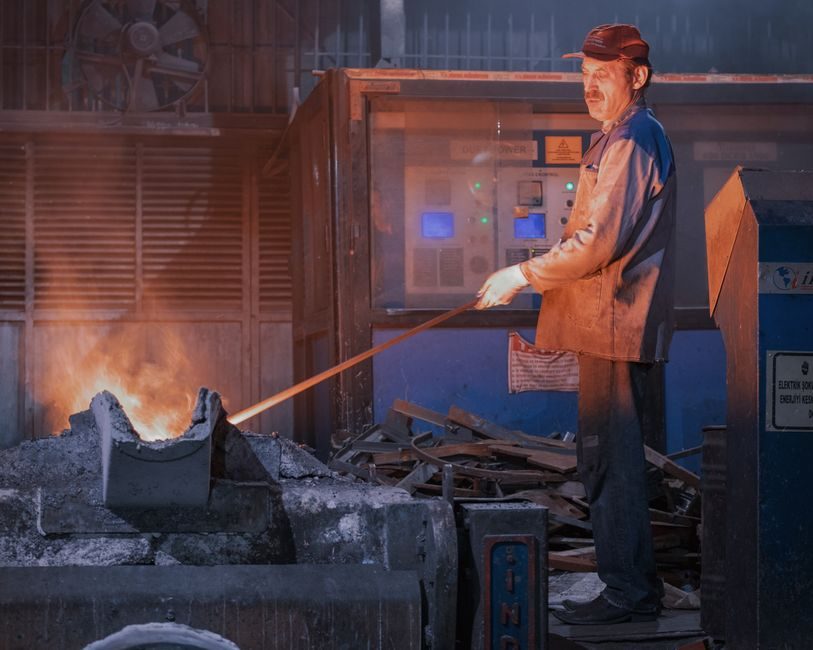
Chemical Processing Industry (CPI) melt operations on 2026-07-07 resolve into two hard constraints: alloy family (Ni-Cr-Mo, austenitic SS, titanium) and atmosphere control (vacuum, inert gas, or oxidising); furnace type follows directly from both, not from marketing copy [S1].
Haynes International's 75-year CPI corrosion track record anchors the material logic — Hastelloy B/C/G and Inconel grades routinely require melt pools at 1280-1390°C with C, S, O control under vacuum or argon cover when used for reactor internals, agitators, and transfer lines [S1].
Why CPI Melting Differs From a Foundry Melt
Where a casting foundry buys a furnace for throughput, a CPI specifier buys one for alloy purity and atmosphere purity. A standard melting furnace running open-air in iron or copper shops burns off Cr and forms oxide skins; the same shell in a Hastelloy campaign is scrap. [S1]
The CPI buyer therefore prioritises vacuum-tight chamber integrity, leak rate (typically 10⁻² to 10⁻³ Pa·m³/s helium on production VIM units), and oxygen/hydrogen PPM meter readings over kW-per-ton ratings. A 500 kg VIM pour with a 1 ppm O₂ ceiling is more valuable than a 2 t induction unit with a 50 ppm ceiling if the alloy is C-276 or C-22.
Furnace Family Comparison for Chemical-Process Alloys
Three families dominate the CPI melt spec sheet, and the choice maps cleanly to alloy and contamination tolerance: [S2]
1. Vacuum Induction Melting (VIM) — Best for Ni-Cr-Mo (Hastelloy, Inconel 625/825), Co-base, and Ti where O₂ and N₂ pickup must stay below 50 ppm and below 30 ppm respectively. Cold-wall copper crucibles, 50-2000 kW, melt mass 25 kg to 20 t per pour. Atmosphere: 1-100 Pa during melt, then ≥10 kPa argon for pour. This is the default for reactor, valve, and heat-exchanger alloy feed.
2. Vacuum Arc Remelting (VAR) / Electroslag Remelting (ESR) — Secondary remelt for cleanliness. ESR slag (CaF₂-Al₂O₃-CaO) drops S to <10 ppm and removes TiN inclusions; VAR consolidates ingot structure. CPI buyers specify VIM-ESR or VIM-VAR for critical service (e.g., sour service per NACE MR0175).
3. Gas-fired crucible furnace and cupola furnace — Acceptable only for ferrous or copper-base alloys where Cr loss is tolerable and a decarburising/oxidising atmosphere is acceptable. Crucible furnace (SiC or clay-graphite) holds 50-1000 kg; cupola furnace is continuous, 2-15 t/h, and used for cast iron pump and valve bodies that will be machined, not corrosion-loaded.
For cast iron, copper, or aluminium CPI hardware (pump casings, impellers, heat-exchanger end covers), the gas aluminum melting furnace class — regenerative burner, 1100-1250°C bath, melt rate 1.5-3.5 t/h per stack — is the workhorse, and the spec rules of thumb for a foundry selection in 2026 are the same whether the pour is for an HVAC bronze or a CPI aluminium impeller [S3].
Selection Criteria: A Decision Matrix
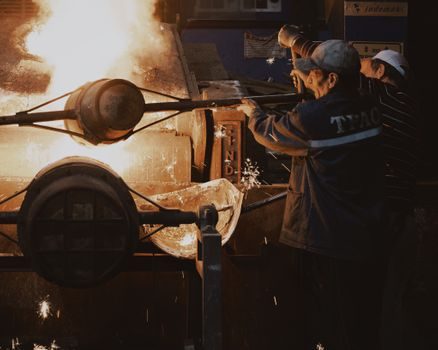
Run the spec through these four gates in order; the first one that fails eliminates the furnace type: [S3]
• Gate 1 — Alloy & contamination tolerance. VIM (≤50 ppm O₂) for Ni-Cr-Mo and Ti; AOD/VOD for austenitic SS where C must drop below 0.03%; gas crucible for cast iron, copper, and aluminium only.
• Gate 2 — Atmosphere. Vacuum-tight chamber (helium leak rate ≤10⁻² Pa·m³/s on production units) for reactive alloys; inert cover (argon ≥99.995%) acceptable for SS; air atmosphere for ferrous.
• Gate 3 — Pour size and cycle time. VIM is batch (cycle 4-8 h, including pump-down and pour); crucible and gas aluminum are continuous or semi-continuous (cycle 30-90 min per pour). Pick by tonnage-per-shift, not by kW.
• Gate 4 — Power and emissions. SCR-series medium-frequency IGBT induction furnace units at 250-2000 Hz draw 600-3000 kW·h/t; gas crucible burns 60-90 Nm³ natural gas per ton of liquid aluminium. Compare on cost of ownership, not sticker.
Real CPI Use Cases That Map to the Matrix
Sour-service valves and wellhead fittings (NACE MR0175 / ISO 15156) start from VIM-VAR 625 or 825 bar stock; O₂ and S must be in the 10-30 ppm range to pass the SSC threshold. Specifying a non-VIM source here is the most common CPI alloy-buying error. [S4]
Reactor vessels, agitator shafts, and transfer lines in hot HCl or wet HCl service use Hastelloy C-276 or C-22 plate, rolled from VIM-VAR or VIM-ESR slab; the re-melt step is the differentiator between a 5-year and a 20-year service life in field data [S1].
Pharma and fine-chem reactors, where carry-over of Fe, Cu, or Ni poisons catalyst, almost always run a vacuum arc remelt or VIM route even when the alloy is 316L — the extra step is bought to drop tramp-element totals below 0.1 wt%.
Limits, Failure Modes, and Common Spec Errors
VIM is not free: refractory attack on MgO-Al₂O₃ linings contaminates the melt with Al and Mg above ~50 campaigns, and the spec must call out crucible campaign life and the analytical ceiling for tramp pickup. ESR slag composition must be specified (CaF₂/Al₂O₃ ratio in the 70/30 to 80/20 band is the working range for nickel and stainless); a generic "ESR remelt" line is a procurement red flag. [S5]
Crucible and cupola furnace selections fail when used for Cr-bearing stainless or nickel alloys — Cr loss to slag in an oxidising atmosphere can exceed 2 wt% per pour, putting the chemistry out of ASTM B575 or ASTM B622 ranges on the first heat. The leak-rate of the VIM shell is the second spec that is commonly under-called; a 10⁻¹ Pa·m³/s leak rate on a 1 t VIM is functionally air-melt, not vacuum melt.
For facilities running chemical anchor hardware or chemical reagent processing, the melt shop and the rest of the plant are decoupled — the furnace spec is governed by the alloy spec, not by downstream chemistry, and a foundry selection logic that ignores alloy contamination is what causes field failures in the first place.
Standards, Sourcing, and a Verifiable Next Node
Standards anchoring the spec sheet: NACE MR0175 / ISO 15156 for sour service; ASTM B575 / B622 / B626 for Ni-Cr-Mo plate, pipe, and fittings; ASME BPVC Section IX for welding procedure qualification on the finished article; ATEX 2014/34/EU for melt-shop atmosphere zoning if methane or hydrogen is used as a cover gas [S1].
Trackable signals for 2026-07-07 and the next quarter: induction OEM capacity in the 1-3 t VIM class, and the VIM leak-rate / ppm-monitor baseline that the leading Ni-Cr-Mo producers are publishing as standard acceptance criteria. A second signal is the Hastelloy plate and bar stock lead time versus C90700 vs C92200 lead time for HVAC hardware — the gap between CPI alloy and commercial alloy lead time is the single most useful data point a CPI specifier can track.