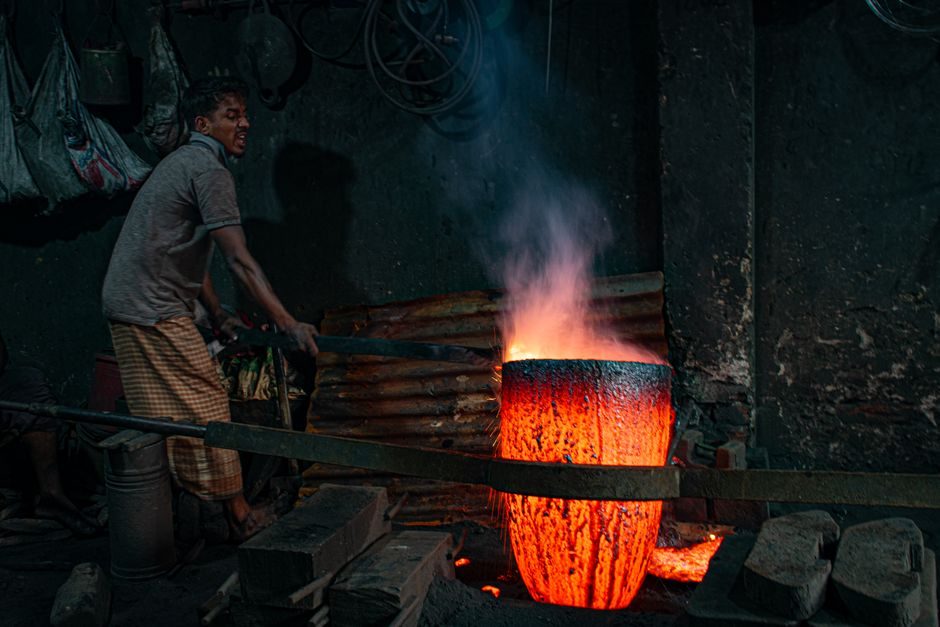
Smelting consumes roughly 50% of a foundry's total energy budget, making furnace type the single largest lever on operating cost per poured kilogram [S3]. A typical industrial induction melting furnace in the China OEM market spans 100 kg to 2 t per batch at US$1,750-67,000, so picking the wrong class of equipment locks in 5-10 years of avoidable fuel or power spend [S2].
Selection is fundamentally a four-variable problem: alloy to be melted, charge weight per shift, required melt rate (kg/h), and the available energy supply. Every other spec — lining, atmosphere control, automation, footprint — is downstream of those four. This article lays out a spec-first method for choosing between induction, gas-fired crucible, cupola and holding classes, with operating-limit data you can use directly on an RFQ.
Furnace Type Comparison: Four Classes Against Four Decision Criteria
An induction furnace delivers 70-90% electrical efficiency and clean, electromagnetically stirred melt, with common small-to-mid sizes of 100 kg, 250 kg, 500 kg, 1 t and 2 t shown on current China OEM listings [S2]. A gas aluminum melting furnace trades efficiency for cheaper fuel and simpler refractory life, and is dominant for non-ferrous alloys below 800 °C. A cupola furnace remains the workhorse for high-tonnage continuous cast iron, fed by metallic charge plus coke. A holding furnace is not a melter in the strict sense — it keeps a tapped melt at pouring temperature and is paired upstream with one of the other three.
On melt rate, induction scales linearly with input kW (typical 250-3000 kW per unit) and outperforms gas on rate-per-square-metre for steel and iron. On atmosphere, induction is essentially neutral (open or sealed/pressurized) while cupola and gas-fired crucible are always oxidising. On capex, an entry-level 100 kg induction unit is in the low five figures USD, while a 1-2 t class lists at US$1,750-67,000 across the same OEM family [S2]. On operating cost, gas/coke units win on energy price in coal-heavy regions; induction wins on energy per kg of melt where grid power is clean and cheap.
Charge Weight, Melt Rate and the Inverter Frequency Question
Specifying charge weight below 60% of nominal furnace capacity raises specific energy consumption measurably and shortens refractory campaign life; oversizing above 120% risks cold spots, slag bridging and coil over-current trips [S1][S2]. The 100 kg / 250 kg / 500 kg / 1 t / 2 t ladder on the induction OEM page maps directly to typical job-shop lot sizes, so the first RFQ filter is to set your median lot weight and pick the next standard size up [S2].
For steel and iron, medium-frequency (MF) coreless induction at roughly 500-3000 Hz gives the best stir-and-power balance; for aluminum and copper, lower frequencies (50-500 Hz) with larger crucibles dominate. Dual-frequency or solid-state MF inverter stacks are now standard on new OEM builds, replacing the older thyristor mid-frequency sets. A crucible furnace — fuel-fired, with a removable crucible — is the right pick when the alloy mix changes several times per week, because crucible swap is faster than refractory patching.
Refractory, Lining Life and the Hidden Operating Window
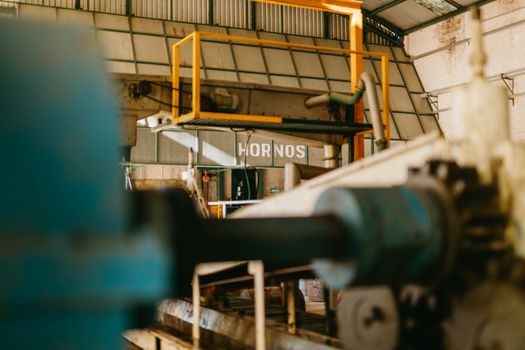
Refractory campaign length is the second-largest cost line after energy, and it is set by alloy, peak temperature and number of cold starts. An alumina-silica lining is acceptable for aluminum up to ~800 °C; magnesia-based linings are mandatory for ductile iron and steel above 1400 °C to avoid slag-line attack. A monolithic dry-vibrated lining is now preferred over brick on mid-frequency induction furnaces because it tolerates the higher hydraulic pressure of the stirred bath. [S1]
A melting furnace spec should always state: (1) maximum operating temperature, (2) cold-start time to first tap, (3) lining material grade, (4) expected campaign life in heats, and (5) oxygen or atmosphere-control provision. Cupolas and gas crucible furnaces are inherently open-bath, so melt-loss to oxidation is 2-5% and must be priced in via return-rate scrap. Induction sealed-furnace builds cut that to under 1% but add a vacuum or positive-pressure enclosure that must be specified up front.
Who Induction Is For — and Who It Is Not For
Induction is the right answer for: ferrous foundries running mixed steel and iron lots, job shops that change alloy several times a day, and any site with cheap, stable grid power. It is the wrong answer for: remote sites with weak or diesel-only power supply, foundries that need to melt mixed scrap with high surface oxide (where a cupola's reducing coke bed is genuinely better), and continuous high-tonnage cast-iron plants, where a cupola + holding-furnace pair still beats a large induction unit on cost per tonne. [S2]
Gas-fired crucible is the right answer for aluminum and zinc die-casting foundries, especially those feeding zinc die casting machine suppliers holding furnaces, where melt cleanliness and hydrogen control matter more than melt rate. It is the wrong answer for high-melt-point alloys or any site with strict NOx or particulate emissions limits without a regenerator or afterburner.
Standards, Safety and Sourcing Reality
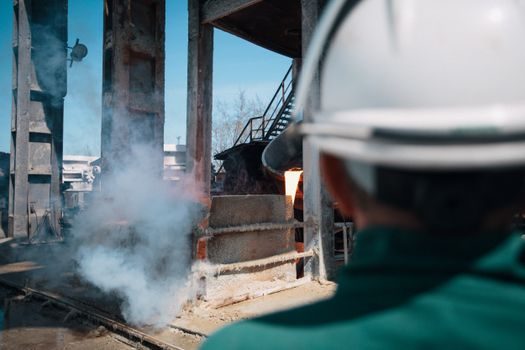
Three standards govern most procurement decisions: IEC 60079 for hazardous-area electrical installation around a furnace (relevant where solvent or hydrogen-rich atmospheres are present), ATEX 2014/34/EU for European explosive-atmosphere certification of the equipment itself, and ISO 9001 / CE for general build quality on OEM imports. Buyers should demand the actual certificate number, not a "CE-equivalent" claim, and verify the certificate scope covers the exact model and kW rating on the nameplate. [S3]
On sourcing, the China OEM market in 2026 is the dominant supply pool for sub-2 t induction furnaces, with 100 kg-2 t models on a single product line and prices from US$1,750-67,000 [S2]. Lead times for standard builds run 30-60 days ex-works; custom kW, voltage (380 V / 415 V / 480 V) or PLC integration typically adds 2-4 weeks. Pre-shipment inspection on refractory density, water-cooling circuit pressure test (typically 0.4-0.6 MPa held for 30 minutes), and a no-load coil insulation test at 2500 V is the minimum acceptance gate.
Decision Rules: Putting It Together on One Page
Step 1 — alloy: ferrous or non-ferrous? Above 1400 °C or below? This alone eliminates two furnace classes. Step 2 — charge weight: pick the next standard size up from your median lot; if that puts you above 5 t per batch, look at cupola + holding, not induction. Step 3 — energy: induction needs stable 3-phase power at the kW rating of the unit; if your site cannot supply that, switch to gas or cupola. Step 4 — duty cycle: continuous 24/7 production favours cupola with its steady-state operation; one- or two-shift job-shop work favours induction's fast cold-start. Step 5 — write the five spec lines above (temperature, cold-start, lining, campaign, atmosphere) into the RFQ and reject any quote that does not address all five. [S1]
Trackable signals for the next 6-12 months: solid-state MF inverter pricing continuing to fall on China OEM builds, and tighter regional NOx/CO limits for gas crucible furnaces in EU and coastal-China industrial zones. Both will tilt new RFQs further toward sealed, medium-frequency induction — a shift visible in the 100 kg-2 t OEM product line that now dominates Made-in-China listings [S2].