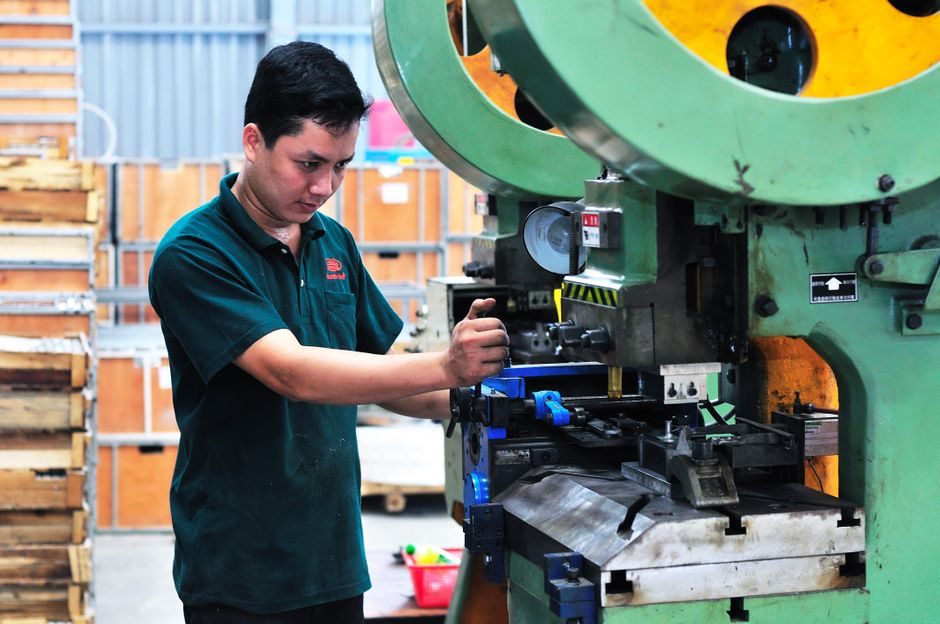
A zinc die casting machine is specified by four coupled numbers — clamping (locking) force, shot weight, platen size and dry-cycle rate — and the only safe build is the one where all four match the projected part, alloy and die temperature window simultaneously [S1].
For Zamak and other zinc alloys the dominant architecture is hot-chamber, with melt held inside a gooseneck immersed in the pot; this is the route used for the bulk of Chinese OEM camera housings, badge holders and small hardware listed at MOQ tiers from 100 to 1,000 pieces [S2][S3][S6]. Cold-chamber machines reappear only when the zinc alloy chemistry is non-standard or when the same cell is shared with aluminium [S1].
Locking Force and Projected Area: Where the Real Failure Lives
Locking force is selected from projected area at the parting line multiplied by the specific injection pressure the cell will run at; under-sized clamps flash the die, oversized clamps waste energy and stretch cycle time [S1]. Hot-chamber zinc cells in the small-machine tier are typically quoted in the 80–900 ton locking-force band, which covers roughly 90 percent of zinc hardware, fittings and electronic housings seen on Made-in-China listings at unit-price ranges from US$0.20 to US$10.00 per piece [S3].
Engineers should size the clamp at 1.2–1.4× the calculated flash threshold on the first article, then trim back only after a stable flash-free curve is logged over at least 500 shots; quoting a clamp at exactly the calculated figure is a textbook way to ship flash on day one [S1].
Shot Weight, Platen Size and Die Mounting Envelope
Shot weight is set by the cold-shot limit of the plunger and the practical fill ratio; running a machine below ~20 percent of its rated shot weight ruins melt temperature stability and accelerates pot attack in hot-chamber zinc cells [S1]. Conversely, exceeding ~80 percent of rated shot weight risks short-shots and air entrapment on long flow paths.
Platen size and tie-bar spacing define the die envelope you can actually bolt up; the same hot-chamber machine quoted for small zinc hardware in Zhejiang typically appears with mould polishing and CNC die-matching equipment in the US$10,000–400,000 band, confirming that die-side tooling cost rivals the machine cost on small zinc cells. For a fuller machine comparison the die casting machine reference entry lays out the cold- vs hot-chamber split, while the zinc die casting machine page covers alloy-specific shot curves and pot metallurgy.
Cycle Rate, Automation and the Real Throughput Equation
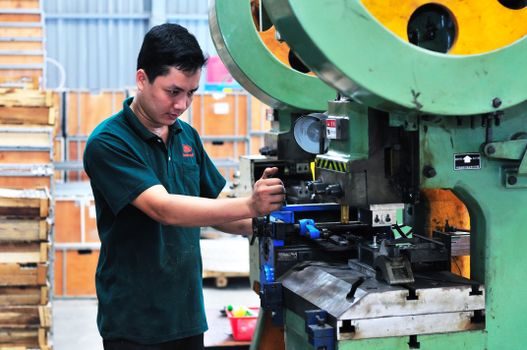
Modern Chinese-built zinc cells are sold as full-automatic production lines, not bare machines, with vendor Tech-Casting publishing 35 cycles per minute as a baseline capability and a 15-minute die-change target to protect OEE on mixed-product runs [S5]. Die-change time frequently dominates effective throughput on zinc hardware cells running families of small parts; quoting peak strokes-per-minute without the die-change budget is the standard way to over-promise capacity.
When the same plant quotes CNC machining centres (Sodick-class) in the die-sinking workflow, the implication is that the cell is built around matched-die manufacturing rather than one-off tooling — a configuration that makes sense for zinc-alloy locks, bathroom hardware and connectors, but not for prototype runs below 5,000 pieces [S5].
Control System, Hydraulic vs Servo and Energy Footprint
Servo-driven hydraulic (or hybrid) clamping has effectively displaced pure proportional-valve hydraulics on new Chinese-built zinc cells, because zinc's fast cycle exposes every millisecond of valve response; the control stack is typically built around an HMI/PLC pair with shot-curve profiling and a real-time injection graph [S5].
Where a buyer is fitting a zinc cell inside an existing aluminum die casting machine bay, the practical constraint is thermal zoning: zinc pots run ~20–30 °C below typical aluminium cold-chamber practice, and the cell exhaust must be ducted separately to keep zinc oxide fumes out of aluminium dross handling.
Cost Bands, MOQ Logic and Sourcing Signals from 2026 Listings

Current Made-in-China listings for finished zinc die castings cluster between US$0.10 and US$10.00 per piece at MOQs of 100–1,000 pieces, with Ningbo and Xiamen suppliers (V-King, Hoxin, Compass Hardware) anchoring the low end and ISO 9001:2015 audited factories sitting at the higher end of the price band [S3]. This price spread is the cleanest market signal of the gap between commodity hardware (badges, keychains, badge holders) and toleranced functional parts (camera housings, lock cylinders, connector shells) [S2][S6].
A spec-side read of the same listings: a buyer paying under US$0.50/piece is buying a casting, not a machined casting, and any subsequent CNC work is a separate PO with separate tolerance. Paying above US$3.00/piece usually implies in-house CNC, surface finish and often a documented PPAP-level process file [S3]. For sourcing context the gravity die casting machine and vacuum die casting machine encyclopedia pages document where zinc cells should NOT be specified — gravity is wrong for thin-wall zinc, and vacuum is reserved for high-integrity structural parts where cycle-rate cost can be justified.
Selection Rules of Thumb and Failure Modes to Engineer Out
Specify hot-chamber zinc whenever the part is sub-7 kg, the alloy is a standard Zamak grade and the production run is above ~10,000 pieces/year; cold-chamber only for non-standard zinc chemistries or shared aluminium cells [S1]. Locking force is sized at 1.2–1.4× calculated flash pressure, shot weight is held between 20 and 80 percent of plunger rating, platen size must clear the die envelope plus robotic pick-and-place reach, and the cycle-rate claim is meaningless without a die-change budget attached [S1][S5].
Trackable signals for a 2026 sourcing decision: a new magnesium die casting machine wave at the same Chinese OEMs is a leading indicator that multi-alloy cells will become the 2027 default, and rising MOQ floors above 1,000 pieces on Zhejiang zinc listings suggest suppliers are consolidating toward longer runs. For a practical application comparison, see the architectural hardware vs PPR pipe breakdown — zinc die castings dominate the hardware side of that trade, and the same unit-cost logic applies.