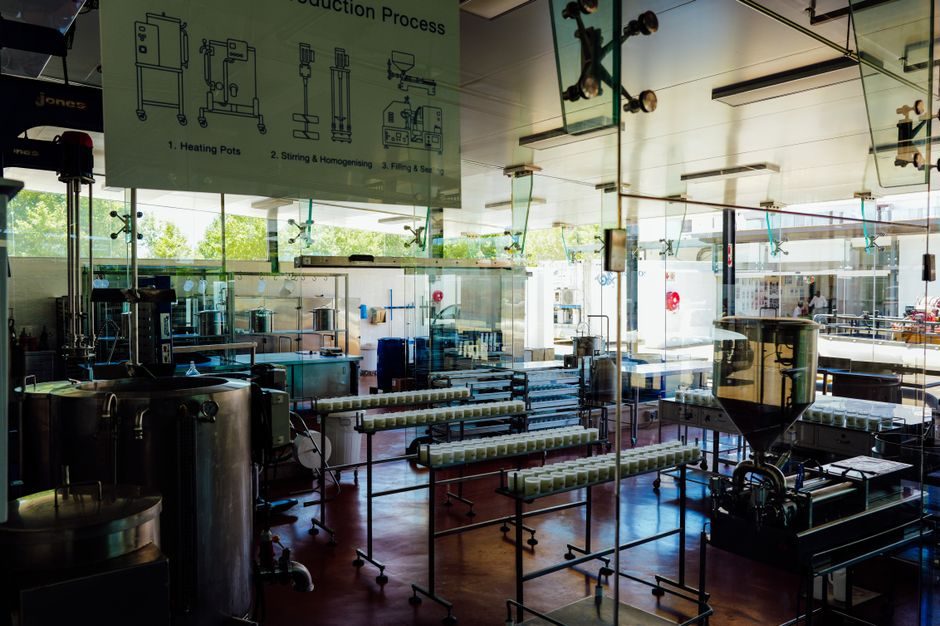
Stainless 304 / 316L automatic molding lines, paired with shell-molding machines and static-pressure molding units, are the dominant specification for food and beverage plants where CIP/SIP wash-down and 3-A / EHEDG hygienic design are mandatory [S1][S4].
Food and beverage converting / packaging is a multi-segment category that spans bottle-and-can beverage lines, dairy and edible-oil container forming, and bulk PET preform production; the molding line sits upstream of the conveyor sorting line that routes formed parts to filling, labeling and palletizing stations [S1].
Hygienic Material and Surface-Finish Bands
Stainless 304 and 316L remain the default contact-surface materials for food-grade forming dies, with 316L specified where chloride-rich cleaning chemistry (NaClO, caustic + acid rotation) is used, since 316L's 2-3% Mo content improves pitting resistance against chlorides [S4].
Surface finish on product-contact surfaces is normally specified at Ra ≤ 0.8 µm (mirror-polish grade) for dairy and beverage contact parts; Ra ≤ 0.5 µm is reserved for aseptic infant-formula and liquid-pharma crossover lines, where bacterial harborage in micro-scratches has been documented as the root cause of CIP failures [S4].
Freudenberg Sealing Technologies lists "beverage and food dispensers," "separators and decanters," and "freezer" applications as seal-development reference points for F&B lines, confirming that hygienic elastomer selection (typically EPDM or FKM with FDA 21 CFR 177.2600 and EU 1935/2004 compliance) is a co-equal design constraint to the metalwork [S4].
Line Architecture: From Molding to Filling
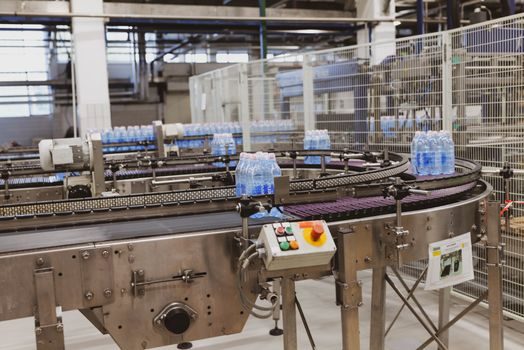
A typical F&B plant pairs an automatic molding line with a line-frequency furnace when glass or specialty alloys are processed, and routes output via a stainless conveyor sorting line into a cleaning-filling-capping monobloc [S1].
For glass-container and PET preform production, the shell molding machine is the workhorse for resin-bonded sand molds or investment shells where high dimensional repeatability (±0.1 mm typical) on neck-finish geometry is needed to mate with downstream capping heads [S1].
Where flat or large-area food-tray forming is required, a static-pressure molding machine operating at 0.4-0.6 MPa platen pressure is typically selected over high-velocity impact molding, because static pressure yields uniform density, lower internal-stress gradients, and a cleaner trim edge on PP and PET sheet [S1].
The decision split: high-speed injection molding (>10,000 pcs/h) for caps and preforms; static-pressure molding for trays, lids and wide-mouth containers; shell molding for metal-contact or specialty glass forming where sand-mold cost is acceptable [S1].
Comparison: Molding-Line Types on Four Decision Criteria
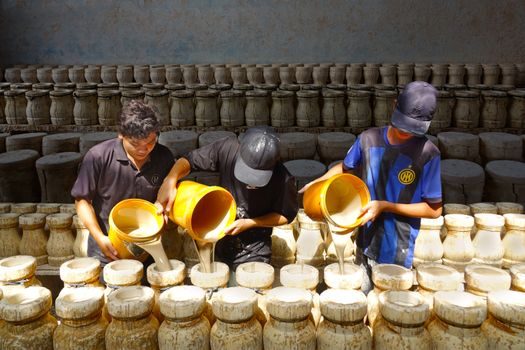
For procurement teams writing RFQs, the four most-cited decision criteria are: cleanability (CIP/SIP compatibility), throughput (parts/hour), tooling cost (USD per cavity), and material range (PET, PP, PS, metal, glass). The table below aligns the three main options: [S1]
Automatic injection molding line: throughput 5,000-40,000 pcs/h (cap/preform class), tooling cost moderate (USD 8,000-50,000 per 32-cavity cap mold), material range limited to thermoplastics, cleanability high with stainless platens and closed-loop hydraulics [S1].
Static-pressure molding line: throughput 600-3,600 pcs/h (tray/lid class), tooling cost low (USD 2,000-12,000 per die set), material range covers PP/PS/PET sheet up to 6 mm, cleanability moderate-large form factors are harder to CIP than small caps [S1].
Shell molding line: throughput 60-400 pcs/h (specialty class), tooling cost high (pattern + resin-bonded sand per batch), material range covers cast iron, aluminum bronze and soda-lime glass, cleanability low-dust, but heavy post-mold wash is normal [S1].
By criterion, injection molding wins on throughput and cleanability, static-pressure wins on tooling cost and wide-format flexibility, and shell molding wins on material range when non-plastic food-contact parts are specified [S1].
Who This Spec Is For, and Who It Is Not For
This specification fits greenfield beverage bottling plants (water, CSD, juice, dairy, edible oil) targeting 12,000-60,000 BPH throughput, where a single-source OEM can deliver the molding line plus downstream conveyors under one warranty and one FAT protocol [S1][S2].
It is also a fit for contract packagers co-packing multiple SKUs on one line, where quick-change tooling (QCT) under 15 minutes is a contractual KPI; this pushes selection toward automatic molding lines with servo-driven platens over hydraulic units [S1].
It is NOT a fit for ultra-small artisan bakeries or single-SKU craft beverage micro-breweries producing under 500 BPH, where hand-fed semi-automatic benchtop presses are more cost-appropriate; capex on a full automatic line is wasted under 2,000 BPH [S1].
It is also NOT a fit for cold-chain frozen-food forming, where modified-atmosphere packaging and -35 °C tunnel freezing dominate the line architecture; in that case, the molding line is upstream but the freezer is the rate-limiting station [S4].
Sourcing Channels, Standards, and Verifiable Signals
Global food machinery sourcing, as of mid-2026, is concentrated in three regional clusters: German/Italian OEMs for high-speed beverage lines, Chinese OEMs for cost-competitive PET and cap lines (listed as the dominant supply cluster on Global FoodMate's supplier directory) [S2], and US/Japanese OEMs for aseptic and ESL dairy lines [S1][S2].
The non-manufacturing inputs that bind an F&B molding line are at least as critical as the press itself: Freudenberg Sealing Technologies publishes F&B-specific seal reference designs (dispensers, separators, freezers) that align with the elastomer compound and metallurgy choices on the press tie-bars and CIP manifolds [S4].
The non-molding quality-test layer (rapid microbial tests such as Oculer's ATP-based platforms) has become a routine release-gate on F&B lines, with same-shift results replacing 24-48 h plate-count methods, which compresses QA hold inventory on the conveyor sorting line [S3].
Trackable signals for the next 6-12 months: (1) EU F&B machinery suppliers consolidating around the new Machinery Regulation 2023/1230 compliance deadline that became applicable in January 2027 for newly placed machines; (2) Chinese PET and cap-line OEMs pushing further into Southeast Asia and MENA via the Global FoodMate directory channels; (3) rapid-microbiology vendors integrating data directly with line PLCs to auto-divert suspect batches before they reach the palletizer [S2][S3].
For related coverage, see Best AS/RS for Pharmaceutical: Spec-Driven Selection in 2026.