
Hypertherm dominates the marine and shipyard plasma-cutter conversation in 2026, with the Powermax 30 XP, 45 XP, 65, 85, 105, and 125 XP families covering cut capacities from 1/4" up to 1 1/4" on mild steel [S1][S2].
Operators on the ARCCAPTAIN, Bestarc, and PrimeWeld 50A dual-voltage inverters, now Amazon best-sellers at $99.99–$179.99, are doing clean 1/2" cuts and severance cuts on 2/3" plate from 110V/220V shop power [S3][S6]. The real spec question is not brand loyalty, it is which unit matches the plate thickness you actually cut 80% of the time, your available input power, and your air supply at the dock.
Cut Capacity Tiers: What 30, 45, 65, and 85 Amps Actually Cut
Hypertherm's selection guidance, still the most cited reference for marine buyers, is to size the cutter for the metal thickness you cut 80% of the time at the recommended cut capacity, not the maximum severance number [S1]. A Powermax 30 XP clean-cuts roughly 3/8" on mild steel and severs 5/8"; the 45 XP steps that to 1/2" clean and 5/8"–3/4" severance; the 65 and 85 XP push clean cuts into the 3/4"–1" range used for hull plate and deck plating [S1][S2]. For typical marine repair work, hull patching at 1/4"–3/8" sits squarely in the 30–45A class, which is why WeldingWeb field reports keep recommending the 45XP over the 30 for any "real" boat work [S2].
Mid-range 50A inverter cutters, ARCCAPTAIN 50A, Bestarc 50A, and PrimeWeld CUT60, publish a 1/2" clean cut and 2/3" max cut on mild steel, matching the Hypertherm 45XP envelope at roughly 8–10% of the price [S3][S6]. For one-off marina jobs under 1/2" plate, these dual-voltage 110V/220V IGBT units are the value sweet spot in 2026.
Input Power and Marine Shore Power Compatibility
110V/220V dual-voltage input is now table stakes for entry-level marine units: the ARCCAPTAIN 50A, Bestarc 50A, and PrimeWeld CUT60 all publish automatic dual-voltage switching with a 1/4 NPT air fitting, sized for standard US shop compressors and the small 6-gallon pancake tanks carried aboard workboats [S3][S6]. Hypertherm's Powermax 30 Air adds a built-in compressor for roughly $2,300 before rebates, eliminating the air-supply problem on remote docks but at a 10x cost premium over inverter separates [S2].
For shipyard and dry-dock work, Welder Supply's heavy-duty catalog skews to 460V and 480V three-phase input, 34 of 42 listed Hypertherm units run on 460V and 12 on 600V, with 25 ft and 50 ft torch leads for reach into hull sections [S5]. Three-phase Powermax 105/125 XP systems are the workhorses for plate cutting above 1" and for CNC table integration on fabrication berths.
Air Supply, Consumables, and the Real Cost of Ownership
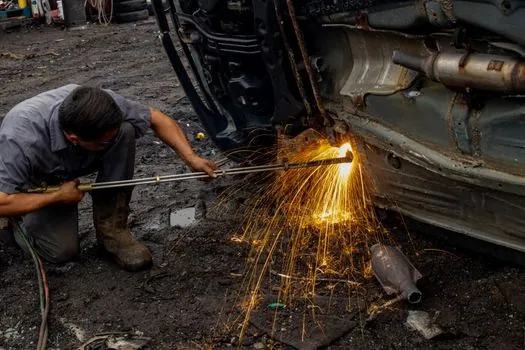
Plasma cutting in a marine environment is air-supply-bound long before it is amperage-bound: a typical 50A unit pulls 4.0–4.5 CFM at 60–70 PSI, and salt-air humidity kills electrodes faster than shop air does. The ARCCAPTAIN 50A and Bestarc 50A both use standardized consumables, which WeldingWeb owners cite as the deciding factor over proprietary-cartridge designs when replacement stock at a chandlery is uncertain [S2][S3]. Hypertherm's six-year warranty on the Powermax 30 Air and the long-term parts availability of older 45XP/65 units are the documented reason used Hypertherms hold value [S2].
WeldingWeb field testing on the 70A Amico against a 50A Vevor over two years showed the Amico replacing the Vevor for any "real" plate work, the user explicitly noted the Amico handles significantly thicker material despite costing more up front, and that the Vevor has not been powered on since [S2]. Consumable standardization, not amp rating, is the repeat-buying signal users cite.
Handheld vs Mechanized vs CNC for Marine Work
Welder Supply's filter catalog breaks plasma cutters into three torch categories: handheld (13 units), mechanized (13 units), and power-supply-only (13 units), with the rest being CNC-ready with CPC ports and serial interface options [S5]. For shipboard hull repair and dock-side plate patching, handheld 25 ft lead units dominate; the 50 ft lead is preferred for working inside a hull section or across a barge deck without repositioning the power supply [S5]. Mechanized and CNC-torch configurations are specified for new-build fabrication shops running plate-cuts on a track or water-table.
Marine buyers should match lead length to the largest workpiece: 12 ft leads (only 1 unit in the heavy-duty catalog) are workshop-only, 20 ft leads cover most deck work, and 25–50 ft leads are mandatory for in-hull or over-the-side cutting [S5]. On an aluminum hull or pontoon repair, the same 50A inverter that runs on mild steel cuts 1/2" 5052/6061 cleanly with the correct shield gas setup, though dross cleanup is more aggressive on aluminum than on steel [S4].
Side-by-Side: Powermax 30 XP vs 50A Inverter vs Powermax 105 XP

On three decision criteria, clean cut on mild steel, input power, and price, the 2026 marine field sorts cleanly. The Powermax 30 XP clean-cuts 3/8" from 110V/240V single-phase at roughly $1,500–$2,000; the ARCCAPTAIN 50A and Bestarc 50A clean-cut 1/2" on the same input range at $99.99–$179.99; the Powermax 105 XP clean-cuts 1" but requires 460V three-phase and lists above $5,000 [S1][S3][S5]. On consumable standardization, both Hypertherm tiers and the 50A Bestarc/ARCCAPTAIN lines use widely stocked standard cartridges; proprietary systems are the documented long-term-support risk [S2].
On duty cycle and CNC-readiness, only the Powermax 65/85/105/125 XP family publishes true 100% duty cycle ratings and CPC-port integration for track tables, the 50A inverters are intermittent-duty and handheld-only by design [S1][S5]. The pragmatic split: buy a 50A inverter for under-1/2" repair and one-off jobs, a Powermax 30/45 XP for sub-3/4" professional hull work on single-phase shore power, and a 105/125 XP three-phase system only if you are running a fabrication berth or CNC plate table.
Material-Specific Notes: Mild Steel, Stainless, and Aluminum Hulls
Plasma passes a constricted electric arc through a gas stream to cut any electrically conductive metal: mild steel, stainless steel, and aluminum all cut cleanly with the right amperage and gas setup [S4]. Welder Supply's heavy-duty filter shows 44 of 42 listed units rated for mild steel, 43 for stainless, and 43 for aluminum, confirming that material compatibility is not a discriminator at the heavy-duty tier [S5]. For marine applications, the practical differences are dross behavior and consumable wear: stainless and aluminum both run hotter and pit more around cut edges, requiring slower travel speeds and more frequent nozzle replacement than mild steel [S4].
When planning a plasma cutter for marine repair, spec the unit for your thickest regular cut, not your absolute thickest job, because a 50A unit forced to 1" plate will run at its thermal limit and consumable life drops sharply. Plate thickness drives the spec, as detailed in the plasma cutter selection reference.
Limitations and Failure Modes Buyers Hit on the Dock

Three documented failure modes show up in 2025–2026 WeldingWeb threads and Hypertherm guidance: insufficient air pressure, undersized input wiring, and ungrounded work clamps in a saltwater environment [S1][S2]. The cheapest imported 50A units, the Vevor class, are described by owners as "basically throw away machines" with weak long-term parts support, while the Amico 70A is the documented "replace it tomorrow" mid-range pick [S2]. Hypertherm's six-year Powermax 30 Air warranty and consumable availability on decade-old 45XP units are the cited reason used Hypertherms trade at a premium on the marine-equipment resale market [S2].
For dock and barge work, a marine valve specifier comparing material cut lists to fabrication scope will recognize the same cut-quality tradeoff: cut speed, edge cleanliness, and heat-affected zone all degrade as plate thickness approaches the unit's published maximum, so the Hypertherm guidance to size for the 80%-of-work thickness, not the absolute maximum, is the rule that keeps consumable costs in check [S1]. Buyers sourcing for a wider marine HVAC fabrication or repair scope follow the same logic, and any outfit also handling rebar-cutter or structural steel will find the 50A inverter class is a useful crossover tool.
Trackable signals going forward: Hypertherm's 2026 product-line updates on the Powermax SYNC cartridge family, ongoing tariff-driven price moves on sub-$200 imported inverters, and the next 6–12 months of field reports on the Amico 70A versus the Hypertherm 45XP at the 1/2"–5/8" cut threshold, the bracket where most marine hull-repair work actually sits [S1][S2][S3].
Background reading: Machine vision as the data layer for production capacity planning.
