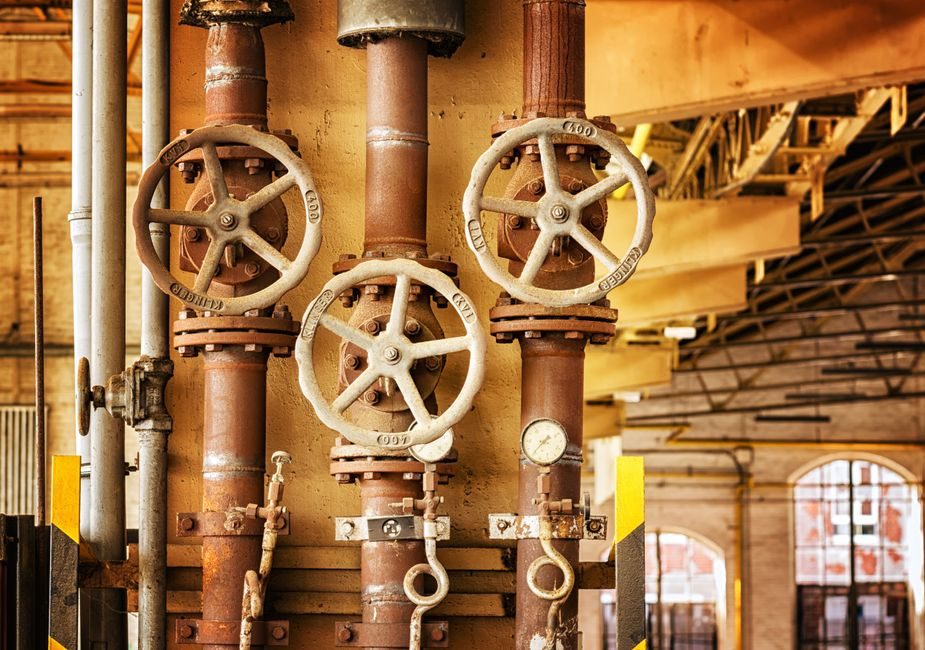
For 2026 hyperscale and colocation data-center builds, the baseline pneumatic valve actuator spec has converged on quarter-turn rack-and-pinion or Scotch-yoke units in stainless or nickel-plated carbon steel, sized for 3-8 bar clean-dry-air supply with spring-return failsafe and a dual-coil Namur-mounted solenoid [S1].
Cooling-loop valves in liquid-to-air and liquid-to-liquid heat-exchanger circuits are overwhelmingly quarter-turn (ball, butterfly, or triple-offset), so the actuator choice is dominated by two technologies: rack-and-pinion (high cycle life, compact envelope) and Scotch-yoke (higher breakaway torque for larger butterfly and triple-offset bodies) [S1][S3]. A complete pneumatic valve actuator package for a data-center use case also requires a pneumatic valve actuator housing, a Namur-mount pneumatic fitting interface, and a separately specified position feedback device.
Why Pneumatic Stays the Default for Data-Center Chilled-Water Isolation
Hyperscale data-center mechanical rooms are not classified hazardous areas, so ATEX/IECEx certification is typically not a contractual requirement on the actuator itself, but designers still specify pneumatic actuation because a spring-return pneumatic actuator fails closed (or open) on loss of air without needing UPS-backed electric power [S1].
Compressed air for valve actuation is normally tapped from the data-center's existing instrument-air ring, which already meets ISO 8573-1 cleanliness targets downstream of the desiccant dryer — so no extra compressor room is provisioned. The actuator must accept the 3-8 bar standard supply window, and the positioner must be tuned for the short stroke (typically 90°) of the pneumatic actuator driving a butterfly or ball segment.
Emerson's final-control product page now lists "Data Center Valves" as a dedicated market segment under common applications, confirming that chilled-water and coolant-loop automation is an OEM-recognised vertical [S1]. The portfolio offered for that vertical includes both rack-and-pinion (RPX, RPE, Stainless Steel M Series) and Scotch-yoke (CBA300, CBB) product lines, all configurable for air supply in the 3-8 bar range and with operating-temperature filters that cover chilled-water ambient conditions of −20 °C to +80 °C [S1].
Selection Criteria: Torque, Failsafe, Cycle Life, and Feedback
Sizing a pneumatic valve actuator for a data-center butterfly valve starts with the breakaway torque of the seat, not the running torque, because EPDM or FKM-seated resilient-seated butterflies can present breakaway-to-running ratios as high as 1.5:1 on cold start-up [S1].
Apply a minimum 1.25-1.5× safety factor on the manufacturer's published maximum dry-breakaway torque to allow for seat wear and scale buildup over the 100,000-cycle design life that chilled-water isolation valves are typically rated for. For Scotch-yoke designs, the published torque curve is non-linear (peak torque at the start of stroke), and the actuator must be selected so its torque envelope at every intermediate position exceeds the valve's required torque at that angle, not just at endpoint [S1].
Failsafe direction is a contractual decision: fail-closed (spring returns to seat, isolates the loop) is the default for chilled-water branch isolation, while fail-open is reserved for circuits where loss of flow would cause a worse failure mode (e.g. certain free-cooling bypasses). Most rack-and-pinion and Scotch-yoke actuators are available in double-acting and spring-return configurations with the spring cartridge field-reversible on the Bettis CBA300, allowing the failsafe direction to be flipped during commissioning without a new actuator [S1].
Cycle life and feedback are the next two filters. Data-center chilled-water valves are typically cycled 20-100 times per year (seasonal load steps and maintenance), so a 100,000-cycle mechanical rating is more than adequate. For position feedback, specify a mechanical or inductive position transmitter with at least two SPDT limit switches and a 4-20 mA + HART or Foundation Fieldbus positioner if the BMS requires analog readout; for purely digital monitoring, a wireless HART device can be retrofitted without pulling new cable.
Rack-and-Pinion vs Scotch-Yoke vs Vane: A Criteria-Based Comparison

The three pneumatic actuator architectures relevant to data-center cooling valves line up differently against the four criteria that drive selection in this application: torque density, envelope, cycle life, and cost. [S1]
Rack-and-pinion pneumatic actuators dominate the 10-2,000 N·m range, deliver symmetrical torque in both directions, fit a compact footprint, and are rated for 1,000,000+ cycles on premium lines, making them the most common choice for 50-300 mm butterfly and ball valves on branch loops [S1][S3]. Scotch-yoke pneumatic actuators deliver higher breakaway torque per unit volume, making them the right pick for valves above 300 mm or for triple-offset butterfly bodies where seating torque spikes near the closed position; their envelope is larger and their cycle life is typically 100,000-250,000 cycles [S1][S3]. Vane actuators are compact and inexpensive but limited to low-torque and low-cycle applications (small ball valves) where their inherent air-consumption penalty is not a concern.
On cost, a stainless-steel rack-and-pinion pneumatic actuator in the 100-500 N·m range runs roughly 2-3× the price of a comparable carbon-steel unit, and a Scotch-yoke with the same torque rating runs another 1.5-2× above that. Most data-center specs land on carbon-steel rack-and-pinion for indoor mechanical rooms and reserve stainless (or nickel-plated) for outdoor or coastal sites where humidity attacks the actuator body over the 20-year design life [S3].
Material and Environmental Specification for Mechanical-Room Duty
Specify a powder-coated carbon-steel body (or 316 SS where the project requires it) with an IP66/67 rating on the actuator housing and Namur solenoid, and demand ISO 8573-1 Class 4.4.3 (or better) air quality downstream of the dryer to keep the pneumatic fitting stack and the positioner diaphragm free of oil carryover. For cooling loops where the glycol concentration pushes the loop fluid below −10 °C on the air-handling-unit (AHU) coil, the actuator's published low-temperature limit must be checked, and many standard Buna-N seals on the actuator must be upgraded to EPDM or silicone for cold start-up reliability [S1].
For the positioner, Emerson and similar OEM portfolio pages list pneumatic and electro-pneumatic positioners as separate items, with the electro-pneumatic variant providing 4-20 mA input, HART, and bus-protocol upgrades for BMS integration [S1]. On quarter-turn actuators the positioner is Namur-mounted and connects to the actuator feedback shaft via a Namur-standard coupling, so a positioner swap is straightforward without disturbing the actuator mounting.
Common Failure Modes and How to Spec Against Them
The four most common failure modes seen on pneumatic valve actuators in data-center cooling service are: (1) spring-set drift after extended hold, (2) solenoid coil burnout from continuous energisation, (3) positioner diaphragm rupture from contaminated air, and (4) seat fouling that pushes breakaway torque above the actuator's rated output. [S1]
Spring-set drift is mitigated by selecting a spring-return actuator whose spring cartridge is rated for the full torque envelope (i.e. can stroke the valve even at minimum supply pressure) rather than just at the nominal 5.5 bar midpoint. Continuous-duty coil burnout is addressed by specifying a dual-coil Namur solenoid with thermal-class F insulation and a low-power (≤2 W) holding coil, or by using a latching solenoid on circuits that are commanded open for long periods. Diaphragm rupture is addressed by the air-quality spec above plus an upstream 5 µm coalescing filter on the actuator's individual air supply line. Seat fouling is a valve-side problem, but the actuator spec should leave room for a 1.5× safety margin so the actuator can still stroke a moderately fouled seat without an overhaul.
For diagnostic visibility, a 4-20 mA + HART positioner exposes actuator cycle count, travel histogram, and end-of-travel deviation, all of which feed the data-center's existing data logger infrastructure for trend tracking and predictive maintenance [S1].
Sourcing, Standards, and What to Verify on Datasheets
On datasheets, verify four lines before signing off: (a) the torque output curve at the actual supply pressure available in the mechanical room (often 5.5 bar, not 8 bar), (b) the maximum cycle rate per hour, (c) the operating-temperature window covering both the chilled-water low and the standby-heat high, and (d) the failsafe direction, spring cartridge part number, and field-reversibility claim [S1].
Standards to call out: ISO 5211 for the actuator-to-valve mounting interface (so the actuator and valve can be sourced from different vendors and still bolt up), VDI/VDE 3845 (or the equivalent Namur standard) for the positioner and solenoid mounting pad, and ISO 8573-1 for the supply-air cleanliness class. ATEX/IECEx certification is unnecessary for indoor mechanical-room duty but becomes mandatory if the actuator is mounted in a classified hazardous area such as a generator-yard fuel-gas train; in that case specify the same actuator with the Ex d or Ex ia solenoid option rather than picking a different model.
For project context, the broader sourcing map for pneumatic actuators in 2026 is covered in the pneumatic actuator market 2026 spec map, which lines up torque class, material, and lead-time signals for utility-grade buyers. Where the application is electric rather than pneumatic — for example on lower-cycle branch valves that can be driven by an electric actuator wired into the BMS — the electric actuator selection map is a useful cross-check on torque, duty cycle, and bus protocol.
Trackable signals to watch in the next procurement cycle: hyperscaler mechanical-room standards (typically published as confidential vendor specs but occasionally surfacing in ASHRAE TC 9.9 guidance), the migration of chilled-water valves from pneumatic to electric on new builds as instrument-air is removed from mechanical-room scope, and the price spread between carbon-steel and stainless-steel rack-and-pinion actuators, which has historically tracked stainless-steel surcharges.