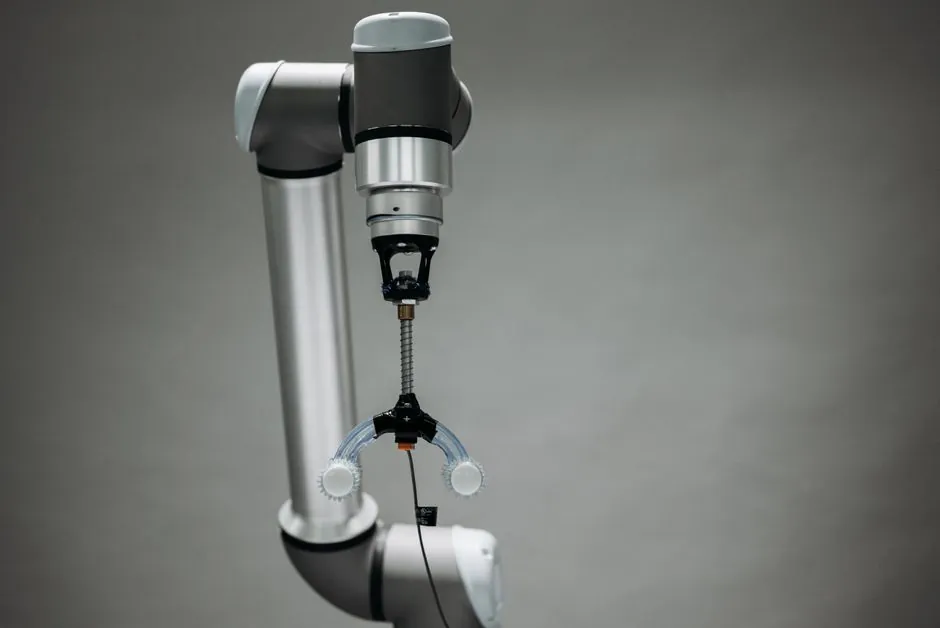
Epson, Yamaha, and Codian anchor the semiconductor SCARA shortlist in 2026, joined by ESTUN and EVST EVS-series on cost-driven, non-front-end steps where ISO Class 5 cleanroom and ±0.01 mm repeatability are not mandatory [S1][S2][S4].
For a working definition of the geometry and its 4-axis architecture (two horizontal revolute joints, a vertical Z, and a wrist rotation), see the SCARA robot reference page; the side-by-side contrast against articulated robots explains why planar pick-and-place cells favour SCARA over 6-axis arms in wafer-handling duty.
What "semiconductor-grade" actually means in a SCARA spec sheet
A SCARA is semiconductor-eligible when it satisfies three measurable thresholds: ISO Class 5 (formerly Class 100) cleanroom rating, ±0.01 mm or better positional repeatability, and a rated cycle time under 0.5 s for a standard 25 mm up, 300 mm horizontal, 25 mm down move [S1][S4]. Codian documents ISO Class 5 on selected SR-series variants, while Epson's RS-series publishes ±0.005 mm repeatability on the high end, compared to ±0.015 mm on larger G-series arms [S1][S4]. Below those numbers, the arm is a general-assembly SCARA, not a semiconductor SCARA, and a procurement team should not let a vendor relabel it.
Wafer-handling duty also constrains the Z-stroke. A 150 mm Z travel covers cassette-to-handler transfers, but deeper insertion work such as stacked-die bonding or multi-up test sockets can require 200 to 300 mm of vertical travel, a fixed mechanical parameter that cannot be retuned in software [S3]. Buyers who treat Z-stroke as a footnote tend to discover the limit during factory acceptance testing.
Selection criteria: payload, reach, cleanroom, and footprint
Four criteria decide the model: payload (kg), reach (mm), cleanroom class, and base footprint. The table below lines up the documented 2026 lineups against those criteria so a process engineer can drop the shortlist directly into a qualification matrix. [S1]
Payload 1-6 kg, reach 400-700 mm, ISO Class 5 option: Codian SR100 (3 kg / 400 mm / IP20 / no cleanroom) and SR200-6 (6 kg / 500-700 mm / Z-stroke 200 or 300 mm), with selected SR variants rated ISO Class 5 [S4]. Payload 1-20 kg, reach 400-1000 mm, no public ISO class on most variants: Epson T (400-600 mm), G (up to 850 mm), RS (550-600 mm), and N (up to 1000 mm) series, with repeatability ±0.005 mm on RS, ±0.015 mm on G [S1]. Payload 2 kg, reach 560 mm, IP45 splash-proof (not cleanroom): igus 4 DOF SCARA at 20 picks/minute and ±0.5 mm repeatability, positioned as a low-cost automation entry rather than a fab-grade arm [S5]. Sub-2 kg to 20 kg, reach 400-1000 mm: EVST EVS-series (EVS600-6L, EVS700-6L, EVS725-10L), repeatability ±0.01 to ±0.02 mm, base footprint under 300 mm on the smaller armspans [S3].
Footprint matters more than the marketing sheet admits. A 300 mm base diameter lets a line builder pitch robots at 400-500 mm centres on a multi-station cell, which is the difference between fitting four arms into a 1.5 m envelope and fitting three [S3]. For a frame of reference on adjacent cell layouts, see the collaborative robot reference, which covers the same packing-density problem on the human-robot side of the line.
Leading 2026 candidates by use case
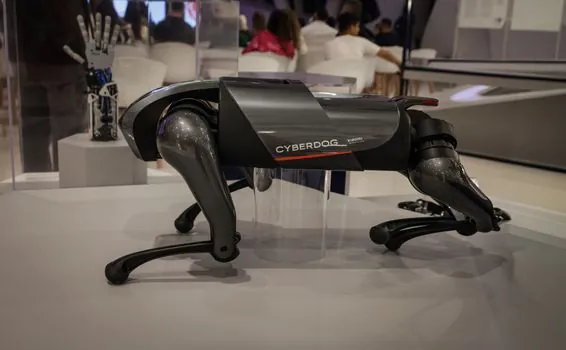
For wafer cassette handling and die-sorters, the qualified arms in 2026 are the Epson RS-series (550-600 mm reach, ±0.005 mm repeatability, sub-0.4 s cycle time on the RS3) and the Yamaha YK-XG series, with the Codian SR200-6 (6 kg / 500-700 mm) as the cleanroom-rated alternative for ISO Class 5 cells [S1][S2][S4]. These three cover the semiconductor backend where repeatability and particle counts are non-negotiable. Price bands sit in the $15,000-40,000 range typical of Japanese incumbents, against $5,000-15,000 for capable Chinese units [S2].
For SMT, PCB assembly, and connector press-fit (less aggressive cleanliness budget), the shortlist extends to ESTUN ER3-500S, EVST EVS600-6L and EVS700-6L, plus the Yamaha YK-XG710, all rated for ±0.01 mm-class repeatability at 1-6 kg payload [S1][S2][S3].
For laboratory and metrology cells (low throughput, ultra-clean bench-top duty), the igus 3 DOF SCARA (0.5 kg / 400 mm / 360 mm Z / 6 picks/min) and the drylin 3 DOF (2 kg / 560 mm / 20 picks/min, IP45) cover the niche where semiconductor throughput is not the constraint [S5][S6]. The industrial robot reference page covers how these light-duty arms fit against heavier six-axis cells in mixed-payload lines.
Where Chinese SCARAs fit, and where they do not
ESTUN and EVST EVS-series are credible on the $5,000-15,000 tier for non-front-end semiconductor steps: PCB insertion, screw driving on sub-M3 fasteners, optical module alignment, and 3C packaging, with cycle times under 0.5 s and ±0.01 mm repeatability on electronics-grade models [S2][S3]. They are not a drop-in for wafer-handling or ISO Class 5 cells unless the vendor publishes a cleanroom certificate for the specific variant under evaluation, which most Chinese catalogues do not list on the public product page [S1][S3].
The practical rule: if the cell has a particle-count spec in the spec sheet, treat any arm without a documented ISO Class rating as not qualified, regardless of price. For context on how AGV/AMR fleets shuttle cassettes between these cells, see the AGV robot and AMR robot reference pages.
Market and demand signal, 2026
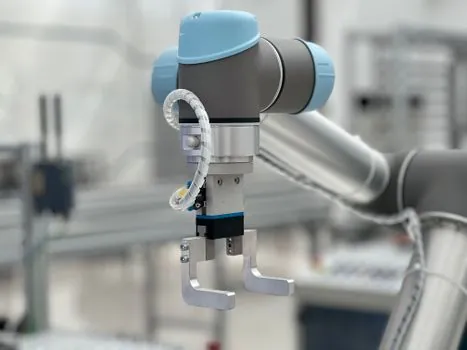
The global SCARA market is projected to reach USD 2.8 billion by 2027, expanding at a CAGR above 9%, with SCARA installations accounting for approximately 15% of all new industrial robot units shipped globally per IFR World Robotics 2025 [S1]. Robotics in semiconductor manufacturing is tracked at a USD 27.34 billion market size by 2035, with ABB, FANUC, Yaskawa, KUKA, and Mitsubishi Electric as named participants in that growth case [S7]. Japan and China together represent over 60% of SCARA unit volume, and Japan retains the largest installed base in precision-critical semiconductor and display manufacturing, the structural reason Japanese brands still anchor the fab shortlist even as Chinese units gain on price [S1].
Specification checklist before PO
Confirm four items in writing before releasing the purchase order: documented repeatability value (not a range), cycle time at the move profile the cell will actually run (25 x 300 x 25 mm is the industry yardstick), cleanroom class with certificate number where applicable, and Z-stroke measured against the tallest fixture in the cell, not the nominal datasheet value [S1][S3][S4]. The Codian SR-series data block is a clean example: SR200-6/700 publishes 6 kg / 700 mm / 200 or 300 mm Z / IP20, and selected variants carry ISO 5, so the engineer can match each cell to a documented configuration without inference [S4]. Anything left as "contact us" on those four items is a signal to keep evaluating.
Track the next two signals through Q4 2026: ISO Class 5 cleanroom certification announcements on the next Codian SR-series release, and any new ISO-rated variant from the EVST EVS-series or ESTUN ER-series, since a Chinese-priced cleanroom SCARA would reset the cost benchmark for backend cells currently locked to Japanese brands [S3][S4]. Also watch the Codian release-2026 announcement thread for SR-series payload or reach extensions that move the boundary between light backend and mid-payload backend handling [S4].
Background reading: Automatic level for plumbing install: 2026 spec map and selection rules.