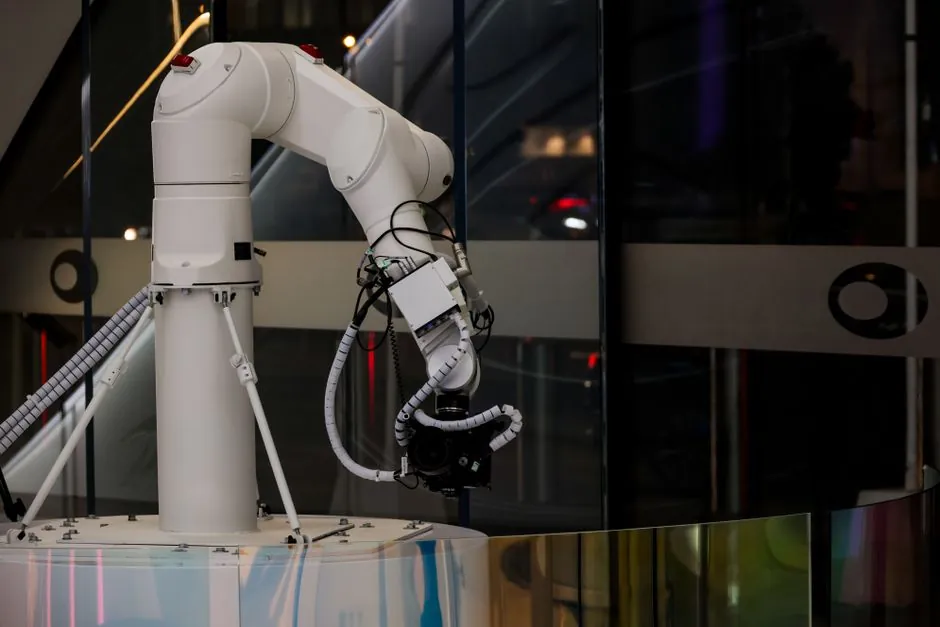
For food and beverage lines in 2026, the strongest articulated-robot fit is a 6-axis food-grade collaborative arm in the 5-20 kg payload class with 994-1418 mm reach, IP67 minimum ingress protection, and NSF-rated food-contact surfaces; the FANUC CRX-5iA, CRX-10iA/L, and CRX-20iA/L Food Grade cobots are the closest matches against this spec window [S3].
Articulated arms (also called 6-axis robots) are the general-purpose workhorse of the food industry: payload spans 5-300 kg, they portion, package, and palletize, and they reach into awkward cavities a delta or SCARA cannot [S1]. The narrower question for a food-plant buyer is which of those 6-axis arms also meets hygienic-design, washdown, and HACCP-compatible data requirements.
What "Food-Grade Articulated" Actually Means in 2026
Food-grade articulated arms are differentiated from general-industrial 6-axis robots by three verifiable attributes: hygienic surface treatment, ingress protection matched to the washdown zone, and food-contact material compliance [S1]. The EU food-manufacturing sector alone employs roughly 4.7 million people and generates about 1.2 trillion euros in revenue, which sets the scale of any deployment decision [S1].
EN 1672-2 is the European baseline that defines hygienic-design requirements for food-processing machinery, including cleanability, absence of dead spaces, and resistance to common cleaning chemistries [S1]. In parallel, food-plant human-collaboration and humanoid platforms entering 2026 are being evaluated against an IP67 minimum for wet zones, IP69K for direct clean-in-place (CIP) and high-pressure washdown, food-grade stainless steel or NSF-rated polymer contact surfaces, and an operating window from -20°C blast freezer to +60°C processing zones [S2].
Selection Criteria: Payload, Reach, IP Rating, Material
Payload and reach are the first cut. Light-pick and packaging cells on a conveyor typically sit in the 3-10 kg band; mid-range case-packing and labeling jobs run 10-20 kg; palletizing 25 kg cartons and heavier secondary packaging move to 35-300 kg articulated arms or shift to gantries above 500 kg [S1]. For food-grade cobots specifically, FANUC currently lists Food Grade variants at 5 kg / 994 mm, 10 kg / 1249 mm, 10 kg / 1418 mm (long-arm), and 20 kg / 1418 mm (long-arm) [S3].
Protection class is the second cut. Wet processing and CIP zones call for IP67 minimum, while direct high-pressure, high-temperature washdown pushes the requirement to IP69K [S2]. Material compatibility matters as much as IP: caustic CIP chemicals, sanitizers, and food acids will attack untreated steel, so food-grade stainless or NSF-rated polymer contact surfaces are specified for any articulated arm that will see product or splash contact [S2]. Temperature is the silent killer: a robot specified only for ambient will fail or condense in a -20°C blast-freezer aisle, so the operating window should be checked against the actual zone map of the plant.
Decision Window: Delta vs SCARA vs 6-Axis vs Cobot

Speed, payload, and reach define the four-way choice more cleanly than any single spec sheet [S1]. The 6-axis articulated arm wins on flexibility, not speed: it can portion, package, palletize, and reach into awkward cavities, while the delta robot is the throughput leader at over 150 picks per minute for sub-3 kg items such as chocolates, cookies, and berries [S1]. Top-tier delta systems reach 300 picks per minute in packaging, with practical food-and-beverage rates somewhat below that benchmark [S6].
SCARA arms are the right call for fast, small-footprint pick-and-place; cobots up to roughly 25 kg suit semi-automated stations with frequent product changeover and shared workspace [S1]. Cartesian (gantry) robots remain attractive for repetitive tasks in food processing because of programming simplicity and cost-effective deployment [S4]. For a buyer who needs one articulated platform that can move between cells, a 6-axis food-grade cobot is the most flexible single asset; for a fixed high-speed picking line, a delta still wins on picks-per-minute.
Concrete Picks: FANUC CRX Food Grade Family
Across the FANUC CRX collaborative family, the Food Grade variants map cleanly to common food-and-beverage duty cycles [S3]. The CRX-5iA Food Grade is the smallest, with 5 kg payload and 994 mm reach, suited to light packaging, labeling, and quality inspection stations where the cobot shares workspace with operators [S3]. The CRX-10iA Food Grade doubles payload to 10 kg at 1249 mm reach for general packaging and case-handling, while the CRX-10iA/L Food Grade extends the same 10 kg payload out to 1418 mm for longer conveyors or larger work envelopes [S3].
At the top of the FANUC food-grade cobot line, the CRX-20iA/L Food Grade offers 20 kg payload at 1418 mm reach, with an underflip motion that suits compact high-payload cells [S3]. All four Food Grade variants share the CRX platform's user-friendly teach pendant and drag-to-teach programming, which is the practical difference between a cobot that gets redeployed across SKUs and one that sits idle after the first integration. The wider CRX family also includes a CRX-30iA at 30 kg / 1889 mm and a CR-35iB at 50 kg / 1643 mm for heavier non-food collaborative work, plus legacy 6-axis units such as the CR-15iA at 15 kg / 1441 mm for material handling [S3].
What a Food-Plant Articulated Cell Needs Beyond the Arm
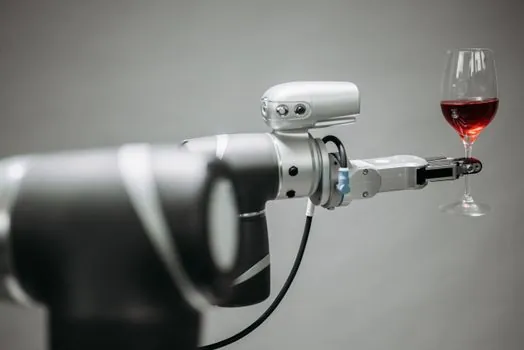
A robot cell is four components, not one: the arm, the controller, the safety technology, and the gripper [S1]. The gripper is where most food-safety failures start: an open process requires grippers that can be cleaned without leaving residue, and dead spaces in either the arm or the end-effector defeat hygienic design [S1]. Cells also benefit when interfaces and safety are pre-coordinated, which is why turnkey robotic cells are the most common entry point for plants new to automation.
Data integration is the other non-obvious requirement. Under FSMA 204, robot data must feed HACCP-compliant records, not just generate sensor files; that requires API connectivity to push inspection findings, sensor readings, and critical-control-point data into HACCP logs, work orders, and traceability records [S2]. CIP verification and environmental monitoring program documentation are structured-data jobs, so the robot controller selection should be driven as much by middleware and CMMS API capability as by cycle time. For packaging-line buyers comparing drive-train options upstream of the robot cell, the gear selection for packaging lines comparison gives a useful parallel criteria framework.
Use Cases: Palletizing, Pick-and-Place, Sanitation Support
Palletizing is the most common entry point for articulated arms in food and beverage, because it is a structured, repetitive task with a clear ROI and a low risk of product damage [S1]. 6-axis articulated arms in the 5-300 kg bracket are the default for case and pallet handling, while gantries above 500 kg take over when full pallet stacks are involved [S1]. Cobots in the 5-20 kg class often start on secondary packaging, labeling, and quality inspection before being promoted to palletizing as confidence grows.
Pick-and-place on a conveyor is dominated by deltas, but articulated cobots take over when the product is irregularly shaped, the conveyor is curved, or the downstream station needs a re-orientation the delta cannot deliver [S1]. A third emerging use case is sanitation and inspection support: humanoid platforms and articulated arms are being evaluated to carry sanitation equipment, perform swab collection, and verify allergen changeover, with payload targets of up to 20 kg per hand on the leading humanoid designs and IP67 washdown as the gating hardware requirement [S2].
Limitations and Failure Modes Buyers Should Price In
Articulated arms lose to deltas on raw pick-rate: a delta can clear 150-300 picks per minute where a 6-axis cobot typically trades cycles for reach and flexibility [S1][S6]. Specifying a 5 kg cobot for a 25 kg carton is a common scoping error; equally common is under-specifying IP rating for a washdown zone, which leads to premature seal failure and motor corrosion.
Humanoid platforms entering 2026 are still evolving on food-specific certifications: some are released at IP54 with food-plant variants under development rather than at IP67 from day one, so a humanoid proof-of-concept in a wet zone should be priced as a pilot, not a production asset [S2]. Temperature-window failures (condensation, gearbox grease thinning) are the most expensive retrofit, so the zone map should be locked before the robot is selected, not after. Buyers should also confirm food-contact material certificates (NSF or regional equivalents) and CIP chemical compatibility from the OEM in writing, because general-stainless marketing language does not equal food-grade compliance.
Standards and Sourcing Checklist
EN 1672-2 governs hygienic-design requirements for food-processing machinery in the EU and is the right baseline citation for any food-grade robot claim in Europe [S1]. FDA audit requirements and FSMA 204 drive the data-integration and traceability side of the spec, particularly the requirement that robot data feed HACCP-compliant records and support KDE capture for traceability [S2]. IP67 and IP69K are the relevant IEC 60529 ingress-protection classes for wet and high-pressure washdown zones respectively, with IP69K reserved for direct CIP areas in dairy, beverage, and ready-to-eat environments [S2].
For sourcing, FANUC maintains a published CRX Food Grade catalog across 5 kg, 10 kg, 10 kg long-arm, and 20 kg long-arm payloads, which gives buyers a like-for-like comparison window [S3]. Delta markets articulated robots under a "Digitized Automation" smart-manufacturing banner, and a robot cell integrating a Delta arm should still be validated against EN 1672-2 hygienic design and the plant's IP-zone map [S5]. For broader packaging-line context, the wrapping machine selection spec map for electronics is a useful reference for adjacent end-of-line decisions. The next data points to track are OEM publication of IP69K ratings on the new CRX Food Grade variants and any FSMA 204-ready middleware certification for the R-30 i B Plus controller family [S3].
For component-level specifications, see articulated robot, construction machinery and equipment, and lamps and light fittings.