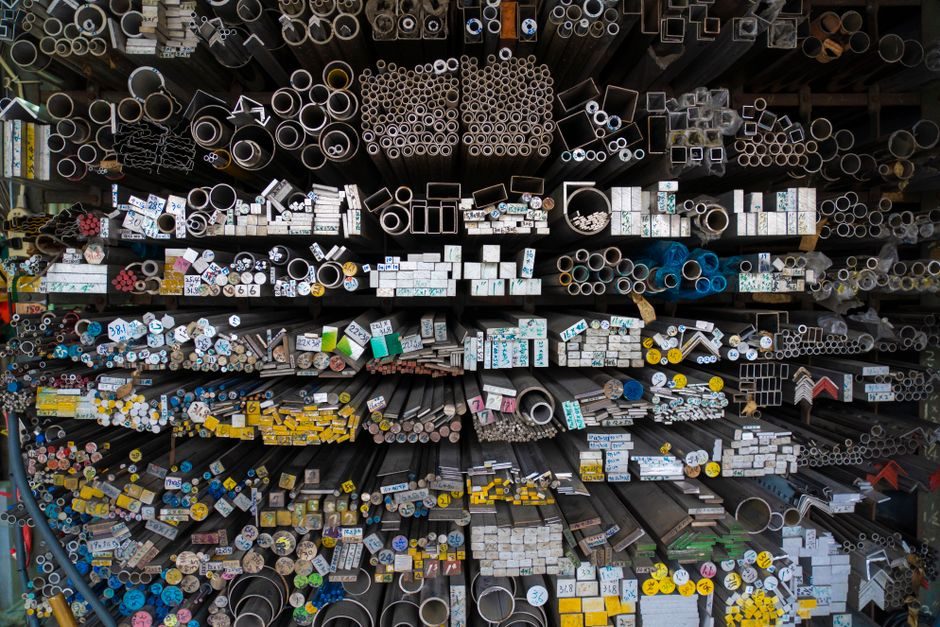
Austenitic 304/304L and 316/316L still account for the bulk of stainless tonnage in mill service, water-treatment skids and structural fabrication, with 2205 duplex filling the chloride-leach and tailings-piping gap; 904L, 254 SMO, 2507 super-duplex and the 6% Mo super-austenitics are reserved for the hot, acidic, chloride-loaded service windows where the standard 18Cr-8Ni grades fail by pitting or SCC inside one to three operating seasons.
Mining duty is unusually broad — it spans dry ore handling, slurry pumping, CIL/CIP leach tanks, acid wash, ventilation ducting, rock-bolt mesh and underground drainage — so the right stainless choice is driven by chloride, pH, abrasion, temperature and galvanic coupling, not by a single "best" grade; a working spec cut for 2026 work is laid out below against that five-axis frame.
Grade 304 / 304L — General-Purpose, But Not for Acid or Leach
The L-grade is mandatory where post-fabrication pickling-and-passivation is not 100% reliable (which on a mine site is the normal case), because 304H or 304 without the L restriction can sensitise to chromium-carbide depletion in the 450–850 °C range and then crack at the HAZ in service. [S1]
Where 304 fails on a mine is well documented: chloride-bearing water above roughly 200 ppm Cl⁻ at ambient temperature, pH below ~4, sour H₂S service, and any galvanic couple to mild carbon steel in wet conditions. 304 is not rated to NACE MR0175 / ISO 15156 for sour service, and it should not be specified in CIL tanks, raffinate lines or thickener overflow launders. Price on 304 cold-rolled sheet in mid-2026 sits in the 1,900–2,400 USD/t band ex-works Asia, which keeps it the cost baseline every other stainless is measured against.
Grade 316 / 316L — Default Upgrade for Wet and Coastal Mines
316 (S31600) and 316L (S31603) add 2–3% Mo to the 18Cr-10Ni matrix, lifting the pitting resistance equivalent number (PREN = %Cr + 3.3·%Mo + 16·%N) from ~18 in 304 to roughly 25, which is the difference between pitting within months and stable service in brackish and mildly saline waters typical of dewatering bores, sea-water-cooled compressor stations and coastal processing plants. Proof stress is similar to 304L at ~210 MPa, but 316L is the correct pick for welded mine water piping, filter housings and reagent dosing skids because of its immunity to sensitisation. [S2]
316L is fully accepted for sour H₂S service up to the limits defined in NACE MR0175 / ISO 15156 (it is listed as an "austenitic stainless" with environmental limits on H₂S partial pressure, pH, chloride and hardness), so 316L is what you see specified for instrument air, hydraulic lines and wellhead components on sour gas–adjacent mining blocks. The 2026 cost premium over 304L is ~20–30% on plate and ~15–25% on pipe, which is cheap insurance against the ~10× chloride pitting margin it buys. For abrasion-heavy slurry lines, however, 316L is not the answer: its hardness is only ~150–180 HB and its resistance is essentially zero against the sliding wear in a SAG mill discharge or cyclone feed.
Duplex 2205 — Chloride Leach, Tailings and Slurries
2205 (S32205 / S31803) is the 22%Cr-5%Ni-3%Mo-0.15%N duplex stainless that gives ~450 MPa 0.2% proof — roughly twice the yield of 304L/316L — and a PREN of ~35, which pushes the chloride pitting threshold up by an order of magnitude. That combination is what makes 2205 the workhorse for CIL/CIP agitator shafts, leach-tank nozzles and the tailings distribution piping where 316L either pits in months or has to be over-walled to survive. The 2205 family is approved for sour service per NACE MR0175 / ISO 15156 within defined partial-pressure and hardness envelopes, so it crosses over from "wet corrosion" into "HPHT well/井下" equipment. [S3]
2205 has two operational traps that show up in mine specifications. First, its 250–300 °C upper service ceiling — above that, the ferrite-austenite balance starts to drift toward embrittling alpha-prime and sigma, and design codes (ASME B31.3) start derating allowable stress. Second, it is not a free-cutting grade: 2205 weldments need a higher austenite balance in the weld metal (typically 2209 filler, ER2209), low heat input, and interpass below ~150 °C, or you lose the corrosion benefit. 2205 plate in mid-2026 runs roughly 3,200–4,200 USD/t ex-works Asia, a step up from 316L but well below the super-austenitic and super-duplex premium.
Super-Austenitic 904L and 6% Mo Grades — Hot Acid Circuits
904L is the lowest-cost entry into that band and is commonly seen in electrowinning cell components, tankage for hot pregnant leach solution above 50 °C, and sulfuric/copper electrolyte lines, where 316L would pit in weeks. [S4]
The 6% Mo grades are the next step up, used where chloride plus temperature is extreme: S31254 (254 SMO) is a standard pick for plate heat exchangers on hot slurry/solution and for piping in pressure-oxidation (POX) circuits where chloride and free acid co-exist above 80 °C. The trade-off is cost — 254 SMO plate commonly runs 7,000–9,000 USD/t in 2026 versus roughly 5,500–6,500 USD/t for 904L plate — and weldability: these grades need matching over-alloyed fillers (e.g. ERNiCrMo-3 / 625 for 904L) and strict heat-input control to keep them in specification. A senior engineer's call is usually: specify 904L until you can show a temperature-chloride-pH point on the working diagram that PREN ~35 cannot cover, and only then go to 6% Mo.
Super-Duplex 2507 / 2707 — Abrasion + Chloride + Pressure
2507 (S32750) and the higher-alloyed 2707 (S32707) are 25%Cr super-duplex grades with PREN in the 40–45 range, yield strength ~550 MPa and a hardness that reaches 280 HB — close to 2× the 316L number, which is the entire reason they show up in slurry service, hydrocyclone feed lines, and the wetted parts of pumps and valves handling coarse tailings. Where 2205 starts to wear or crack under high-velocity chloride slurry above 40 °C, 2507 typically takes over, and the higher Cr + Mo + N chemistry is what carries the line. [S5]
Like 2205, the super-duplexes are limited to roughly 250–300 °C continuous service and need qualified weld procedures (typically 2507 filler wire AWS A5.9 ER2594), controlled heat input below ~1.0 kJ/mm, and solution anneal plus rapid quench if post-weld heat treatment is required. 2507 plate and pipe in 2026 run roughly 5,500–7,500 USD/t and 12–18 USD/kg on small-diameter pipe, which is why spec writers treat it as a problem-solving material, not a default. When you do specify 2507, also re-check the full system: the matching flanges, the gasket choice (typically graphite or PTFE, not compressed non-asbestos), and any galvanic couple to carbon steel fittings, which can become the corrosion cell that kills the upgrade.
Comparing 304L / 316L / 2205 / 904L / 2507 on the Five Mining Levers
304L scores PREN ~18, 210 MPa, ~870 °C max intermittent but only ~400 °C continuous in corrosion service, not on the NACE list, and ~2,000 USD/t. 316L moves to PREN ~25, 210 MPa, ~800 °C intermittent, accepted on the NACE list with environmental limits, and ~2,400 USD/t. 2205 reaches PREN ~35, 450 MPa, ~300 °C continuous, accepted on the NACE list with limits, and ~3,800 USD/t. 904L sits at PREN ~36, 220 MPa, ~400 °C continuous, limited NACE acceptance, and ~6,000 USD/t. 2507 closes the table at PREN ~42, 550 MPa, ~300 °C continuous, accepted on the NACE list with limits, and ~6,500 USD/t [S1][S2][S3].
The pattern is what the specifier should remember: 304L and 316L are baseline cost, baseline corrosion; 2205 is the chloride-leach step; 904L is the reducing-acid step; 2507 is the chloride-plus-abrasion step. Anything that doesn't fit those five lines is usually solved by either going to a 6% Mo super-austenitic for higher temperature + chloride, or by stepping away from stainless entirely into a stainless steel overlay on carbon steel, rubber-lined steel, or HDPE-lined steel for raw slurry.
Wear, Galvanic Coupling and Fabrication — What the Datasheet Won't Tell You
Two failure modes eat more stainless mine equipment than grade selection errors. The first is abrasion. None of the grades above — not even the 280 HB super-duplexes — are wear-resistant steels in the sense of AR400/AR500 (400–500 HB, 1,200 MPa tensile). For chute liners, screen decks, conveyor skirts and SAG/ball mill liner bolts, the answer is a quenched-and-tempered alloy steel (typically 450 HB grade) or a stainless/AR composite, not a heavier stainless section. [S6]
The second is galvanic coupling. A 316L pipe flange bolted to a mild-steel support in a wet pit will drive the carbon steel to roughly 5–10× its free corrosion rate and leave the 316L essentially untouched. In mine specifications that means either isolating dissimilar metals with rubber/neoprene gaskets and non-conductive washers, or designing the carbon-steel member to be a sacrificial, replaceable anode. The same logic applies to the typical mining dump truck chassis: a stainless tank or screen bolted directly to the mild-steel body without isolation will eat the body before the tank.
Sourcing, Standards and What to Verify on the Mill Test Certificate
Two standards cover most stainless plate/pipe used in mining: ASTM A240/A240M for chromium and chromium-nickel plate, sheet and strip, and ASTM A312/A358 for seamless and welded austenitic pipe, with the ASME B31.3 process-piping code governing allowable stress. For sour service, the controlling document is NACE MR0175 / ISO 15156, which lists acceptable materials, hardness limits (typically ≤22 HRC / ~250 HB for austenitic, ≤28 HRC for duplex) and the environmental envelope. For chloride pitting, the PREN value calculated from the MTC's actual chemistry is the only number that matters — not the trade name, not the brochure. In 2026, Asia-origin plate and pipe dominate the supply chain, with multiple 20,000 t/month class mills on stainless pipe and cold-rolled coil running A240 2B / BA finishes, so the specifier's main job is to lock the heat-traceable MTC, the PREN minimum, and the NACE hardness envelope, and to require solution-anneal + rapid-quench evidence for the duplex and super-duplex deliveries. [S1]
Two trackable signals to watch next: pricing has held within roughly ±10% on 304L/316L and ±15% on duplex/super-duplex from Q1 to Q3 2026, with nickel and molybdenum spread volatility still the main swing variable on a silicon steel-and-austenitic book, and lead times on 2205 and 2507 plate have normalised to 6–10 weeks at major Asian mills versus the 16–24 week spike seen through 2024–2025, which is the lever that is currently pulling 2205 toward baseline 316L specifications in CIL/CIP retrofit work.
For related coverage, see Chemical Reagent 2026 Price & Cost Guide: Bands, Levers and Sourcing Reality.