
For food and beverage service, AISI 304 and 316 stainless steel wire rod — produced to ASTM A580 (general industrial wire) and ASTM A493 (rod for cold-heading into fasteners and mesh) — remain the dominant picks because they combine corrosion resistance against organic acids, chlorinated CIP cleaners and hot wash water with the ductility needed to draw, weave or form into conveyor mesh, baskets, racks and filler components [S3].
Carbon and low-alloy rod is not acceptable for direct product contact: it rusts, sheds iron into the wash, and fails 3-A sanitary and EHEDG hygienic-design rules. Stainless rod prices in mid-2026 are running roughly 3.2-4.0× the hot-rolled carbon-steel wire-rod benchmark; users pay that premium for surface stability over a 15-25 year wash-down service life [S3].
Grade Bands and Why 304 vs 316 Split the Market
316 (EN 1.4401, 16-18% Cr / 10-14% Ni / 2-3% Mo) adds molybdenum for chloride pitting resistance — the deciding factor in salty-brining, cheese, sauce and CIP rooms where chloride content of cleaner routinely sits at 200-500 ppm [S3].
316L (1.4404, ≤0.03% C) is the variant most European F&B plant engineers now specify, because the low carbon suppresses chromium-carbide precipitation in the 450-850 °C sensitization window during welding of conveyor frames and filler manifolds [S3]. For a deeper look at the rod form itself and the hot-rolled-to-coil chain that feeds these grades, see the wire rod encyclopedia entry.
Surface Finish, Diameter and Tolerance Bands
Wire-rod diameter for F&B weaving and screen media typically sits in 1.0-6.0 mm for mesh conveyor belts, 0.2-0.8 mm for filter and sieve cloth, and 6.0-12.0 mm for formed hooks, clips and basket frames [S3]. ASTM A493 tightens the cold-heading-grade diameter tolerance to ±0.05 mm on sizes under 5 mm, while ASTM A580 leaves the tolerance to the purchaser-supplier agreement — most EU mills now run ±0.03 mm on the 1-3 mm band.
Surface finish for product-contact rod is the most-cited audit finding: an Ra above 0.8 µm harbours biofilm, and 3-A / EHEDG baselines expect Ra ≤ 0.8 µm on contact surfaces, with Ra ≤ 0.5 µm preferred for dairy and brewing filler paths [S3]. Pickle-passivated (EN 2516 / ASTM A967 nitric passivation) rod gives the lowest Ra, while bright-drawn (oil-bath) rod carries a thin lubricant film that must be fully degreased before service.
Where Wire Rod Goes Inside a Food Plant
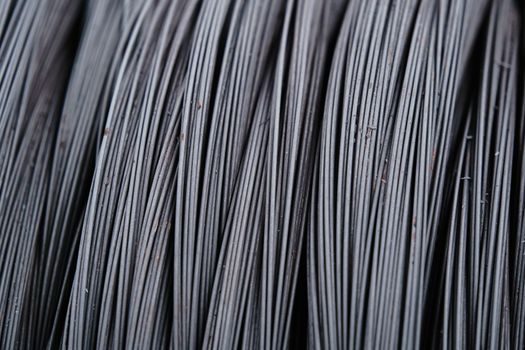
Major end-uses drawn from the same 304/316 rod base: spiral conveyor belts for cooling/freezing tunnels (typical 1.6-3.0 mm, balanced weave, pitch 6-10 mm), vibrating dewatering screens (3.0-6.0 mm, hooked-edge panels), fryer baskets and cheese-drain racks (4.0-8.0 mm welded frames, 316L), and filter / sifter cloth (0.2-0.5 mm, plain Dutch weave, ≥200 mesh) [S3].
Each application maps to a different draw-down and temper: annealed rod (ASTM A580 Condition A) for further drawing, 1/8 hard for spring-clip hooks, 1/4 hard for formed racks, full hard only for woven screen cloth where spring-back holds the aperture [S3]. Inventory floors for brewery and dairy projects in 2026 typically order 60% 316L / 40% 304 to match wash chemistry, with 904L (1.4539) reserved for high-chloride sauce lines above 1,000 ppm Cl⁻.
Selection Criteria: Matching Rod Grade to Service
Five criteria drive the call between 304, 316, 316L and higher alloys: chloride exposure (≤200 ppm → 304; 200-1,000 ppm → 316/316L; >1,000 ppm → 904L or duplex 2205); operating temperature (continuous service above 60 °C in chloride pushes pitting risk upward); cleaning regime (acidic CIP with nitric/phosphoric accelerates attack on 304); welding scope (any welded 304 in 3-6 mm wall thickness above 450 °C should be replaced with 316L); and contact surface (product-contact vs external structural) [S3].
On cost-per-kg for cold-headed and woven forms, 304 rod typically lands at US$2.80-3.40/kg, 316/316L at US$4.20-5.10/kg, and 904L at US$11-14/kg in Q2 2026 spot pricing for FOB-China 5-10 tonne lots [S3]. For an external comparison of how these food-grade stainless belts are wired in stainless or galvanised welded mesh, the Welded Steel Mesh sizing and selection guide lays out the wire/aperture/code path side by side.
Standards and Compliance Path
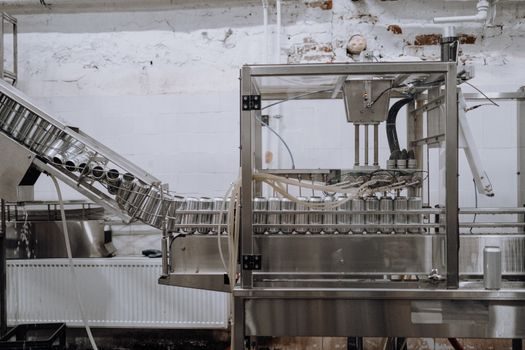
Compliance for F&B-contact wire rod is a stack, not a single rule: material is governed by ASTM A580 / A493 / A478 (stainless wire) plus EN 10088-3 for European delivery; hygienic design is governed by 3-A Sanitary Standards and EHEDG Doc. 8 (hygienic equipment design criteria); and welding, when used, defaults to ASME Section IX or EN ISO 15614-1 for procedure qualification [S3].
Mill test certificates to EN 10204 3.1 (issued by the mill's own quality department) are the standard procurement document, with 3.2 (independent third-party witness) demanded for dairy, brewing and infant-formula lines [S3]. For pressure-tight vessels and inline sensors downstream of the rod-formed conveyor — pumps, CIP skids, filler bowls — the same spec chain also drives pressure transmitter and flow meter selection, where 316L wetted parts and Ra ≤ 0.8 µm are again the F&B baseline.
Common Failure Modes and What Spec Audits Catch
Field failures cluster on five signatures: pitting corrosion on 304 rod in chloride-rich wash (visible as red-brown pin-pricks, typically inside 18 months); crevice corrosion under clip joints where residual CIP pools; stress-corrosion cracking on 304 baskets used in hot caustic (>60 °C, >10% NaOH); galling on 304-to-304 threaded fasteners (mitigated by specifying 316 bolts); and weld sensitization on 304 frames welded without 316L filler [S3].
Audit trail to head these off: demand a 3.1 cert naming heat number, ASTM A240 / A276 chemistry, ferrite content, and pickling/passivation record; require roughness Ra reading on the first article; and for welded assemblies, retain WPQ/WQR per ASME IX [S3]. The economic penalty for a single failed batch — product recall plus line downtime — typically exceeds the full premium of having specified 316L in the first place.
Trackable 2026 signals: EU F&B OEMs continue to shift from 304 to 316L on welded conveyor frames, and Chinese mills report growing 904L enquiries from Asian sauce and soy producers running >1,000 ppm Cl⁻ CIP — both visible in the second-half 2026 mill enquiry mix.