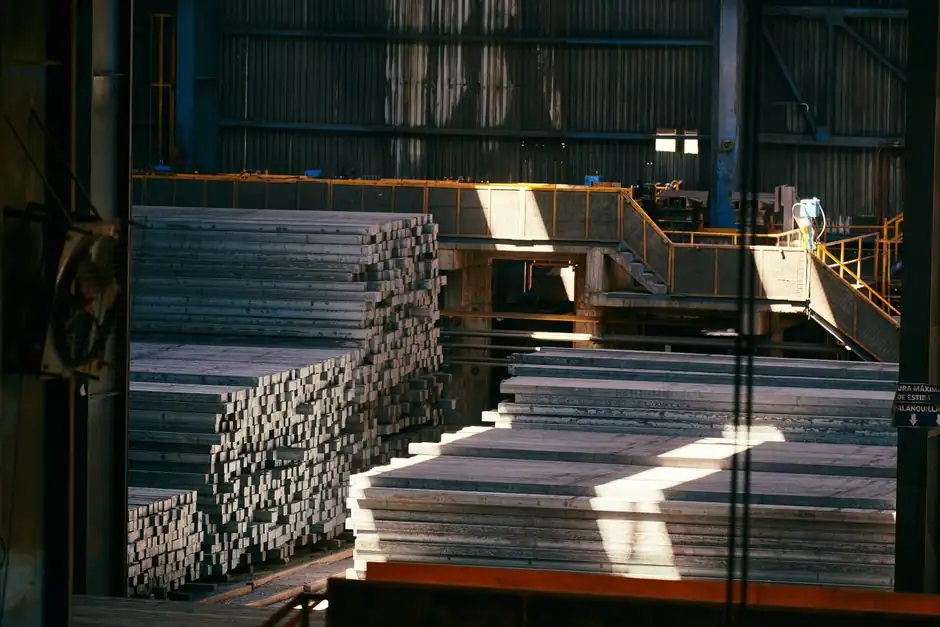
A billet continuous casting line should be selected by working backwards from product mix, section size, and steel grade, not by chasing nominal strand capacity; for steel billet projects, the cast product spec (material grade, square or round section, dimensional range, surface quality, and downstream rolling destination) is the first filter applied to any caster proposal [S1].
Billet casters in commercial service cover sections from 100 mm up to 200 mm, in both square and round formats, with curved-machine radii from 6 m to 12 m [S4]. Productivity per strand ranges roughly 30 tph on entry-level curved designs to 75 tph on high-speed configurations, and multi-strand layouts can push annual output toward 2.4 Mt/yr at 12 strands [S4].
Mould and vibration drive surface quality and shell strength
The mould is the single component in direct contact with the molten steel, and it is the binding constraint on surface quality, shell soundness, and caster uptime: material in contact with the melt needs high thermal conductivity, the body needs structural rigidity against ferrostatic impact, and the tube should be light enough to keep mould-oscillation inertia loads within the vibration drive's force budget [S3]. Small square billet machines typically use tubular copper moulds, while large square billet casters can run either a copper tube or an assembled plate design, depending on section size and steel grade [S3]. Common vibration modes specified for billet machines include synchronous, negative-slip, and sinusoidal oscillation, and the vibration table must deliver the selected waveform consistently across the casting speed range [S3]. For a project that also evaluates a moulding line or a casting mould package, the same thermal-conductivity and rigidity logic applies, which is why the mould spec is usually the longest technical schedule in the enquiry.
Secondary cooling and water quality set the operating window
Cooling is split into three zones along the strand: primary cooling inside the mould forms the initial shell, secondary cooling below the mould completes solidification through controlled water spray, and tertiary or air-cooling sections bring the billet down to cutting temperature [S5]. Secondary cooling on billet casters has two jobs at once: deliver forced water to fully solidify the strand across grades and section sizes, and physically support and guide the billet (and the dummy bar during start-up) along its set trajectory through the spray frame [S3]. Because spray intensity is grade- and section-dependent, suppliers should be asked to publish nozzle flow maps, pressure windows, and water-quality limits, then the plant's utility envelope (cooling tower capacity, inlet temperature, filtration class) is matched to that boundary before contract signature [S1]. A casting ladle interface review is the natural place to confirm tundish preheat, ladle-to-tundish shroud practice, and the temperature-loss budget that defines the casting-speed window on the caster itself.
Strand layout and caster tier determine throughput and footprint

Vertical, curved, and vertical-bending layouts have different space, maintenance, and metallurgical envelopes, so the choice is driven by section size, site elevation, crane coverage, and access philosophy rather than by tonnage alone [S1]. On curved billet casters, Danieli's range maps directly to three operating tiers: the Lean Cast® runs 6 m or 7 m radius machines aimed at 100,000–300,000 t/yr of commercial grades at up to 30 tph per strand; the Fast Cast® uses 9 m or 10 m radius with up to 12 strands, with the Power Mould® and Fast Cast Cube® packages reaching 75 tph per strand on commercial steel and 2.4 Mt/yr at full configuration; and the Quality Cast platform (9–12 m radius) adds submerged stream casting and the full technology package set for stainless and special carbon grades [S4]. For comparison, a lost foam casting line or a resin sand line sits in a completely different batch-production universe, so a buyer mixing those processes with continuous casting typically runs them as parallel facilities rather than as substitutes.
Withdrawal, straightening, and dummy bar define start-up and grade change
The withdrawal-straightening unit has to overcome mould and roller friction while keeping the partially solidified shell inside its strain limit, and it must also allow pulling-speed adjustment across the full casting-speed range to handle different steel grades, section sizes, and start-up conditions [S3]. On smaller billet casters, the withdrawal and straightening rolls are often integrated into a single frame; on larger machines they are split, with straightening taking place below the curved mould and the final withdrawal pinch rolls placed further down the strand [S3]. The dummy bar and its storage system are part of the same scope, because strand start-up, grade transition, and emergency shut-down all depend on a dummy bar that can be inserted, withdrawn, and parked without disturbing the spray frame or the ladle area above the mould [S3]. Buyers comparing continuous casting with batch casting on a cold-box core machine or a V-process line need to remember that billet casting's start-up and shut-down sequence is strand-level, not mould-level, so dummy-bar availability is a real throughput constraint, not a procedural detail.
Automation scope should match plant capability
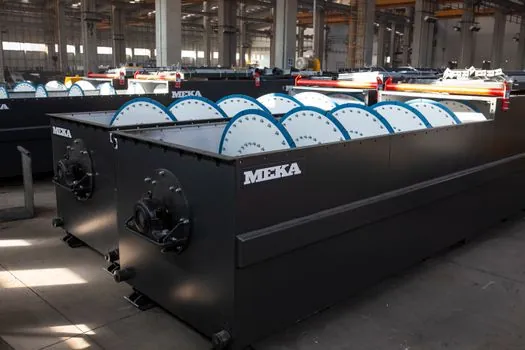
Process displays, trend logs, interlocks, and fault diagnostics generally deliver more uptime than advanced model-based control features that the local electrical and maintenance team cannot support, so the automation specification should be aligned to training capacity and to the plant's existing PLC/DCS standard [S1]. On the mould level, suppliers such as Primetals position mould-level control as the primary lever on steel quality and caster stability, and pair it with the caster-level automation to manage secondary cooling, withdrawal speed, and cut-to-length logic [S2]. For a small or mid-size minimill running a die casting die shop alongside a billet caster, the practical move is to lock the caster's control platform to the same vendor family used for the mill drives, so spare parts, training, and the on-call engineering pool are shared across both process areas.
Metal delivery and upstream stability bound the whole line
A continuous caster cannot compensate for an unstable upstream process: ladle-to-tundish temperature loss, refractory erosion, slide-gate practice, and steel cleanliness all set the casting-speed window and the defect rate downstream [S1]. The handover between melting, casting, and maintenance should be mapped step by step, including emergency access, consumable movement, and the ladle change-over sequence, because most caster trip events originate at those interfaces rather than inside the strand itself [S1]. Small-section high-speed billet casting has been demonstrated on Chinese minimills for HRB400E rebar steel, where the bottleneck shifted to start-up sequencing, dummy-bar cycle time, and secondary-cooling uniformity rather than to the caster's nominal rating [S6]. For a project that runs an automatic moulding line in parallel with a billet caster, the right design discipline is to keep the two process flows physically and operationally separate, with their own ladle and tundish schedules, so a stoppage in one does not starve the other of metal or crew.
Trackable signals for the next planning cycle: (1) the caster supplier's published tonnage-per-strand versus your realistic shift pattern, with start-up, grade change, and planned-maintenance hours stripped out; (2) the utility boundary, especially cooling-water quality, inlet temperature, and flow stability, written into the contract rather than left as a "site responsibility" line. For a related read on how a different casting process is specced in 2026, see gravity die casting line cost: what an entry-level setup actually runs in 2026.