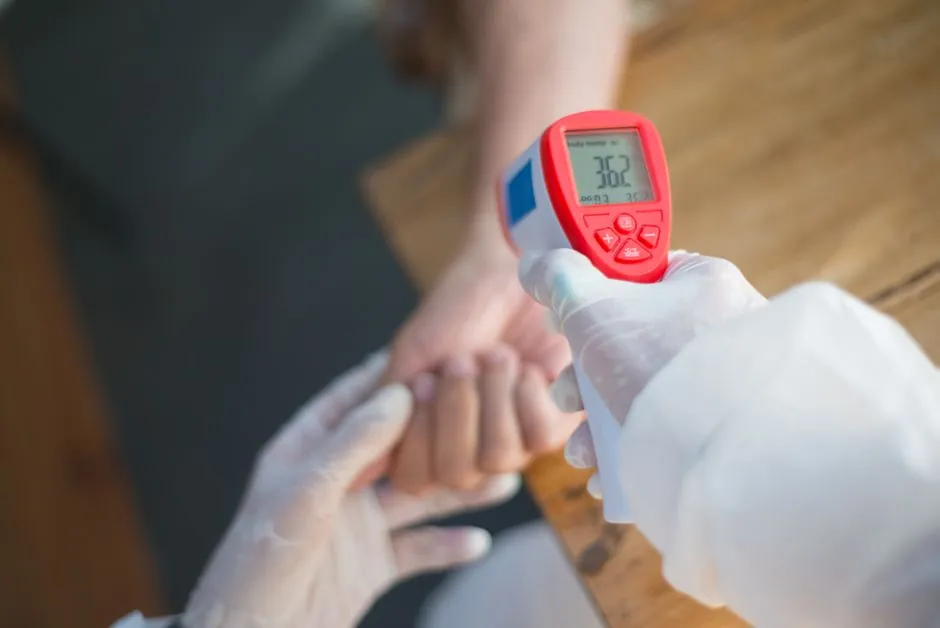
Utility 3-inch bimetal dial thermometers list from US$26.67 on surplus channels (118 units sold, 635 in stock, 0-250°F, 1/2 NPT, SS case) [S4], while adjustable sanitary 3-inch models with 1½" Tri-Grip tri-clamp and all 316/316L wetted parts list at ¥126,665 (US$860 approx.) on the same vendor's Japanese catalog (2026-07) [S2].
A 3-inch versus 5-inch dial step adds roughly 8% on adjustable sanitary lines, and a stem length extension from 2½" to 6" adds another 2% on identical configurations [S2]. Industrial buyers in pharma, food, and chemical skid builds should treat dial size, stem length, and sanitary certification as the three largest line-item cost drivers before negotiating volume tiers.
What a bimetal thermometer is and where it fits
WIKA's product taxonomy lists dial thermometers as one of three primary industrial temperature measurement families, alongside gas-actuated and expansion designs, with selection driven by response time, temperature limits, and application range [S1]. A bimetal thermometer uses two metals with different expansion coefficients bonded into a coil; stem deflection drives the pointer, which is why the format dominates low-pressure, local-readout service rather than control loops.
The format is "specially designed for direct insertion into process applications when a standard thermowell is not specified or the process environment is not exposed to pressure" per the OMEGA sanitary datasheet, and is described as "ideal for process industries" [S2]. Buyers building a bimetal thermometer spec sheet should plan around three reference points: dial size (3" vs 5"), stem length (2½" through 15"), and wetted metallurgy (carbon steel vs 316/316L).
Price tiers and what each tier actually buys
Three concrete data points anchor the 2026 market. Entry-tier utility units: US$26.67 for a 3" face, 2½" stem, 0-250°F, SS case with calibration dial, 1/2 NPT, 635 units in stock, 118 sold [S4]. Mid-tier sanitary adjustable 3": ¥126,665 (US$860 approx.) for LL--40-160F-21/2 with 2½" stem, 3" dial, 1½" Tri-Grip, all 316/316L wetted, hermetically sealed, 32 Ra max wetted surfaces [S2]. Mid-tier sanitary adjustable 5": ¥136,406 (US$925 approx.) for JJ--40-160F-21/2 with 5" dial, otherwise identical wetted and finish spec [S2].
Within the OMEGA sanitary 3" line, the same -40 to 160°F configuration holds flat at ¥126,665 across 2½", 4" stems, then steps to ¥129,283 at 6" stem (US$877 approx.) [S2]. The 5" dial step is roughly a 7-8% premium across the matched stem lengths. Lead time on the sanitary line is consistently 6 weeks for build-to-order variants and 2 weeks for stocked dual-range SKUs such as JJ-0-250F--20-120C-21/2 [S2].
Configuration cost drivers that move the quote

Stem length premium: 2½" → 6" adds ¥2,618 on LL-0-200F (¥126,665 → ¥129,283), roughly 2% on sanitary 3" builds [S2]. Dial size premium: 3" → 5" on otherwise identical sanitary configuration adds ¥9,741 on the 2½" stem (¥126,665 → ¥136,406), about 7.7% [S2]. Range/division selection has near-zero list-price impact inside the same dial and stem class; -40 to 160°F and 50 to 500°F both list at ¥126,665 on LL-2½" [S2].
Option codes from the same OMEGA family carry explicit surcharges: silicone fill ("-SF") adds $50, polycarbonate window ("-PY") adds $7, and Ra20 max wetted finish ("-R20") is optioned on the build sheet for sanitary service [S2]. A similar three-tier option-cost logic is seen on 316L instrumentation in adjacent specs, where a thermocouple sensor price guide breaks out sheath material, calibration class, and termination as the dominant deltas, and these same line items apply to the bimetal option sheet.
Comparison: utility 3" vs sanitary 3" vs sanitary 5"
Three reference points line up the decision: Utility 3" (US$26.67, 1/2 NPT, no sanitary rating, SS case only, no Ra guarantee on wetted) [S4]. Sanitary 3" adjustable LL (¥126,665 / US$860, 1½" Tri-Grip, all 316/316L wetted, 32 Ra max, hermetically sealed, 6-week lead) [S2]. Sanitary 5" adjustable JJ (¥136,406 / US$925, same wetted and finish, larger readable face for outdoor or remote-read) [S2].
On a normalized $/stem-inch and $/dial-inch basis, the sanitary 5" JJ is the most expensive per unit display area, but the cheapest per inch of total readability. For a tank-side readout in a washdown area, the JJ 5" with 6" stem at ¥138,930 is the spend choice; for an inside-panel local indicator, the LL 3" 2½" at ¥126,665 is the floor. The same 5" JJ in 2½" stem form undercuts the 6" version by ¥2,524, which is roughly the marginal cost of the extra 3.5" of 316L stem plus the recalibration pass [S2].
Total installed cost: what the PO line doesn't show
Purchase price is roughly half the fielded cost on a bimetal thermometer build. Add a stainless thermowell (US$80-200 for a flanged 316L unit, not in the research but a standard sourcing range buyers should price), a calibration certificate traceable to NIST or an equivalent national body, and a tag or SS nameplate for GMP-traced plants, and the installed multiplier runs 1.8-2.5x. Sanitary 3" sanitary tri-clamp units at ¥126,665 carry a 6-week lead [S2]; utility 3" units ship in days from channel stock [S4]. Lead-time delta alone can outweigh a 20% list-price gap on a tight shutdown.
Recurring cost is low. A bimetal has no electronics, no loop power, no I.S. barrier, and no scheduled consumables; the only meaningful maintenance is a 12-month visual-plus-calibration check, which on a 3" dial runs well under the cost of a single RTD recalibration in adjacent specs (e.g. the Pt100 RTD price 2026 reference for comparison, where IEC 60751 Class A recalibration and lead-wire compensation dominate TCO). For a facility standardising on local-readout dials, expect energy and ownership cost to be effectively zero across a 10-year service life.
Who a bimetal is for, and who should pick something else
A bimetal thermometer is the right pick when the application is local readout, no control signal needed, no hazardous-area classification, and the process is at or near atmospheric pressure, matching the OMEGA sanitary datasheet's "process environment is not exposed to pressure" framing [S2]. It is also the right pick when the operator needs a glanceable face (5" JJ) or a fast stock SKU (utility 3") and the budget rules out a digital head-mount transmitter.
A bimetal is the wrong pick when the buyer needs a 4-20 mA or HART output for the DCS, when the area is ATEX/IECEx classified (bimetals with switch contacts exist but are a different cost class), or when accuracy better than roughly ±1% of full scale is required, since a pressure transmitter or RTD loop will outperform it. Buyers cross-shopping bimetals against infrared units for non-contact surface measurement should note that infrared thermometer cost is driven by optics and emissivity, not by the dial/stem logic covered here.
Standards, materials, and sourcing signals

Sanitary wetted specs in this class default to 316/316L stainless with 32 Ra max on all wetted surfaces, hermetically sealed case, and a glass lens standard, per the OMEGA sanitary datasheet [S2]. Tri-clamp compatibility is 1½" Tri-Grip, with stem diameter 6 mm (¼") standard and stem lengths from 2½" to 15" [S2]. Connection and wetted Ra figures are the two specs a QA auditor will check first, and they are exactly the two the option code list targets ("-R20" for Ra20 max wetted finish) [S2].
For cross-reference on form-factor and readability logic (3" vs 5" dial, hermetically sealed case, switch-contact variants), the lighting equipment and electric lamps and linear guide encyclopaedia pages cover adjacent form-factor and tolerance discipline, useful when building a multi-instrument vendor audit. Two trackable signals to watch: any 2026-Q3 lead-time change on the 6-week sanitary SKUs at OMEGA Japan, and any new utility-channel SKU below the US$26.67 entry point [S4] [S2].