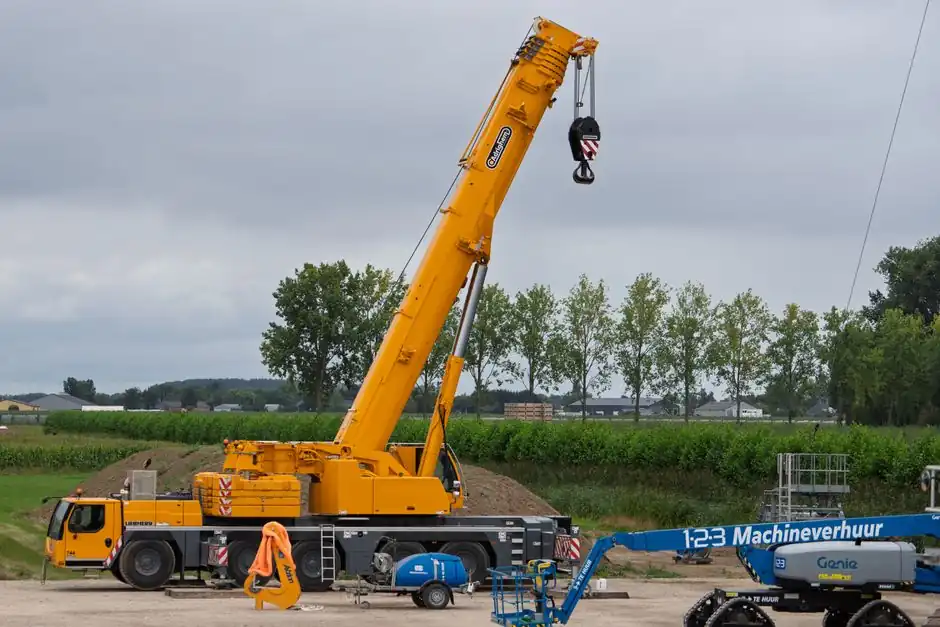
A new mobile crane in 2026 typically costs between USD 150,000 and USD 1,200,000 depending on capacity class, with compact 4-5 t self-erecting units such as the Terex CSE 32 at the low end and 100+ t all-terrain or crawler machines dominating the upper band [S1][S2].
The reference data set runs from a Terex CSE 32 self-erecting mobile crane with 4,400 kg (9,700.3 lb) max load and 32 m horizontal reach to a LIFT SYSTEMS MOBILIFT series with load range 33-110 t [S1][S2]. For context on the wider market, mobile crane revenue is forecast to grow at a 5.8% CAGR through 2026, anchored by construction and shipbuilding demand [S4]. A working mobile crane reference on type taxonomy is worth bookmarking before sizing a unit.
Cost Drivers: What Actually Moves the Sticker Price
The dominant price lever is lifting capacity: doubling capacity more than doubles the steel content, the outrigger load path, and the counterweight mass, which is why a 4.4 t unit lists in a different order of magnitude than a 100 t unit [S1][S2]. Boom kinematics and reach are the second lever, with a 32 m horizontal reach on the CSE 32 paired to a 1,050-1,150 kg tip load, while compact industrial pick-and-carry units trade reach for footprint [S1].
Certification scope (CE machinery directive 2006/42/EC conformity, ASME B30.5 for mobile and locomotive cranes) and country-specific load chart validation add audit cost rather than hardware cost but typically add 3-7% to a delivered price. The chart on the CSE 32 specifies an 11 kW (15 hp) crane engine and 56,000 mm/min hoisting speed at max load, indicating that smaller-capacity units run lighter auxiliary drives [S1].
Class Tiers Compared: Self-Erecting, Pick-and-Carry, All-Terrain, Crawler
Compact self-erecting mobile cranes in the 3-5 t class sit at the entry tier (typical 2026 list USD 150,000-300,000), sized for low-rise residential and small commercial sites where a full tower crane is uneconomic. The Terex CSE 32 exemplifies this class: 4.4 t max load, 27.5 m working height, 32 m jib, 2.25 m swing radius, 0.9 rpm swing speed, and Terex Power Plus (TPP) electronic control for precision lifting [S1].
Pick-and-carry industrial mobile cranes occupy the 33-110 t band, with the LIFT SYSTEMS MOBILIFT series covering 33 t minimum and 110 t maximum, designed for in-plant machine installation with under-load 90° steering capability [S2]. All-terrain mobile cranes (typically 30-1,200 t, roadable on highway axles) and crawler cranes (typically 40-3,000 t on lattice or telescopic booms) are the upper two tiers, and most 2026 list prices in the USD 600,000-1,200,000+ band are concentrated here, especially for units above 80 t capacity. For lifting accessory budgeting, a paired crane scale load-monitoring device is a common line item.
Who Mobile Cranes Are For, and Who Should Spec Something Else
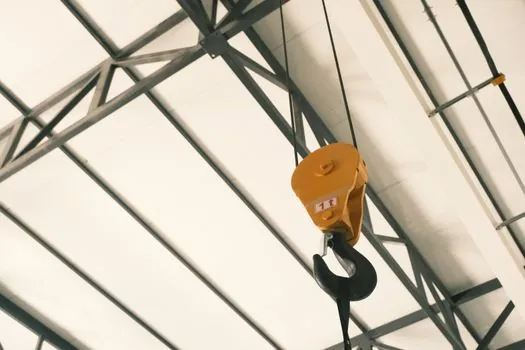
Mobile cranes are the right call when lifts repeat on multiple sites (transport amortises), when ground prep cannot accept a tower crane foundation, or when under-hook height and reach fall between 20 m and 90 m with a single setup. They are the wrong tool for permanent high-cycle duty above 200 m hook height, where a tower crane is cheaper per lift-hour, and for indoor cleanroom or low-noise sites where diesel emissions or combustion noise disqualify combustion units. Compact units in the CSE 32 class target small-to-medium construction sites where the alternative is renting a truck-mounted crane at a higher day rate [S1].
Pick-and-carry industrial cranes in the MOBILIFT class are specified for in-plant machinery installation, foundry work, and warehouse rigging, with 90° steering under load enabling tight-aisle operation [S2]. They are not suitable for long-distance travel between sites; road-mobile all-terrain units are required for that. Specifiers should also pre-validate outrigger pad ground-bearing pressure against site geotech, since soft ground routinely drives the choice toward a smaller unit with timber mats or a different machine class entirely.
Use Cases and Total Cost of Ownership
Sticker price is roughly 55-70% of a 5-year TCO on a working mobile crane; the rest is transport, rigging labour, fuel, periodic inspection, and certification renewal. [S1]
For a compact CSE 32-class unit, fuel burn is low (11 kW crane engine, no main carrier engine) and transport fits on a standard low-loader, so the same 5-year TCO lands closer to USD 1,200,000-1,600,000 against a USD 200,000 purchase [S1]. A good cross-reference is the lighting equipment and electric lamps guide, because the night-shift auxiliary lighting package on a crane site is a small but recurring TCO line item that is easy to overlook in the spec sheet. Insurance and theft-protection for the lifting accessory set (slings, shackles, crane scale) is another small but cumulative TCO component.
Failure Modes and Sourcing Constraints
The most common spec-side failure on a mobile crane purchase is under-rating the tip-load chart: the 1,050-1,150 kg capacity at 32 m reach on the CSE 32 is the binding constraint, not the 4,400 kg headline figure, and a misreading turns into a refused lift on day one [S1]. The second is selecting an all-terrain unit when the route survey reveals weak bridges or low clearance; the crane never arrives, and the rental is cancelled at full cost.
Supply-side, lead times for 80 t+ all-terrain units stretched into 9-14 months during 2024-2025 and have only partially normalised in 2026, so used or refurbished units from verified dealers are a meaningful share of 2026 deliveries in this class. Sourcing should also lock the OEM's load chart revision policy, since electronic control firmware (such as the TPP / Power Match functions on the CSE 32) is updated over the unit's life and changes the rated chart [S1]. The global mobile crane market is reported at USD 14.35 billion in 2018 with a forecast USD 22.34 billion by 2026, a 5.8% CAGR that reflects steady unit demand rather than shortage-driven price spikes [S4].
Standards, Selection Criteria, and What to Verify on the Quote
Three standards govern the safety envelope and therefore the cost of compliance: EN 13000 for hydraulic mobile cranes (Europe), ASME B30.5 for mobile and locomotive cranes (North America), and ISO 12480-1 for safe use of cranes. Specifiers in 2026 should confirm the OEM's CE Machinery Directive 2006/42/EC declaration of conformity for EU-delivered units, the load-test certificate, and the calibration of any fitted linear guide or slewing-ring drive, since slewing-ring fatigue is a primary life-limit item on telescopic and crawler units. [S4]
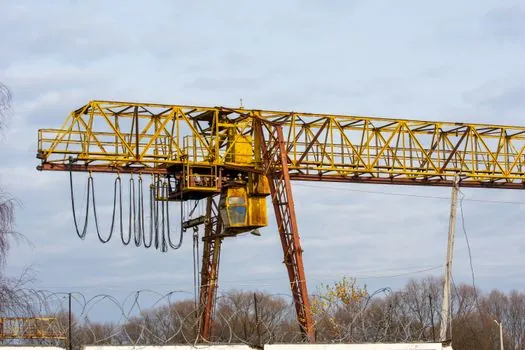
On the quote itself, separate the line items for the base crane, the optional jib extension, the load moment indicator (LMI) with the latest firmware, the rigging accessory pack, transport, commissioning, and operator training; a single lump sum hides the negotiation room. For buyers comparing a mobile crane against a fixed gantry or AGV robot workflow, the deciding factor is almost always annual lift count and hook-height variability, not sticker price. Practical reading list for a 2026 specifier: the Power Quality Analyzer Buying Guide 2026 and the Pressure Switch Price 2026 guide both use the same cost-driver framework that applies to a mobile crane RFQ.
Track these two signals in late 2026 to refine any 2027 mobile crane budget: OEM delivery lead times for the 80-150 t all-terrain class (normalising to 6-9 months signals the upper price tier softening), and the EU Stage V / EPA Tier 4 Final aftermarket retrofit pricing, which directly moves the total TCO of an existing fleet. Specifiers should also re-check the load chart revision schedule from the chosen OEM at the moment of contract signing, since chart updates on Terex Power Plus and comparable electronic control systems have been the single most common cause of mid-life rated-capacity changes across the self-erecting class in the last 24 months [S1].