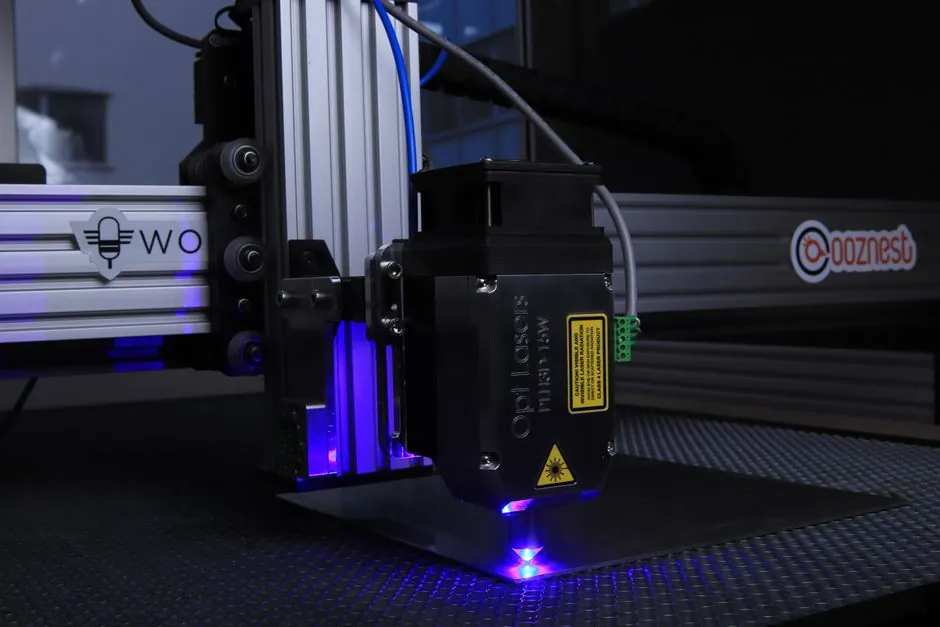
A laser profile scanner is a 2D line-scan triangulation sensor that builds a height profile across a projected laser line, and on industrial catalogs it is grouped with 3D laser scanners in the 224-product laser scanner category on DirectIndustry, of which 39 are profile-class units and 23 are scanning systems [S1].
The 2026 buying decision is driven by four quantifiable parameters: Z-axis (height) measuring range, X-axis (line) field of view, profile point rate, and the laser source class/wavelength, all of which must be matched to stand-off distance, target reflectance, and the plant-side interface (Ethernet, RS422, fieldbus) before a brand shortlist makes sense [S1][S5].
Z-Range, X-Standoff, and Resolution: the Optical Triangle
The first thing a spec sheet on a 2D profile sensor must show is the Z (height) measuring range, the X (line) measuring range, and the stand-off, because the triangulation geometry ties all three together and a wider Z range always costs resolution at the far end of the stand-off [S1].
Concrete ranges on the DirectIndustry 2026 catalog illustrate the tiering: the Micro-Epsilon scanCONTROL 29x0 family spans 8-100 mm measuring distance with a 53-290 mm length form factor, the scanCONTROL 30x0 high-end profile sensors cover 15-480 mm measuring distance in a 78-1,050 mm housing, and the scanCONTROL 8x00 (green-laser, 4K-class) family sits at 16-95 mm measuring distance with 24-115 micrometre Z-resolution [S1]. For CMM-class 3D scanning rather than 2D profiling, the Creaform MetraSCAN 3D jumps to 200-6,000 mm measuring distance in a 289 x 235 mm hand-held or robot-mounted body, while the SIMSCAN-E pocket scanner holds 300 mm stand-off in a 203 x 80 mm housing [S1]. The pattern is consistent: short Z-range gives sub-100 micrometre line resolution, long stand-off gives metre-class reach but a larger triangulation footprint and lower per-profile point density.
Profile Rate, Point Density, and Inline Suitability
Profile point rate is the throughput number that decides whether a sensor survives a moving web, a robot weld cycle, or a rotary index table, and the scanCONTROL 30x0 is rated at up to 7.37 million points per second of calibrated 2D profile data, which is the current high-water mark for triangulation-based profile sensors in this catalog [S1].
Three rate tiers dominate the 2026 market: entry units in the 1-2 kHz profile rate range, mid-range industrial units in the 4-10 kHz range, and high-end units in the 20-50 kHz range, and buyers should match the rate to the line speed in mm/s divided by the required X-direction point spacing in mm. The KEYENCE LJ-X series of 2D/3D laser profilers, which are laser displacement sensors that collect height data across a laser line rather than a single point, also capture intensity data alongside the height profile, and that intensity channel is the difference between a stable reading on dark rubber, shiny steel, or transparent film and a sensor that drops out at the edge of every part [S8]. For gap and edge work specifically, the Micro-Epsilon gapCONTROL 2711 measures gap types up to 300 mm deep by 50 mm wide at 4 kHz profile rate with Ethernet or RS422 standard outputs, and the Setup Software pre-selects gap modes such as edgeless, projected, general, and V-gap so the sensor is configured for the seam-tracking job before the first weld bead drops [S5].
Laser Source: Wavelength, Class, and Target Material
Laser source choice is the second axis of differentiation and is dictated by target reflectance and the ambient lighting around the line: red 660 nm lasers are the low-cost default, blue 405-450 nm lasers win on hot metal, glowing steel, and dark plastics because the shorter wavelength is absorbed rather than scattered by the surface, and green 520 nm lasers are used on transparent, organic, or red-hot targets where red and blue both underperform [S1][S8].
Eye-safety class is a hard gating spec: a Class 2 red-laser unit is fine for an enclosed fixture with interlocks, while an open-top robot cell or a hand-held weld-inspection scanner needs Class 3R or higher and operator PPE. The Micro-Epsilon scanCONTROL 29x0 uses a blue laser line specifically to project onto difficult surfaces with roughly twice the resolution of the previous red-laser generation over a 25 mm measuring range [S1]. Buyers specifying into semiconductor, pharmaceutical, or food lines should also check IP rating (IP67 is the common industrial minimum) and housing material (anodized aluminum versus stainless), since the optical bench is the same but the washdown rating is not.
Interface, Integration, and Fieldbus Fit
Interface and protocol decide whether the sensor drops onto an existing PLC, robot controller, or vision PC without a gateway box, and the 2026 mainstream for 2D profile sensors is Gigabit Ethernet (GigE Vision, GenICam), with RS422 and analog 4-20 mA as fallback for older lines, and PROFINET, EtherNet/IP, or EtherCAT added through a small external gateway or via a sensor with an integrated fieldbus option [S1][S5][S8].
The gapCONTROL 2711 ships with Ethernet and RS422 standard, and the modular output unit extends connectivity to other fieldbus types without re-engineering the sensor head, which is the right pattern for retrofit lines [S5]. For robot-mounted 3D scanning, the Creaform MetraSCAN 3D-R is engineered for seamless integration into automated quality-control cells for at-line inspection in mass production, and it tolerates shop-floor vibration that would shake a coordinate measuring machine off tolerance [S1]. For users comparing 2D profile sensors to other 2D measurement tools, the laser displacement sensor reference page lays out the single-point counterpart, and the laser profiler page covers the inline-gauging tier. Engineers building a wider gauging stack should also see our thickness gauge selection guide on substrate, technology, and accuracy, which covers cross-thickness sensing that often sits one station upstream of a profile-scanner checkpoint.
Who a 2D Profile Scanner Is For, and Who Should Pick Another Tool
A 2D profile scanner is the right tool for inline gap and flushness measurement, weld-seam tracking, tire tread and rubber extrusion profile, adhesive bead inspection, and web-edge or width control on a moving line, because the laser line gives a full cross-section in a single exposure with no raster scanning overhead [S5][S8].
It is the wrong tool when the part needs full 3D point-cloud coverage of a free-form surface, when the part is larger than the sensor's X field of view, or when the inspection requires sub-micrometre tolerance in a lab, not a line. In those cases, step up to a laser tracker for large-volume metrology or a robot-mounted optical CMM scanner such as the MetraSCAN 3D-R for shop-floor 3D inspection, and step down to a single-point laser displacement sensor when the measurement is a single Z height, not a profile. A 2D profile scanner is also a poor fit for very high-speed 100% surface inspection of a 2D web such as sheet metal or paper, where a laser level and camera-based 3D triangulation rig is the standard architecture.
Decision Matrix: 2D Profile, 3D Optical CMM, or Tracker
The shortlist logic in 2026 resolves into three bands: short Z-range (under 100 mm stand-off), high point rate, GigE output, blue-laser or green-laser option for 2D profile scanners; medium stand-off (200-1,000 mm), 3D scanning over a defined patch, robot or hand-held mounting for optical CMM scanners; and long range (over 3 m), large-volume metrology of fixtures, tooling, and turbine housings for laser trackers [S1][S2].
Price follows the same band: 2D profile sensors sit in the low-thousand to mid-thousand USD range, 3D optical CMM scanners in the tens of thousands, and laser trackers in the high-tens to low-hundreds of thousands. For most 2026 inline-gauging projects in metalforming, battery cell stacking, EV body-in-white weld inspection, and tire/wheel assembly, the 2D profile scanner is the right first call, the 3D optical CMM is the right lab or end-of-line tool, and the laser tracker is the right fixture-certification tool, and the specification discipline above is what separates a working purchase from a stranded one.
Trackable signals to watch through the rest of 2026: a wider rollout of integrated fieldbus (PROFINET/EtherCAT) on mid-range 2D profile sensors, blue-laser pricing closing the gap to red-laser units, and the adoption of higher-resolution 4K-class triangulation sensors such as the scanCONTROL 8x00 into EV battery and semiconductor applications [S1].