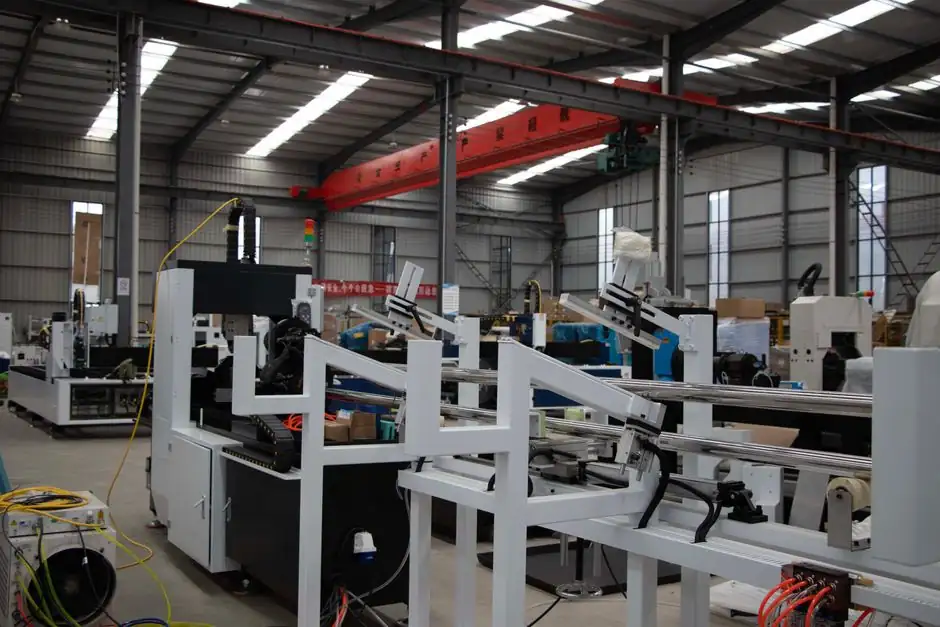
Turnkey bipolar plate production lines for PEM fuel cells integrate high-speed precision stamping, fiber-laser welding, hot-press lamination, and 100% in-line inspection, compressing the per-plate cycle to roughly 45 s on lines documented by Ronstein [S4].
Stainless steel and titanium foils as thin as 0.02 mm are being formed and welded at laser spot diameters of a few micrometres, with flow channel depths held to 0.3–0.8 mm to keep contact resistance and reactant distribution inside the window a membrane electrode assembly needs [S1][S5].
Process chain: from foil coil to sealed plate
A modern bipolar plate line runs stamping, laser welding, dispensing, and a leak test as one cell, with cycle time of 45 s per plate on the Ronstein reference build [S4]. Upstream, a high-rigidity precision press paired with dedicated tooling forms the flow-field geometry in a single draw, which the supplier describes as delivering micron-level channel depth consistency while keeping spring-back under control [S1].
Downstream of forming, Haosen integrates stamping, welding, coating, sealing, and in-line inspection into a single line and targets less than 30 min changeover between plate variants through an automated main/sub conveyor system and fixture return [S2]. Fraunhofer IPT frames the line as a continuous web process for high-volume builds, holding web tension to 3000 N at 5 m/min on its roll-to-roll test rig, and a discrete sheet process for lower-volume, higher-mix programmes [S5].
Stamping: tooling, channel geometry, and what is hard
Bipolar plate flow channels are stamped at depths of 0.3–0.8 mm with tight depth and flatness tolerances, and the forming tool itself is micro-machined to single-digit micrometre accuracy so that the active inserts survive the abrasive stainless and titanium work [S1][S5]. Tool wear is one of the dominant cost lines in series production, so the Fraunhofer group simulates and measures insert wear, and integrates heating channels and inline quality sensors directly into the tool body to extend life and catch drift before plates scrap [S5].
Discipline matters more than press tonnage here: the supplier specifies a high-rigidity press frame, dedicated progressive or transfer tooling, and online visual inspection at the press exit to weed out plates with channel-depth or burr excursions before they reach the laser cell [S1]. On the material side, thin stainless steel, titanium, aluminium, and nickel alloys are all candidates, with foil thickness down to 0.02 mm on the Fraunhofer line and laser spot diameters in the few-micrometre range [S5].
Laser welding: why fiber lasers now dominate
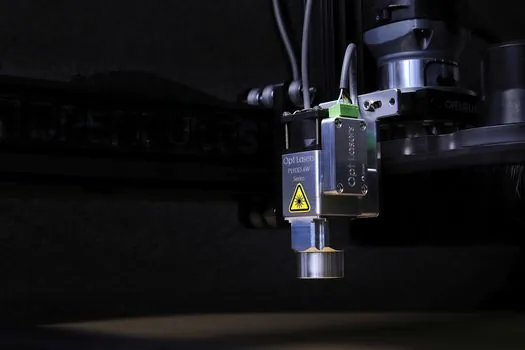
Fiber lasers, including Coherent's ARM FL family, weld PEMFC bipolar plates at production-relevant feed rates while keeping the heat-affected zone narrow enough not to distort the stamped flow field [S3]. The weld is the structural and sealing interface between two formed plates and the surrounding frame, so a clean, spatter-free seam at sub-millimetre precision is the gating spec for downstream leak testing [S7].
Lecheng's 2026 product note states that its laser-welding technology delivers sub-millimetre precision and industrial-scale automation for hydrogen bipolar plate manufacturing, positioning the process as a mass-production enabler rather than a lab technique [S7]. RAYLASE complements this with beam-steering modules for cutting, cleaning, and welding of fuel cell stacks, which lets OEMs share a single motion platform across multiple cells in a line [S6]. For the underlying laser optics, the relevant engineering trade-offs (spot size, pulse profile, seam tracking) sit in the same family as oxy-fuel cutter and welding cutting tool selections, where beam control, not raw source power, sets the usable weld quality.
Inspection, leak testing, and changeover
Haosen's full-dimension in-line measurement and leak test are claimed to deliver 100% defect screening on every plate, with the leak rate being the single metric that decides whether a plate ships or gets reworked [S2]. The line architecture pushes stamping, welding, dispensing, and leak test into a single indexed cell, and Ronstein's published 45 s cycle is a useful reference number for capex-driven cycle-time modelling [S4].
Changeover under 30 min is the second-order number that decides whether a line can economically run multiple plate SKUs, and Haosen ties that capability to its main/sub conveyor and fixture-return layout rather than to faster individual stations [S2]. The automation logic here overlaps with the wider electrical automation stack used across fuel-cell stack assembly, where servo drive sizing, I/O density, and safety zoning drive the real throughput. Lines that spec a 45 s plate cycle need servo buses and safety controllers on the same scan budget, the kind of trade-off covered in 230 VAC vs 400 VAC servo drive selection for the small-axis stations around the press.
Where this fits, and where it does not
This automation stack is built for metal bipolar plates in PEMFC passenger-vehicle and stationary stacks, where the cost target is cents per watt and plate volumes need to clear tens of thousands of plates per line per year. It is less applicable to graphite or composite-moulded plates, which are formed rather than stamped and joined, and to low-volume R&D builds where a discrete sheet process with hand-loaded fixtures is more flexible than a continuous web [S5].
Buyers should also be clear-eyed about constraints: titanium and thin stainless feed stock is expensive, micro-machined tooling has lead times measured in months, and the laser weld is the single process step that gates both dimensional yield and leak rate [S5][S7]. A reasonable 2026 buying checklist: per-plate cycle time at full mixed-model production, changeover time, tool life in shots between regrinds, in-line leak-test threshold in sccm, and the maximum plate active area the press and laser cell can accept.
Comparable approaches on the same line
Three execution styles now compete on the same shop floor. Discrete-sheet lines (Ronstein, Shuntian) use a press plus an indexed laser cell and target the 45 s plate cycle with quick-change tooling for moderate volumes [S1][S4]. Continuous roll-to-roll lines (Fraunhofer IPT development track) move foil over rollers at controlled web tension up to 3000 N at 5 m/min, and suit the highest-volume automotive programmes once a single plate design is locked [S5]. Integrated turnkey lines (Haosen) add hot-press lamination, coating, and sealing, and under 30 min changeover, which is the strongest fit for contract manufacturers running multiple OEM plate designs on one shop [S2]. On the welding side, the practical choice is between a single high-power fiber laser (Coherent ARM FL class) for maximum feed rate, and a galvo-steered multi-process head (RAYLASE class) when cutting, cleaning, and welding share one station [S3][S6].
Trackable signals for the next planning cycle: published cycle-time updates from Chinese turnkey line builders, Fraunhofer IPT's next roll-to-roll wear and web-tension data releases, and any OEM announcement of a sub-100 MW bipolar plate line going into series production. Material feed stock pricing for 0.05–0.1 mm 316L and titanium strip, and published tool life in shots between regrinds, are the two numbers worth watching in supplier datasheets over the rest of 2026.