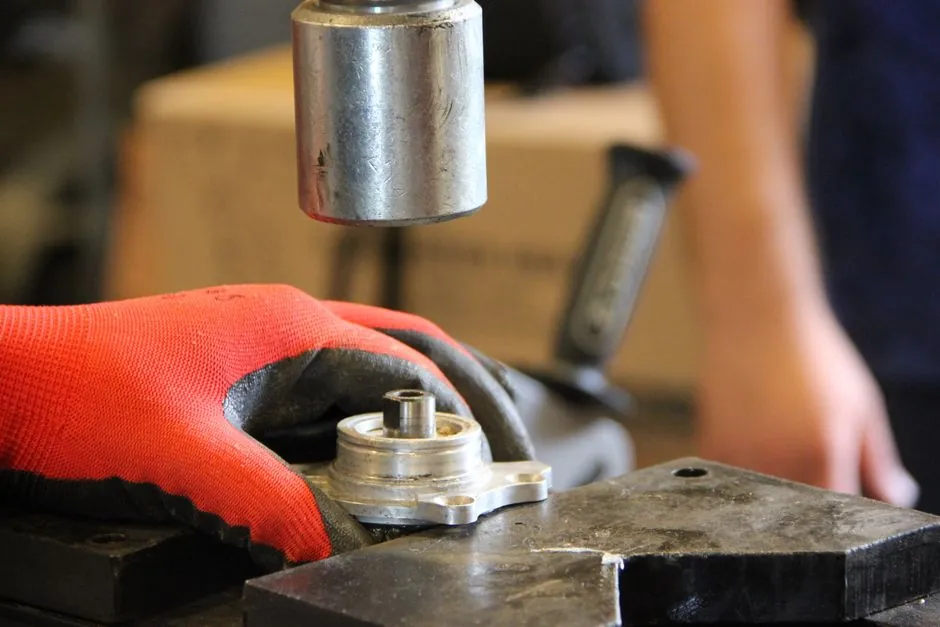
A bonded seal washer (Dowty style) is a stamped metal carrier with a vulcanised NBR ring moulded to its inner bore, and it seals both the thread path and the face under the fitting head in one component, with the metal acting as a hard stop that limits rubber compression to roughly 70–80% of free height [S7][S1].
Selection hinges on thread form and seat geometry: bonded seals only work on parallel threads (BSPP, metric parallel), while annealed copper crush washers deform on banjo seats, taper seats, and drain-plug bosses, and are rated for the highest-pressure service hydraulic fittings see in mobile and stationary work [S2][S4].
How a bonded seal actually seals
The rubber element sits 0.3–0.6 mm proud of the metal carrier when uncompressed, so it contacts the mating face first, then deforms radially into the gap between bolt shank and bore, then bottoms out against the metal stop as the fitting reaches torque [S1].
That controlled-crush sequence is the design's whole point: without the metal hard stop, a torque-controlled assembly would either under-squash the rubber and leak or over-squash it and split within a few thermal cycles, which is why generic bonded seal washers survive on hydraulic adapters where thread tape and anaerobic sealant are forbidden [S7][S1].
How a copper crush washer seals
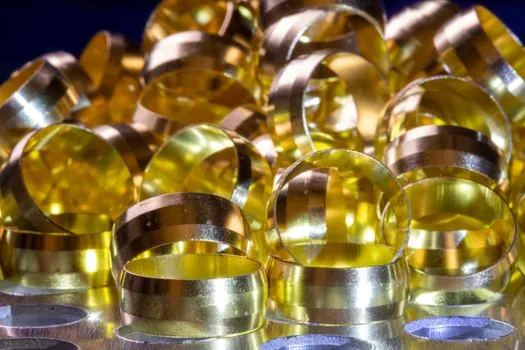
A copper crush washer is a soft, annealed copper ring that plastically deforms under bolt load and flows into the micro-valleys of the two steel faces, becoming a custom-moulded metal gasket at the moment of torque [S3][S4].
Because the deformation is permanent, the washer is single-use in normal practice: a re-used copper washer has work-hardened, lost the ability to flow into micro-gaps, and will weep under pressure cycling, so the field rule is "always fit a new copper washer during reassembly" [S4].
Thread form is the first decision gate
Bonded seals only work on parallel-thread ports (BSPP, metric parallel), never on tapered NPT or BSPT threads, because the seal is made on the face under the washer, not on the threads [S1][S5].
For a tapered thread, a copper crush washer on the face is the wrong seal anyway, since tapered threads seal by thread interference, so the relevant comparison is only on flat-faced parallel ports and on banjo-bolt seats, where both types can theoretically be used [S2][S5].
Pressure, temperature, and fluid compatibility
Bonded seals are common on hydraulic adapters, gauge ports, lubrication banjos and pump fittings where the rubber element is matched to the fluid: NBR for mineral oil and most hydraulic fluids, FKM/Viton for high-temp or aggressive media [S1].
Copper crush washers are the safe pick for hot oil, fuel, coolant, ATF, brake fluid, and hydraulic fluid, especially on banjo bolts feeding brake and clutch lines, where published reference data puts the operating envelope up to 10,000 PSI in mobile-equipment sealing applications [S3][S2].
Reusability, torque behaviour, and field failure modes
Bonded seals are not designed to be re-used: once the rubber is compressed and the metal carrier is bottomed, the controlled-crush geometry is gone, and a second install often under-seals because the rubber has taken a compression set [S2][S7].
Copper crush washers are technically re-usable after a dull-red anneal and water quench to restore softness, but field practice treats both as single-use, and a seep on a banjo bolt is almost always solved by fitting two new washers rather than retorquing the bolt, because banjo bolts carry little shank metal and cannot be cranked further [S2][S4].
Decision matrix: bonded seal vs copper crush washer
On a parallel BSPP or metric port with a flat machined spotface, on a mineral-oil hydraulic line, a bonded seal is the cleaner choice: one part, controlled compression, no thread prep, and a stable seal up to the working pressure of standard hydraulic adapters [S1][S7].
On a banjo-bolt seat, on a tapered-thread adapter, on a brake or fuel line, or wherever temperature exceeds the NBR limit, an annealed copper crush washer remains the default, since it tolerates rougher surface finish, higher temperature, and the more aggressive chemistry of fuel and brake fluid [S2][S4][S3].
Spec notes for procurement and drawing call-outs

For a BSPP port, call out the bonded seal by its BSPP size and the standard bore/outer-diameter pair: 1/4" BSPP / M14 is 13.7 mm bore x 20.0 mm OD, 3/8" BSPP / M18 is 17.3 x 23.7 mm, 1/2" BSPP / M22 is 21.6 x 28.5 mm, and 1" BSPP / M33 is 33.7 x 41.5 mm, with NBR as the default elastomer and FKM only where the fluid demands it [S1].
For copper crush washers, size to the bolt (M6, M8, M10, M12, M14 are the common metric sizes), confirm the seat surface finish on the drawing, and specify "annealed copper, single-use" on the BOM; buying un-annealed stock off Amazon is a known source of weep on first torque-up [S4][S2].
Limits and what bonded seals do not fix
Bonded seals do not compensate for a badly machined face: radial scratches from a sloppy port counterbore, or a tapped hole that is not square to the spotface, will leak past the rubber element no matter how clean the part looks, and the field fix is re-machining the face, not adding sealant under the washer [S5][S7].
Copper crush washers do not fix poor surface finish either, but a bonded washer on a smooth face tolerates more surface variation than a copper washer because the rubber can flow into micro-gaps the copper cannot reach at low torque, which is the reason mechanics reach for a bonded seal on a less-than-perfect spotface [S2][S3].
For a new hydraulic build, default to bonded seals on every parallel-thread port and use spring washers only where the drawing calls for a locking element under the fitting head, not as a sealing aid, since the spring's job is vibration resistance, not face sealing.
For mobile-equipment service and any brake, fuel, or high-temperature circuit, keep a stock of annealed copper crush washers in the common banjo sizes, and treat both washer types as single-use at every reassembly, since the cost of a new washer is trivial compared to the cost of a comeback from a weep on a hydraulic line. For plants already running a hydraulic actuator or hydraulic cylinder rebuild programme, the washer policy should be written into the work-instruction, not left to the mechanic's memory.
For related coverage, see Bump cap vs ANSI Z89.1 hard hat: protection level and selection map.