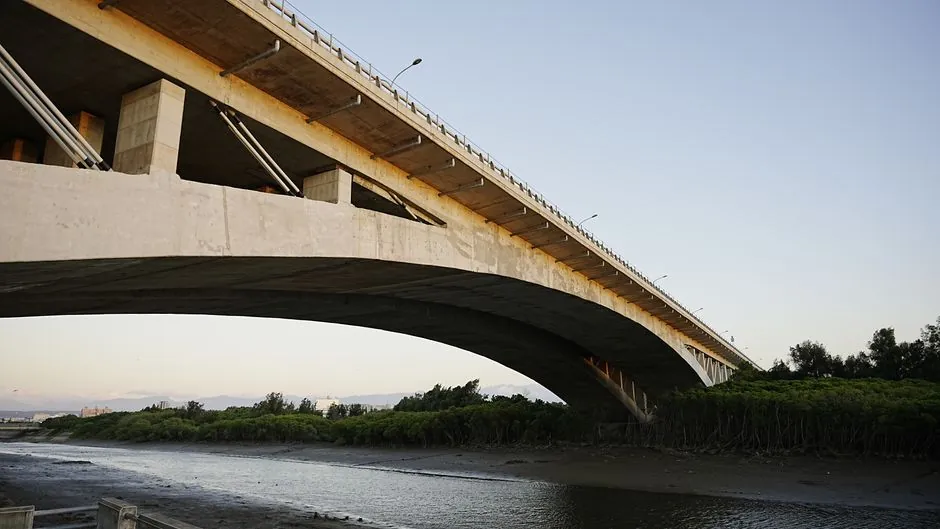
Immersion (internal) vibrators are the default consolidation tool for bridge piers, pile caps, pier caps, and deck soffits because they act from inside the form, displacing entrapped air that can run up to 20% of the unconsolidated volume in standard mixes [S1].
The two physical metrics that govern consolidation quality are amplitude (the maximum displacement of the poker head from its rest position) and frequency, expressed in vibrations per minute (VPM); high amplitude moves larger aggregate, while high frequency liquefies the sand-cement mortar and lets air bubbles migrate to the surface [S1]. For bridge elements, both must be set against the section geometry, the rebar congestion, and the slump of the delivered mix.
Head Diameter vs. Reinforcement Spacing: The First Decision
Selecting the needle (poker) diameter before anything else is the single most consequential call on a bridge pour, because the head must pass between rebar layers and still cover the full lift with overlapping radius of action. As a working rule that aligns with manufacturer and contractor guidance, the poker head diameter should not exceed roughly one-third of the spacing between reinforcing bars, and the immersion spacing on the lift should be held to about 1.5 times the radius of action [S1].
Commonly stocked heads for bridge work fall into bands of approximately 25-35 mm (for heavily reinforced columns and pile-cap starter bars), 45-60 mm (for typical pier shafts, abutments, and pier caps), and 75-90 mm (for mass pours in footings and large pile caps with open rebar grids) [S2]. A 35.8 cc or 38.7 cc 4-stroke gasoline backpack drive turning at 3500 RPM is the most common match for the 25-60 mm band, and it is what major retail catalogs continue to ship as the default bridge/road kit in 2026 [S4].
Power Source: Electric, Battery, Gasoline, or Pneumatic
The power unit sets the limits on duty cycle, jobsite logistics, and exhaust management. Electric motor-in-head (high-frequency) pokers deliver the highest VPM and the lowest operator fatigue on long pier pours but require clean 50/60 Hz supply and proper grounding; backpack gasoline drives remove the cable trip hazard and let crews work on remote pier shafts where grid power has not been run, at the cost of fumes and the need for fuel handling on elevated decks. [S4]
The 2026 retail market is dominated by 4-stroke backpack gasoline units in the 31-38.7 cc class at 1.0-1.4 HP (about 0.75-1.0 kW), with a 3500 RPM output speed and steel vibrator rods in the 9.84 ft (3 m) and 14.96 in (380 mm) head configurations marketed explicitly for building, road, and bridge work [S4]. For typical pier-and-deck operations these are the most flexible off-grid option; for very long continuous deck pours, high-frequency electric converters driving 12,000+ VPM heads remain the spec of choice on large infrastructure jobs [S1][S2].
Amplitude, Frequency, and the Re-Vibration Question
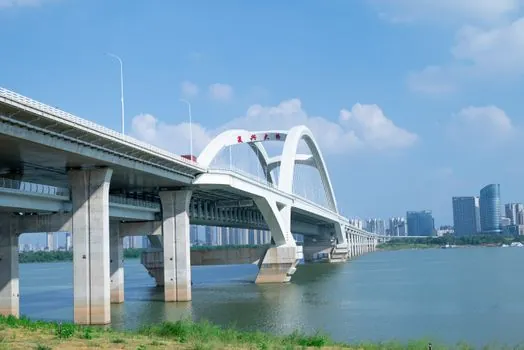
Freshly placed concrete contains entrapped air that can run up to roughly 20% of volume; vibration temporarily liquefies the mortar matrix and lets that air rise [S1]. The mechanism depends on both amplitude and frequency being correct for the aggregate size, and on the operator holding the poker vertically and withdrawing slowly (about 1 cm/s, or 5-15 seconds per insertion point depending on mix).
Peer-reviewed work on re-vibration, published in 2026, confirms that a second pass with a rod-shaped vibrator inserted at the same position as the initial compaction, applied for 5 seconds, can further densify concrete and improve mechanical properties compared with single-pass vibration, with the qualification that the second pass must be timed before the mix has set [S3]. For bridge piers where cover concrete and rebar congestion are critical durability concerns, this is a relevant technique but is operator-skill dependent, not a substitute for getting head size and frequency right on the first pass.
Formwork Pressure, Lift Height, and Operator Safety
Lift height should be limited to roughly 300-500 mm per immersion pass on heavily reinforced bridge elements, because deeper lifts risk the poker not penetrating to the bottom of the previous lift and trapping a weak horizontal plane. Formwork pressure on bridge piers climbs sharply with concrete head height and with the use of superplasticized, high-slump mixes, so when high-slump self-consolidating concrete (SCC) is used, external form vibrators or a reduced lift height is often specified instead of aggressive internal vibration. [S2]
For the operator, the three concrete-vibrator hazards that show up repeatedly in bridge work are hand-arm vibration syndrome (HAVS) from extended handheld use, trip hazards from flexible shafts on rebar mats, and falls when working from deck formwork. A practical control set, taken from current site guidance, is to limit continuous handheld vibration time, route the flexible shaft clear of foot traffic, and use backpack or motor-in-head designs where the deck is congested [S1].
Comparison: Power Source Options for Bridge Piers and Decks
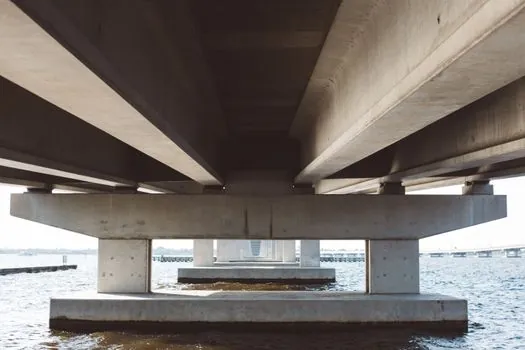
Choosing a drive type on a 2026 bridge project comes down to four criteria, lined up below against the three common power-source families. Gasoline backpack drives (31-38.7 cc, 1.0-1.4 HP, 3500 RPM, with 3 m / 9.84 ft rods) score well on portability and rebar access, and are stocked off-the-shelf for bridge/road use, but generate exhaust and have higher vibration exposure for the operator [S4]. High-frequency electric motor-in-head units (typically 200 Hz / 12,000 VPM class) score well on consolidation quality and operator fatigue, but require clean power and cable management that can be awkward on elevated decks [S1][S2]. Pneumatic (air-driven) pokers score well on continuous-duty use and explosion-risk environments such as cofferdam work near fuel or gas, but require a compressor hose that adds a trip hazard and a logistical burden on remote piers [S1].
For a typical land-based highway overpass with grid power available at the abutment, high-frequency electric still wins on quality. For a remote river-pier pour with no grid access and a small crew, the 35.8 cc or 38.7 cc 4-stroke 1.4 HP gasoline backpack unit at 3500 RPM, fitted with the 9.84 ft (3 m) flexible shaft, is the 2026 stock answer in retail channels [S4].
Standards, Sourcing, and What the Procurement Record Should Show
There is no single ISO or EN standard that universally governs concrete vibrator selection itself, but the equipment sits inside the broader concrete-production chain, so procurement should reference the project's concrete specification (typically tied to EN 206 or ACI 318) and record the vibrator's frequency, amplitude, head diameter, and radius of action for the inspector. A practical procurement record for a bridge pier pour in 2026 includes: head diameter in mm; rated VPM or RPM; amplitude in mm; flexible-shaft length in metres; power-source class (electric / 4-stroke gasoline / pneumatic); and the chosen insertion spacing on the lift [S1][S2].
For deeper context on the concrete vibrator type family and how internal pokers compare with screeds and external form vibrators, the linked reference page lays out the full taxonomy. Selection sits inside the wider construction tools ecosystem, so the same criteria logic (head size matched to member geometry, power source matched to site logistics) carries across adjacent work such as cement concrete mix design and admixture dosing, where concrete admixture choices around superplasticizers directly affect whether aggressive internal vibration is even safe for the formwork. For adjacent selection logic on the mason's side of the same equipment family, the masonry concrete vibrator guide applies the same head-size and VPM framework to wall and column work, and a complementary look at poker vibrator sizing for demolition assessment and concrete separation covers the reverse problem of using the same tool class for removal rather than placement.
The next trackable signal for bridge-vibrator selection in the second half of 2026 is whether the 4-stroke gasoline backpack standard (31-38.7 cc, 3500 RPM, 1.0-1.4 HP) continues to dominate retail listings for bridge/road SKUs through the autumn buying season, given tightening jobsite emissions rules in several jurisdictions; a second is whether battery-driven high-frequency pokers drop to a price band that lets them compete on cost, not just ergonomics, on remote pier pours.
