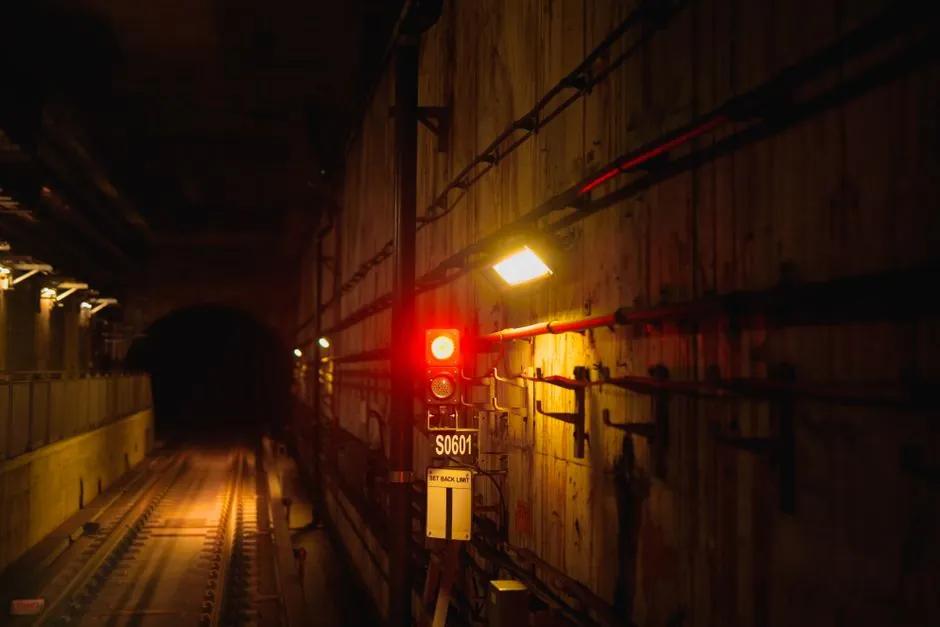
Immersion (poker) vibrators running 12,000-17,000 VPM remain the dominant consolidation tool for tunnel invert, sidewall, and crown pours, with head diameter, amplitude, and drive type selected against reinforcement density and section thickness [S2].
The selection logic for a tunnel differs from open-deck slab work: confined form geometry, dense rebar cages, single-sided shutters, and continuous shift cycles push the spec toward smaller heads, higher frequency, and a power source that survives 24/7 duty in damp, often poorly ventilated headings [S1][S2].
What "Strongest Compaction" Actually Means in a Tunnel
Compaction strength in a tunnel is the product of frequency and amplitude, not frequency alone: frequency (VPM) drives fine-particle movement and cement-paste liquefaction, while amplitude moves coarse aggregate and defines the radius of action around the poker head [S2]. Fresh concrete can trap up to 20% entrained air by volume before vibration, and the vibrator's job is to collapse that void content before initial set locks it in [S2].
The high-frequency band of 12,000-17,000 VPM overlaps the natural resonant frequency of most standard mixes, which is why it is the default operating window specified for structural concrete in confined pours rather than low-frequency 3,000-6,000 VPM form vibrators [S2]. When reinforcement is dense, the effective radius of action shrinks, so insertion spacing has to be reduced to keep the overlap zones continuous and avoid honeycombing behind the rebar [S1].
Head Diameter, Amplitude, and Pour Geometry
Head diameter is the first selector: thinner walls, arch crowns, and reinforcement-crowded zones (typical of tunnel sidewalls with double-mesh plus lattice girders) call for 25-38 mm pokers, while mass-concrete invert sections can take 60-75 mm heads for higher volume throughput [S1]. Larger heads move more concrete per insertion but need higher amplitude to maintain radius of action; small heads need higher frequency to keep cement paste mobile without segregating the coarse fraction [S2].
Standard field practice is to set insertion spacing at roughly 1.0-1.5 times the stated radius of action, and to pull the poker slowly while the surface still sheens and air bubbles cease, since withdrawing too fast leaves voids and withdrawing too late risks re-mixing the paste [S1]. For a deeper reference on the broader vibrator family, the concrete vibrator overview catalogues the immersion, form, and surface categories used across civil work.
Drive Type: Electric, Pneumatic, Hydraulic in a Tunnel Heading
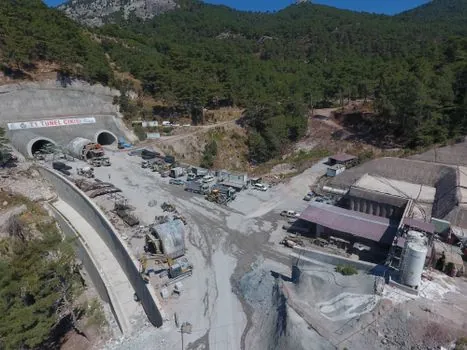
Three drive families compete in tunnel work, and each trades off differently against heading conditions. Electric high-frequency internal vibrators with integrated or external frequency converters are the most common on civil sites because they pair cleanly with site transformers and residual-current protection, but they demand stable supply and proper grounding in damp environments [S1]. Pneumatic pokers tolerate damp and explosion-hazard atmospheres and survive rough handling, at the cost of needing a sufficiently large compressor and clean, dry air to keep start-up and output consistent [S1].
Hydraulically driven internal vibrators deliver the highest power density and continuous-duty rating, which suits long tunnel shifts where a hydraulic power pack is already on site for formwork jacks or drilling rigs [S1]. For broader equipment context, the construction tools reference maps these drives against adjacent compaction and placement gear, while a head-size and power-source walkthrough for lighter pours sits in the landscaping concrete vibrator spec guide.
Selection Criteria Comparison for Tunnel Duty
Matching a vibrator to a tunnel pour comes down to four decision axes: head size, frequency, drive, and effective radius of action. The table below lines up the common options against those criteria so the spec can be set before the heading is opened. [S2]
Small-diameter electric pokers (25-38 mm, 12,000-15,000 VPM) suit heavily reinforced sidewalls and crown pours, give a 15-25 cm radius of action, and are quiet and clean but sensitive to voltage drop on long cable runs [S1][S2]. Mid-range electric and pneumatic pokers (40-60 mm, 10,000-14,000 VPM) cover general invert and sidewall bays with 25-40 cm radius and tolerate damp, slightly rougher conditions, at the cost of air-supply logistics for the pneumatic option [S1]. Large hydraulic and high-power electric pokers (60-75 mm, 8,000-12,000 VPM) handle thick invert and mass sections with 40-60 cm radius and run continuously, but are heavier, need a power pack or large genset, and over-pour thin lifts [S1][S2].
Site Practice, Indicators of Completion, and Common Failure Modes
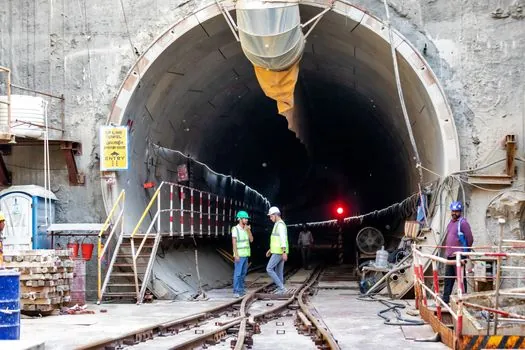
Three field signals confirm a properly consolidated lift in a tunnel: a steady wet sheen on the surface, the cessation of rising air bubbles, and an audible change in pitch as the poker is withdrawn [S1]. Reverse the process, and three failure modes show up repeatedly on post-pour surveys: honeycombing behind congested rebar where spacing was not tightened, bug holes and surface voids on formed faces where the poker was pulled too fast, and segregation (a layer of laitance over coarse aggregate) where amplitude was too high for the section thickness [S1][S2].
Maintenance is not optional on a 24/7 heading: pre-shift checks of head wear, coupling integrity, and hose condition; in-shift monitoring of temperature, vibration behavior, and noise; post-shift cleaning and hour-meter logging for bearing and seal replacement [S1]. For mix-design interactions, the cement and concrete reference covers how water/cement ratio and admixtures shift the workability window that the vibrator has to liquefy, while concrete admixture guidance addresses the plasticizers and superplasticizers that change the slump-versus-frequency balance on a given poker. The deeper structural context, especially how consolidation ties into rebar cover and long-term durability, also informs decisions in adjacent areas such as single girder crane specs for tunneling, where the same heading logistics drive the equipment spec.
Standards, Sourcing, and What to Verify Before Purchase
No single ISO or EN number in the research pinpoints vibrator frequency or amplitude limits, so spec sheets should be cross-checked against the head diameter, VPM at rated load, amplitude in mm, and effective radius of action stated by the manufacturer for the actual concrete slump on site [S1][S2]. For a typical listing shape on commercial channels, gas-powered and power concrete vibrators with shock-absorption mounts and large-capacity cement finishing motors are bundled for house, tunnel, and bridge sites, which gives a working reference for the form-factor and motor class expected at this duty [S3].
Watch for two procurement traps. First, ignore bare VPM claims: a 15,000 VPM head with insufficient amplitude will not move the coarse aggregate, and the radius of action collapses, especially in a 100-150 mm cover zone over tunnel reinforcement [S2]. Second, match the power source to the heading: long cable runs need oversized conductors to keep voltage drop under control, pneumatic lines need adequate bore to hold output, and hydraulic circuits need a power pack sized for continuous rather than intermittent duty [S1]. Where the pour is heavily fibre-reinforced rather than rebar-reinforced, the concrete fibre reference covers how fibre type and dosage shift the rheology the vibrator has to work against.
Next signal to track: whether the project's QA plan cites a specific effective radius of action value per poker model, since that single number lets the foreman set insertion spacing without re-trialling the head on every bay, and it is the cleanest cross-check between the manufacturer's spec sheet and what actually happens in the form.
