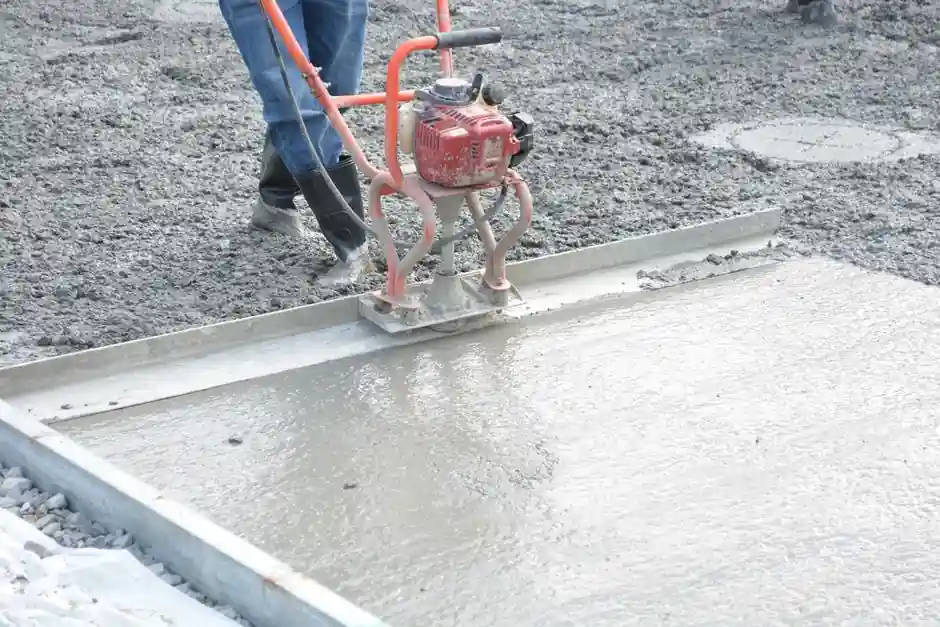
For block fill, brick beam grouting, and masonry foundation walls, immersion vibrators in the 7/8 in. to 1-1/4 in. head range are the workhorses, running 10,000 to 12,000 VPM (vibrations per minute) on 115V drives or 72V backpack-style lithium-ion cordless heads [S4][S6].
Selection is driven by four concrete data points: minimum wall dimension, rebar spacing, pour depth, and whether power is available on site; brand label is the last decision, not the first. Matching those four numbers to head diameter, shaft length, vibration frequency, and power source is what determines void-free consolidation in a wall pour, per the guide material compiled in mid-2026 [S1].
Head Diameter Mapped to Wall Thickness and Rebar Grid
Head diameter must clear the inside face of the form and the rebar grid; the rule of thumb is a head roughly 1/4 the minimum wall dimension, with the head passing between bars without contact [S1]. For a 6 in. CMU cell or a thin brick-beam cavity, a 7/8 in. head is the practical minimum, while 8 in. to 12 in. poured masonry walls take 1-1/16 in. or 1-1/4 in. heads [S4].
Three Northrock head sizes, 7/8 in., 1-1/16 in., and 1-1/4 in., share a common shaft and motor platform (60A-series shafts, 60S-series motors), so a contractor can run one drive unit and swap heads as the pour moves between bond beams, cells, and pilasters [S4]. Each head is 17.0 in. long and weighs 4.0 lb, a size that stays controllable on a wall pour without fatiguing the operator [S4]. For broader consolidation choices, the concrete vibrator reference covers frequency, amplitude, and radius of influence in detail.
Shaft Length, Radius of Influence, and Pour Depth
Shaft length should exceed the deepest lift in the wall by at least 12 in. so the head can be fully immersed and withdrawn without the shaft whipping against the form face. Northrock 60A-series compatible shafts run 2 ft, 5 ft, 7 ft, 10 ft, 14 ft, and 20 ft lengths on the same head [S4].
The radius of influence (the lateral distance the head still consolidates effectively) scales roughly with head diameter; a 1-1/4 in. head will move concrete 12 in. to 18 in. laterally in a 4 in. to 5 in. slump mix, while a 7/8 in. head drops to roughly 6 in. to 10 in. Manufacturers call out the sealed-head, high-frequency design as the reason a 1-1/4 in. head gives "consistent high-frequency consolidation for void-free results" in formwork and rebar-dense pours [S4]. Deep lifts in tall masonry walls pair the 10 ft or 14 ft shaft with the 1-1/4 in. head; a more detailed walkthrough of the VPM/head/power interaction sits in the head size, VPM, and power source selection guide.
Power Source: 115V Mains, Cordless Backpack, or Drive Unit
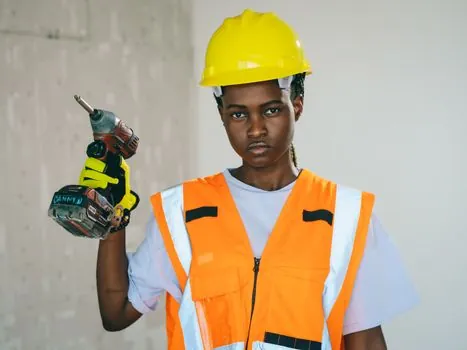
Three power options cover nearly every masonry site: 115V mains-driven internal vibrators, 72V lithium-ion backpack systems for slab and wall pours where a generator is impractical, and 3/4 in. corded drill adapters for very small DIY grout jobs [S2][S6]. The Wacker Neuson IRFU65/120/5 US is a 115V, 650W-class internal vibrator with a 5 m shaft, sold through Acme Tools in early August 2026, typical of the mains-driven end of the masonry market [S6].
For sites without clean 115V, the Milwaukee MX FUEL backpack concrete vibrator kit ships with two batteries and a charger under part number MXF371-2XC; the published spec is "the power to push up to 2-1/2 in. heads", which is overkill for most masonry cells but useful for heavy bond beams and pilasters [S2]. The corded-drill adapter (1/2 in. or larger chuck drill driving a 7/8 in. or 1 in. pencil head) is the lower-cost option for small brick-veneer grout jobs and is the configuration most rental counters stock [S5]. Masonry wall pours sit between these: too big for a drill adapter, often too small to justify a backpack system, which is why 115V mains units dominate the rental fleet, as seen at A Tool Shed in San Jose listing a Northrock electric concrete vibrator at $65 per 4 hours, $85 daily, $221 weekly, $585 monthly (28 days, max 160 hours) [S5].
Frequency (VPM), Amplitude, and Concrete Mix Window
Internal vibrators consolidate by combining frequency and amplitude; high-frequency (10,000 to 12,000 VPM) low-amplitude heads suit low-slump, high-strength mixes with tight rebar spacing, while 6,000 to 9,000 VPM higher-amplitude heads suit 4 in. to 6 in. slump wall mixes. The Wyco "CK-8900" style sealed head that Northrock builds around runs on precision ball bearings in a synthetic oil bath, which is the bearing arrangement that lets the eccentric hold frequency under load when the head is buried in stiff masonry grout [S4].
Match the head size to the mix: a 1-1/4 in. head running at 10,000+ VPM consolidates a 4 in. slump mix in roughly 5 to 15 seconds per insertion; over-vibration pulls paste to the form face and segregates the aggregate, so insertion timing is part of the spec, not a feel-based judgment. The cement and concrete properties page covers slump, air content, and how they interact with vibration energy.
Sealed, Maintenance-Free vs Serviceable Heads on Site
Sealed, permanently lubricated heads (synthetic oil bath, no grease zerks) suit rental fleets and masonry crews that swap heads between pours and do not want a re-greasing step; serviceable heads with grease fittings suit high-hour contractors who rebuild in their own shop. The Northrock 1-1/4 in. head carries a lifetime limited warranty from Northern Tool, ships within 2 business days on standard orders, and lists no field-service step on its spec sheet, a clear flag for low-maintenance operation [S4].
Coated and soft-tipped variants of the same head are available where the pour contacts epoxy-coated rebar or finished form faces, since bare steel can scar both [S4]. For crews that already run Wacker Neuson or Wyco-style drives, this lets a sealed head drop onto an existing motor (60S1, 60S1-QD, 60S2, 60S2-QD, 60S3, 60S3-QD) without re-buying the drive train [S4].
Rental, Buy, and Crew-Size Decision Logic
Rental dominates the masonry concrete vibrator market because most pours last hours, not weeks. Published Bay Area rates from A Tool Shed (San Jose, August 2026) are $65 / 4-hour, $85 daily, $221 weekly, and $585 monthly, with a 28-day, 160-hour cap on the monthly rate, which puts a single-vibrator job inside $100 to $250 for most masonry pours [S5]. Florida rental counters (Jupiter, FL) stock concrete vibrators under a "Concrete & Masonry" category alongside mixers, screeds, and power tools, and frame them as a standard rental rather than specialty equipment [S3].
Buy becomes the right call above roughly 80 to 100 hours per year of use, which is when rental cost crosses a 1-1/4 in. sealed head plus a 60S-series drive. Crew-size rule: one immersion vibrator per active pour zone plus one backup, since downtime on a wall pour is expensive. For crews running both steel and masonry, a steel-construction selection guide covers the higher-amplitude end of the market, while road-maintenance vibrator selection covers the high-VPM slab-pour side. Adjacent consumables like concrete admixtures and concrete tools round out the wall-pour package.
Trackable signals for the next quarter: (1) whether 72V backpack platforms such as MX FUEL publish 7/8 in. and 1 in. head SKUs suited to thin CMU cells, since the current 2-1/2 in. head spec targets heavy slabs [S2]; (2) rental-fleet refresh of Northrock 60A/60S-series sealed heads through Northern Tool and Wacker Neuson IRFU-series 115V units [S4][S6]; (3) any 2026 spec publication on vibrator radius-of-influence testing under ACI 309, since that is the standard contractors most often cite for insertion spacing.