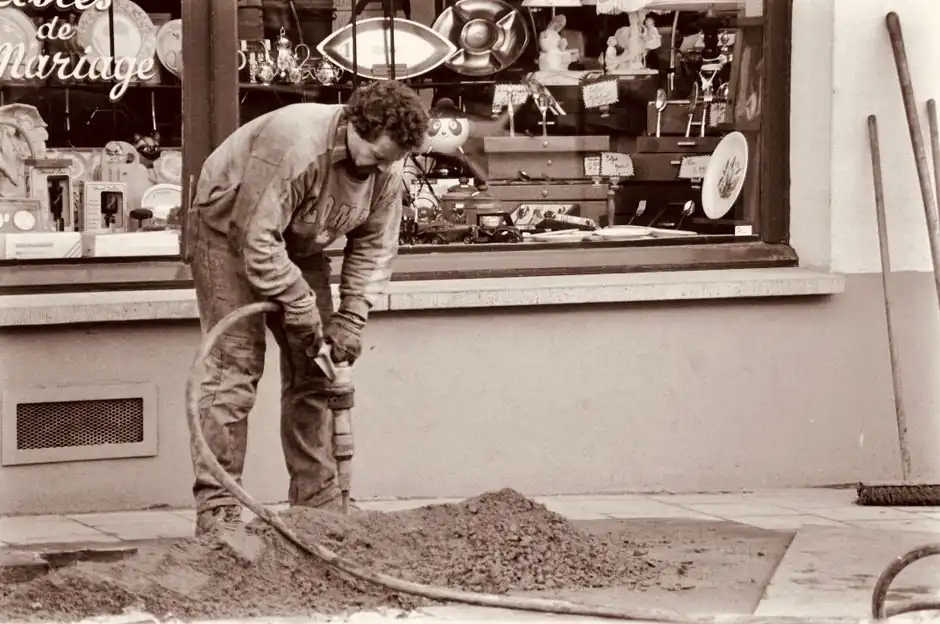
Landscaping concrete differs from structural work in three ways: pour depth rarely exceeds 18 inches, rebar density is light, and the priority is finish quality over ultimate compressive strength. That profile makes a flexible-shaft electric poker vibrator the default tool, paired with a small vibrating screed for flatwork larger than about 200 sq ft [S1][S4].
Why Landscaping Pours Need Vibration, and What Happens Without It
Unvibrated concrete carries 5% to 20% entrapped air by volume; proper vibration drops that to 1% to 2%, and the resulting consolidated matrix develops 5% to 15% greater compressive strength than non-vibrated concrete [S1]. For a 4-inch-thick patio slab, skipping the vibrator step commonly produces bug holes 1/8 inch to 1 inch across and visible honeycombing along the form edges, both of which drive patching costs to $15 to $50+ per square foot [S1].
Landscape contractors also see cold-joint failures on stepped footings when successive lifts sit too long between pours; vibration in the previous lift restores workability at the bond line. ACI 309 (Guide for Consolidation of Concrete) is the industry reference for these procedures, and landscapers working to spec on municipal paver bases or pergola footings are increasingly asked to document vibration coverage on the pour record [S1]. A short refresher on concrete consolidation clarifies why a 30-second insertion at 6-inch spacings outperforms a single 2-minute plunge.
Four Vibrator Types, and Which Ones Fit Landscape Work
Internal (immersion) vibrators, external (form) vibrators, surface (screed) vibrators, and vibrating tables each target a different pour geometry [S1]. For landscaping, internal pokers are the workhorse, vibrating screeds handle flatwork, external form vibrators serve narrow vertical elements like fence-post collars and pier forms, and vibrating tables are limited to precast landscape blocks, stepping stones, and small site-cast ornaments.
Internal poker units span head diameters of 1 inch to 2.5 inches or larger, shaft lengths of 3 feet to 21 feet, electric motors of 1 HP to 2.5 HP, and gas engines of 1.5 HP to 6 HP; effective radius of action runs 3 inches to 10 inches depending on head size [S1]. The 1-inch head suits pours up to 6 inches deep (most patio slabs), while the 2-inch head reaches 18-inch retaining-wall footings. External vibrators generate 500 to 10,000 lb of centrifugal force and mount to the outside of formwork when internal access is blocked by congested rebar or thin cross-sections [S1]. For a side-by-side of head size, VPM, and best-fit pour, the masonry-focused breakdown in Masonry Concrete Vibrator Selection: Head Size, VPM, and Power Source maps the same data set onto block-fill and wall work, useful as a cross-check.
Spec Criteria: Matching Head, VPM, and Power to the Pour
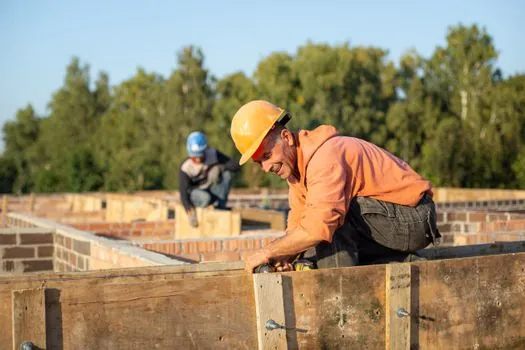
Selection boils down to four numbers: head diameter, VPM, shaft length, and power source. For a 4-inch patio slab with light wire mesh, a 1-inch to 1.25-inch head at 10,000–12,000 VPM on a 10-foot flexible shaft is the common rental-yard configuration [S1][S2]. Stepping up to a 6-inch driveway slab or a 12-inch footing calls for a 1.5-inch to 2-inch head, still inside the 8,000–14,000 VPM window [S1].
Power source is the next decision: electric 1–2.5 HP units dominate indoor, covered-patio, and noise-restricted sites; gas 1.5–6 HP units cover remote sites without generator power. Battery backpack vibrators, listed in the 2026 retail channel at INR 5,000 to INR 25,000 in the Indian market, are gaining ground on small residential jobs where cord management is the bottleneck [S3]. FordeClaw's 2026 product line and Summit Forge Supply's catalog both show electric flexible-shaft pokers (BravePro BRPV105 at $461, ENAR TDX shaft assemblies) as the price-lead configuration for landscapers [S1][S4].
Concrete, Aggregate, and Admixture Factors That Change the Spec
Mix design drives vibrator choice as much as pour geometry. A stiff low-slump mix (3-inch to 4-inch slump) with 3/4-inch aggregate needs higher VPM and longer insertion times than a wet 5-inch to 6-inch slump; the same 1.5-inch head that consolidates a standard mix in 15 seconds may need 30 seconds on a low-slump batch. Self-consolidating concrete (SCC) generally eliminates internal vibration, leaving a vibrating screed as the only step needed to close the surface [S1].
Admixtures and fiber reinforcement both shift the choice. Polypropylene or steel fiber mixes, common in slab-on-grade patios, require the head to stay moving to avoid fiber segregation; high-range water reducers (HRWR) extend working time but do not remove the need for vibration. Two reference pages help frame the trade-off: concrete admixture for the chemistry side and concrete fiber for the reinforcement side. For deeper pours or pier work, contractors working from a concrete vibrator reference that lists effective radius of action by head size will see quickly that a single-head sweep pattern is wasted effort on a 12-inch footing.
Who Should Buy, Rent, or Skip the Vibrator
Buy if a landscaper pours more than about 30 cu yd of concrete per month; a $450 to $1,500 electric flexible-shaft unit pays back inside one season for that volume. Rent if pours are occasional or one-off: 4-hour rental on a Northrock electric concrete vibrator in San Jose runs $65, daily $85, weekly $221, and monthly $585 (160-hour cap) [S2]. Skip vibration entirely only when using SCC on a slab with no rebar congestion, or for bagged premix repairs under about 0.5 cu yd where hand-tamping is faster than setup.
Landscape crews on shared sites with multiple trades should also be aware of equipment-class boundaries. The same product reference that covers a concrete tool ecosystem notes that vibrating screeds, tamping rammers, and plate compactors are often listed together in the same equipment category on rental sites such as Summit Forge Supply and ACE Equipment Rentals, which simplifies a one-stop pickup [S4][S5]. For work that crosses over into utility trenching or pier replacement, the road maintenance guide covers heavier 3-inch to 4-inch head units and gas drive configurations beyond the typical landscape range.
Head Materials, Shaft Care, and Common Failure Modes
Standard steel poker heads handle rebar contact but score coated reinforcement. Urethane-coated heads such as the Diamond MV800C 5 series are specified for coated rebar applications and pencil-vibrator use, running cooler with no oil carry-through to the concrete surface [S6]. Hard-chrome plated shafts resist the slurry abrasion that wears through bare steel after about 200 hours of immersion work.
Common failure modes on landscaping jobs are predictable: burned-out motor from continuous run on a 6-inch slab, snapped flexible shaft from kinking the drive end, and bearing failure on a gas unit that has been tipped on its side. Limits worth remembering: do not run an electric vibrator more than about 30 minutes continuously without a cool-down, keep insertion spacing at 1.5 times the effective radius of action (so a 1.5-inch head at 8-inch radius wants 12-inch centers), and withdraw slowly so the head does not leave a void cone behind it. The encyclopedia entry on concrete admixture notes that set-retarding admixtures widen the working window but do not extend the practical vibration insertion time, which remains bounded by the mix temperature and the head's heat dissipation.
Trackable signals for the next planning cycle: gas-powered concrete vibrator demand at rental yards typically peaks in California and the Gulf Coast from May through September, and the 2026 retail channel shows the Indian market pricing band at INR 5,000 to INR 25,000 across electric, gas, and battery SKUs (2026-08) [S3]; the next data point worth watching is the Q4 2026 product refresh from major US rental chains, which historically adds battery backpack units to the landscape-crew rental inventory. For crews that also pour utility pads, a plumbing-context selection map at Concrete Vibrator Selection for Plumbing Installation covers a similar spec-first flow with thicker slabs in mind.