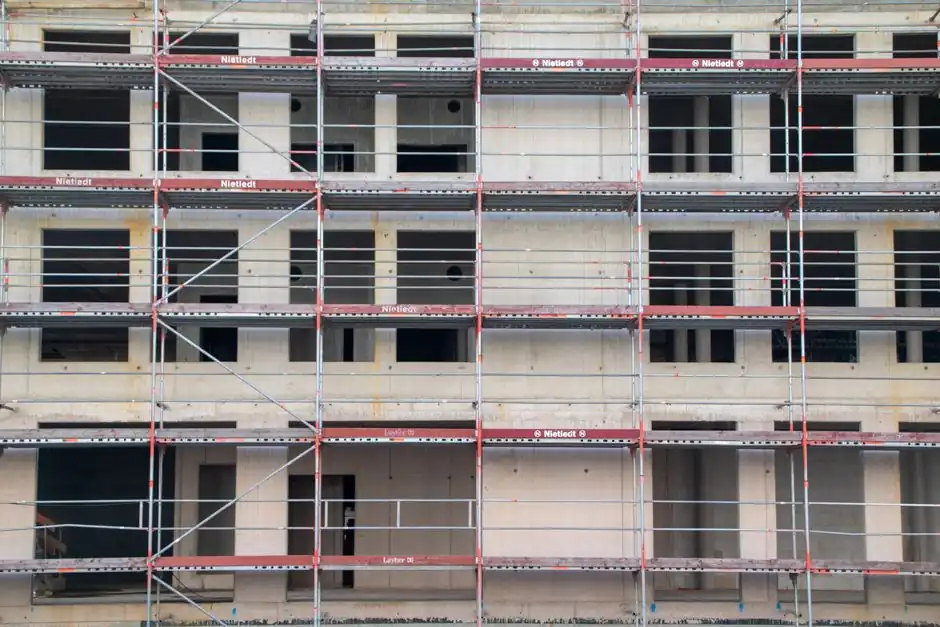
For 2026 bridge projects, the four scaffolding families that consistently win specification are cuplock (pier/abutment formwork, 75 kN/leg minimum), H-frame falsework (deck spans 5-15 m, 25 kN/sqm wet concrete), movable scaffolding systems (MSS) for cast-in-place segment cycles, and ringlock modular systems for variable-height access on towers and curved geometry [S3][S1][S5].
The selection problem is less about brand and more about matching leg load, bay geometry, and reusability to the bridge type, with rental economics dominating on flyovers and MSS ownership dominating on long repetitive viaducts. Engineers who fix the wrong system early typically pay in cycle time, not in unit price [S3][S1].
Cuplock for Piers and Abutments: The 75 kN/leg Benchmark
Cuplock with heavy props remains the default for pier and abutment formwork where single-leg loads reach 75 kN minimum and erection heights run 10-40 m above water or live traffic [S3]. The cuplock node locks four horizontals into one cup, which gives a stiffer joint than typical tube-and-clamp under eccentric wet-concrete pours and is the reason it appears in nearly every bridge-rated rental fleet [S3]. For waterlogged foundations, the engineering guidance is to extend base jacks over piling mats rather than rely on sole plates, since soft alluvium under cyclic pour loads is the most common cause of pier-formwork settlement [S3].
Design factor of 1.6 over the combined wet-concrete (20 kN/sqm), live worker (4 kN/sqm), and wind (1.2 kN/sqm) envelopes is the published working value used in the Indian infrastructure rental spec set, calculated against IS:875 wind loading [S3]. On a 100 m flyover segment, this works out to roughly 250 cuplock bays at about Rs 85 per bay per month, a line item that tends to drive the rental-versus-purchase decision more than the headline scaffold price [S3].
Deck Falsework: H-Frame Centering for 5-15 m Spans
Deck pours between 5 m and 15 m clear span are almost universally handled with H-frame falsework plus steel centering plates, sized for 25 kN/sqm of wet concrete with traffic management below and wind loading on the open frame [S3]. H-frame wins here because each pair sets in minutes, the centering plates transfer deck loads into the legs without horizontal shimming, and the frames stack for variable soffit heights without custom fabrication [S3].
Two failure modes dominate deck falsework incidents and are worth pinning in the spec: insufficient lateral bracing between frames (which lets wet concrete shift the centroid during vibration), and missing traffic-rated base systems when the flyover crosses an operating carriageway, where the minimum under-span clearance is 5.5 m [S3]. For bridges over live rail or highway, parapet and railing work shifts to mobile cantilever towers at 2-4 m above deck because they can be repositioned between segments without striking the main falsework [S3].
Movable Scaffolding Systems (MSS) for Repetitive Segment Casting
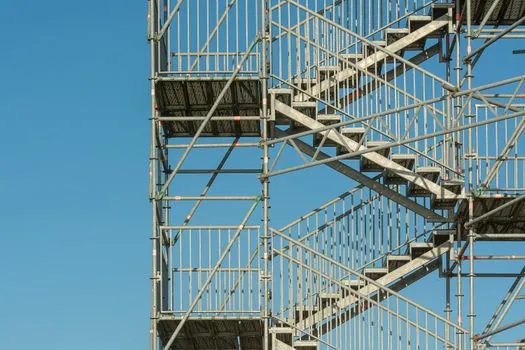
MSS merges load-bearing, formwork support, and working platform into a single unit that advances along the bridge axis between segment pours, typically by hydraulic launch or rail, shifting from one segment to the next in hours rather than the days a fixed falsework cycle would need [S1]. The productivity logic is to combine formwork setup, reinforcement placement, and concrete pour into one cycle, which removes the idle time between span finishes that conventional scaffolding cannot avoid [S1].
Modern MSS builds use Q355 and Q235 steel for primary members with aluminum cross-beams to cut dead weight without sacrificing stiffness, a balance that matters when the system self-launches on its own rails [S1]. On-board monitoring tracks deflection, load distribution, and alignment during the move, with visual smart-sync control across lift points to keep even jacking and avoid the racking that wrecks formwork faces [S1]. The MSS route pays back when the bridge has enough identical segments to amortize the system, and it loses to rental cuplock plus H-frame on short, non-repetitive spans [S1][S3].
Ringlock and Kwikstage: Modular Access for Variable Geometry
Ringlock is the modular system of choice when the bridge geometry varies in height and angle, because the ring-and-pin node allows eight connections per rosette and lets crews assemble complex curved access around piers, towers, and arch springs faster than cuplock [S5]. Typical assemblies pair standards (vertical posts), ledgers (horizontal supports), and braces in a way that distributes load evenly while keeping the parts count low enough for fast strike and re-erection on the next pier [S5].
Kwikstage is the competing modular standard and shows up most often in two bridge roles: heavy-duty standard scaffolds with bays up to 2.5 m wide and 5000 kg per bay load capacity for large-scale bridge projects, and narrower access towers adjustable to 3.2 m for maintenance on existing structures [S2]. Bridge deck platforms in 1.2 m or 1.5 m widths sit on top of either system to give a stable working surface, while 1.8 m diagonal bracing and 15 kg high-strength steel guard rails close out the safety envelope [S2]. For curved tunnel and arch approaches, ringlock's 360 degree access around the circumference is a real advantage over Kwikstage's orthogonal layout [S3][S5].
Bridge Tower Scaffolding and Bailey-Type Heavy-Duty Systems

Bridge tower scaffolding is the dedicated access family for inspection, repair, painting, and bearing-replacement work on existing structures, built from vertical standards, ledgers, diagonal braces, working platforms, guardrails, toe boards, base plates, and integrated access ladders, with components usually in high-strength steel or aluminum [S4]. It is engineered to handle the variable geometry of cable-stay towers, arch ribs, and high piers where conventional access equipment cannot maintain a stable platform [S4].
For heavy temporary spans and gantry duties, Bailey-type bridge scaffolding (Evercross COMPACT-200, COMPACT-100, CHINA 321, PB 100, LSB, GWD, DELTA, 450 among the listed model codes) is the long-standing panel-bridge system, priced in the published supplier range of USD 1000-2000 per ton and certified to CNAS, COC, PVOC, SONCAP, CIDB, FORM E, and FORM F origin documentation [S6]. It is rarely the right pick for cast-in-place segment work, but it is the workhorse for haul gantries, crane platforms, and emergency bridging [S6].
Decision Matrix: Matching System to Bridge Element
Across the four decision criteria of element type, leg load, cycle speed, and reusability, cuplock wins on pier and abutment leg load at 75 kN/leg minimum, H-frame wins on deck falsework cost for 5-15 m spans, MSS wins on cycle time for long repetitive segmental bridges, and ringlock or Kwikstage wins on variable-geometry access where modular reconfiguration matters more than raw leg load [S3][S1][S5][S2]. For maintenance and inspection on existing towers, bridge tower scaffolding with high-strength steel or aluminum members is the only family that handles the geometry cleanly [S4].
Spec-side, the three numbers worth pinning in the purchase order or rental contract are: leg load in kN/leg (75 minimum for piers), wet-concrete pressure in kN/sqm (25 for deck, 20 baseline for general design), and design factor (1.6 over combined load case per the published rental spec set) [S3]. Corrosion protection should be hot-dip galvanised for any element within 1 km of saltwater or de-icing salt spray, since bridge scaffolding failures from corroded couplers are far more common than overload failures in temperate coastal work [S3].
Standards, Sourcing, and 2026 Trackable Signals
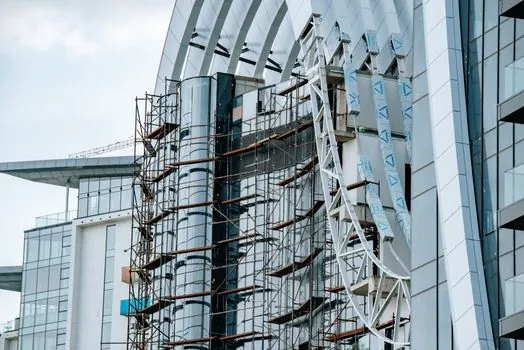
The dominant published engineering reference for wind loading on Indian bridge falsework is IS:875, with hydrostatic and traffic-management protocols layered on top, and water-resistant couplers, galvanised finish, vibration resistance for heavy pours, and traffic-rated base systems listed as the four critical component features [S3]. For Chinese-supplied Bailey-type systems, the documentation stack typically includes CNAS, COC, PVOC, SONCAP, CIDB, FORM E, and FORM F, which matters when the project is financed by multilateral lenders who require origin certification [S6]. Movable scaffolding system steel grades Q355 and Q235 are the published baseline for primary structural members, with aluminum cross-beams specified where self-launch weight must be minimized [S1].
Two signals worth watching into late 2026: the rate at which MSS hydraulic-launch packages are tendered for high-speed rail viaducts in South and Southeast Asia (where repetitive segment casting favours MSS over rental cuplock), and whether bridge-rated scaffolding suppliers begin standardising on a single digital load-monitoring telemetry spec, since current MSS offerings still use proprietary on-board monitoring for deflection and alignment during moves [S1]. Engineers specifying bridge scaffolding in the meantime can compare these systems against related construction tools requirements, review scaffolding baselines, and cross-check deck and pier picks against construction machinery and equipment capabilities for the gantry and launch phases.
This topic is covered further in Tunnel Scaffolding Selection: System Types, Load Ratings, and 2026 Spec Map.