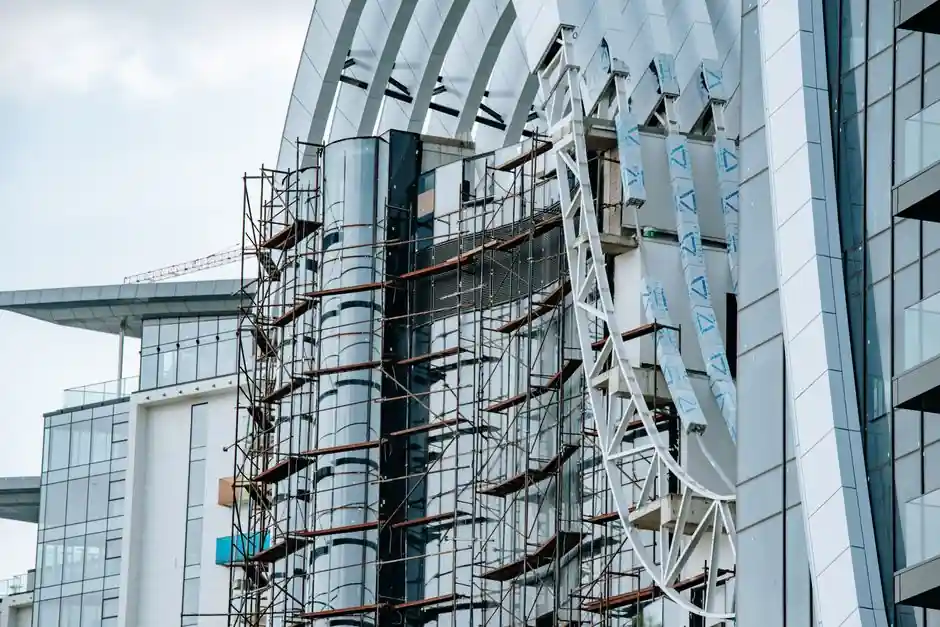
Tunnel scaffolding is not a commodity buy; it is a temporary structure that has to hold back wet concrete, hydrostatic head, and shifting ground for 24-hour pour cycles, and the wrong cup-lock or traveller choice shows up as deflection, blowout, or a rebar strike. The four systems that dominate 2026 tunnel bids are cuplock, ringlock, hydraulic travellers, and cut-and-cover gantry carriages, each with its own load envelope.
Across bridge-rated and tunnel-rated OEM offerings, wet concrete pressure is the binding number: 20 kN/m² for general pours, 50 kN/m² for segmental lining, 25 kN/m² for deck falsework, 75 kN/leg for pier/abutment legs, with a 1.6 design safety margin specified against IS:875 wind and hydrostatic loading [S3]. Tube diameter on modern modular systems is 48.3 mm, ledger lengths 0.5-3.07 m, and the scaffold must be HDG (hot-dip galvanized) for waterlogged tunnel headings [S4].
System-by-System Selection Map for Tunnel and Bridge Heads
For tunnel headings and curved shafts, ringlock (also called disk-lock or rosette) is the default because the 360° rosette node lets bays fan out to the full tunnel diameter without custom fabrication, and ringlock ledger lengths of 0.5-3.07 m with a 3.2 mm wall in Q355 steel cover the load ranges a 6-12 m diameter bore actually sees [S4]. When the same job also demands rapid repositioning between bridge segments, ringlock and cuplock share most accessories, which keeps the spare-parts list short.
For heavy concrete pours in tunnel linings, a 3.0 m crossbar cuplock on 1.6 m verticals, hot-dip galvanized, with HDG tubes, is the workhorse SKU across Chinese OEM catalogues priced at $20-40 per set with a 5-15 day lead time and 100-piece MOQ [S1]. On bridge piers above water, the same cuplock system is specced at a 75 kN/leg minimum with cuplock verticals plus heavy props up to 40 m above the deck [S3]. For interior access in tight tunnel shafts, aluminum mobile towers are too light; they belong on short-duration, low-load finishing work, not tunnel headings.
Load, Pressure, and Geometry Numbers That Drive the Spec
The first number to fix on the drawing is wet concrete pressure, and the second is cycle time. Segmentally lined tunnels using hydraulic travellers run a 24-hour pour-cure-advance cycle at 50 kN/m² lining pressure, with 4 kN/m² live worker load and 1.2 kN/m² wind per IS:875 added on top [S3]. Deck falsework under 5-15 m clear spans runs at 25 kN/m² wet concrete, which rules out light-duty systems and forces H-frame plus steel centering plates.
For the support structure itself, mandatory Chinese practice (GB55023-2022) sets steel-pipe wall thickness at ≥3.6 mm with ±10% tolerance and fastener torque at 65 N·m, while structural scaffolding load capacity is capped at 300 kg/m² for formwork support and 200 kg/m² for decoration work, and anything above that needs special design [S2]. Heights above 24 m require reinforced frames; cantilevered structures must be checked for anti-overturning coefficient [S2]. On a 100 m flyover segment, that translates into roughly 250 cuplock bays, 40 H-frames, and 8 mobile parapet towers, costing on the order of ₹6.5 lakh/month on rental [S3].
Steel Grade, Finish, and Hardware Checks for Tunnel Sites
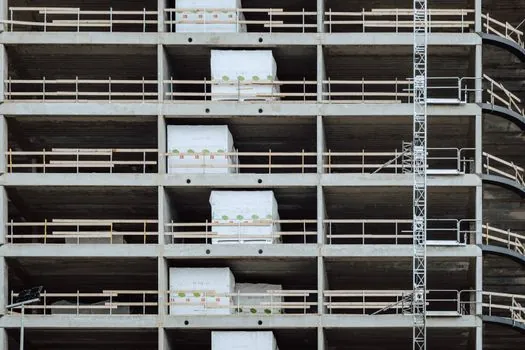
Tunnel sites are wet, often brackish, and frequently vibrate from nearby blasting or TBM passes, so material grade and coating are not optional. Standard tube steel is Q195/Q235/Q355B, with Q355 the spec for ringlock verticals at 3.2 mm wall and 48.3 mm OD, hot-dip galvanized, with a ≥4 safety factor and ≤±3° horizontal adjustment on ledger connections [S4]. The same Q355 cuplock is sold at the 3.0 m × 1.6 m bay size with "high corrosion resistance" finishes for bridge and tunnel export orders [S1].
Couplers and fittings must be water-resistant rather than standard zinc-plated, because standard couplers gall and seize in tunnel humidity, slowing strip-out and adding safety risk during dismantling [S3]. For TBM-driven tunnels, segmental lining is more often poured by the TBM's own precast erector than by site formwork, but the access scaffolding still has to be sized to the full tunnel diameter and rated for the same 50 kN/m² pressure during any cross-passage or invert pours [S5]. General scaffolding hardware and formwork selection principles apply, but the corrosion and hydrostatic checks dominate on tunnel jobs.
Who Tunnel Scaffolding Is, and Is Not, For
Engineered modular scaffolding (cuplock/ringlock) plus hydraulic travellers is the right call for: new TBM-lined rail/metro tunnels, cut-and-cover boxes, bridge piers over water, segmental flyover decks, and tunnel cross-passages where load is high and cycle time is short [S3][S5]. It is the wrong call for: short interior fit-out (use aluminum mobile towers instead), low-rise brickwork (use traditional coupler-and-tube steel pipe frame at 1.5-1.8 m vertical spacing), and any site where the foundation is soft and the contractor will not commit to base jacks plus piling mats [S2][S3].
Bamboo and timber scaffolding is being banned in several Chinese cities specifically because buckle-type systems offer better stiffness and lower component loss, so any urban metro project now defaults to modular galvanized steel regardless of crew familiarity [S2]. For a quick comparison, the table below lines up the main systems against four decision criteria:
System / Max wet concrete load / Typical span or height / Cycle time / Best fit. Cuplock: 75 kN/leg, up to 40 m pier height, segment-repeating, heavy civil pours [S3]. Ringlock (Q355 HDG): ~50 kN/m² lining pressure, full tunnel diameter access, 24 h cycles, curved tunnel walls [S3][S4]. Hydraulic traveller: 50 kN/m², full tunnel section, 24 h pour-cure-advance, segmental lining [S3]. Cut-and-cover gantry: roof-slab scale, trench-width clear spans, daily advance, shallow tunnels and stations [S5]. H-frame + steel plates: 25 kN/m², 5-15 m deck spans, weekly repositioning, bridge deck falsework [S3].
Safety Margin, Foundation, and Failure Modes
The non-negotiable safety margin on bridge and tunnel scaffolding is 1.6 against combined dead, live, wind, and hydrostatic load, with wind per IS:875, wet concrete 20-50 kN/m² depending on element, and 4 kN/m² live worker load [S3]. On waterlogged foundations, base jacks alone are not enough: extended base jacks plus piling mats are the standard fix, otherwise settlement during the pour jacks the shoring and the formwork deflects [S3].
The dominant failure modes underground are: (a) hydraulic traveller lock failure during a pour, which can release hundreds of cubic metres of wet concrete into the heading if a single ram is unattended, (b) trench-wall collapse on cut-and-cover jobs before the box structure is closed, and (c) millimetre-scale deflection of metal formwork that compromises long-term lining durability [S5]. Engineers running a construction tools and formwork review for a tunnel package should treat those three modes as the explicit checklist items, not generic "safety".
Standards, Sourcing, and Procurement Notes for 2026
For Indian bridge/tunnel projects, the load and wind references are IS:875 (wind) plus the hydrostatic and concrete-pressure rules in standard formwork practice; the safety-factor and load values cited above (75 kN/leg, 50 kN/m², 1.6 SF) are drawn from a 2026 infrastructure rental specialist's published engineering data [S3]. For Chinese domestic projects, GB55023-2022 is the mandatory scaffold code, specifying ≥3.6 mm wall, 65 N·m fastener torque, and 300 kg/m² vs 200 kg/m² load classes [S2]. For export orders, EN 12811-1 is the load/design reference commonly declared on ringlock datasheets (48.3 mm tube, Q195/Q235/Q355B, 0.5-3.07 m ledger, ≥4 safety factor) [S4].
Procurement signals worth tracking on the next 30-60 days: Q355 HDG ringlock at 48.3 mm × 3.2 mm from Chengdu and Tianjin OEMs at $20-40 per bay with 5-15 day lead time and 100-piece MOQ [S1], and continued enforcement of buckle-type-only rules in tier-1 Chinese cities pushing traditional bamboo scaffold out of metro packages [S2]. For buyers cross-checking construction machinery and equipment packages for a tunnel site, the safer move is to lock the system (cuplock vs ringlock) and the steel grade (Q235 vs Q355) on the datasheet before negotiating bay counts, since most field disputes trace back to those two lines, not price.
Background reading: Bimetal Thermometer Sizing and Selection: Spec Map for Process Buyers.