
Round link chain, pin-bush chain and plate-link chain are the three traction formats that dominate centrifugal and continuous-discharge bucket elevators; each one maps to a different combination of bulk material, temperature and capacity, so a spec-by-spec comparison is the fastest path to the right choice.
Round link welded chains are specified for hot meal, dry dust, raw meal and cement up to the abrasive-duty range where a simple ring will outlast any bushed joint [S5]. Pin-bush and plate-link formats are the standard for NE-type high-capacity elevators in cement, NPK fertilizer and slag handling, with chain plates in 45# steel and pins, sleeves and rollers in 40Cr alloy [S2].
Round link chain elevators: where the welded ring still wins
Round link chain elevators are the workhorse for vertical conveyance of high-temperature or low-temperature bulk materials including raw meal, dry dust and cement, with a covered process path that limits spillage and dust [S5]. The chains are built from wear-resistant steel with a simple welded ring geometry, which is why RUD-class systems run with little lubrication and almost no planned maintenance in cement and grain duty [S5]. A typical engagement problem is running swing: when the chain stretches unevenly or the boot shaft is misaligned, the loop whips inside the casing and the weld is the first point that fails, so field practice focuses on tensioning and boot bearing condition rather than the chain itself [S6].
The trade-off is precision and speed: round link is flexible but is not as geometrically accurate as a bushed roller chain, and the format is being progressively replaced on newer high-speed centrifugal elevators by roller chain and plate-link designs [S8]. For low-speed, high-temperature, high-abrasion service it remains the lowest-cost traction option per metre of lift.
Pin-bush and central chain elevators: the high-capacity middle ground
Pin-bush type plate link chain elevators are the standard dual-strand configuration for the NE-type bucket elevator, with the bucket bolted across two parallel chains, each chain running over an upper drive sprocket and a lower tensioning sprocket [S2]. Buckets are spaced evenly, usually every two links, over the chain length, and the design drivers are superior pin and bushing wear resistance, low chain elongation and easy connect/disconnect inside the elevator housing [S3].
Central elevator chains fit centrifugal discharge and high-capacity bucket elevators; the bushes are deep-carburized to maximize wear life in abrasive dust service [S7]. At chain speeds above about 45 m/min a 24-tooth sprocket is the typical engagement choice, while low-speed units below 45 m/min can stay on a 12-tooth sprocket [S3]. Centrifugal discharge units commonly run above 80 m/min and are sized to a typical capacity band around 300 t/h in bulk-material duty [S3].
Plate-link (block) chain elevators: the heavy-duty end
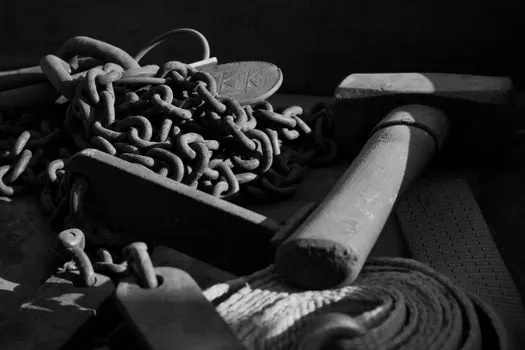
Plate-link chain elevators use forged block chains, welded plate chains or high-strength alloy block chains, and they are the preferred traction format for heavy-load NPK and cement VRM plants where lifting height and impact load dominate [S2]. In dual-strand form the chain is supplied as a complete assembly: chain, sprockets, rim wheels, buckets and boot bearings, with rim wheels precision-machined for correct tooth engagement and reliable torque transmission [S1]. A straight-link plate chain variant is sold for standard bucket elevator applications, with a wide inner width and a rollerless bush design to minimize friction and extend service life [S4].
Material specification is the most concrete differentiator against pin-bush. NE plate chain plates are typically 45# medium-carbon steel, pins, sleeves and rollers are 40Cr alloy steel (quenched and tempered for wear and fatigue resistance), and the upper/lower sprockets are ZG310-570 cast steel with overall quench and temper to HB229-269, plus tooth-surface induction hardening to HRC40-48 [S2]. NE plate chain pins are additionally high-temperature quenched manganese steel, which is the upgrade over a standard pin-bush pin in high-temperature bulk-material service [S2].
Selection criteria: temperature, speed, capacity, abrasion
Round link is the default when the bulk material is hot (raw meal, clinker cooler dust, dry cement) and the elevator runs slow, because the welded ring tolerates thermal cycling that would crack a hardened bushing [S5]. Pin-bush and central chain cover the mid-range: high-capacity continuous and centrifugal discharge, with the deep-carburized bush providing the wear life that a plain round link cannot match at chain speeds above 45 m/min [S3][S7]. Plate-link (block) chain is specified where lifting height, bucket weight and impact load push the tensile demand into the forged-block or high-strength alloy range, typical of NE-type elevators in NPK fertilizer and finished cement [S2].
A practical decision rule from the field data: centrifugal discharge is increasingly the norm because the equipment footprint has shrunk and chain speeds now exceed 80 m/min, which favours 24-tooth sprockets and a two-strand plate or central chain rather than a single-strand round link [S3]. Where two chains are installed, one on each side of the bucket, the design is inherently safer because the bucket remains supported if one chain is taken out of service for repair [S3].
Maintenance, wear and common failure modes
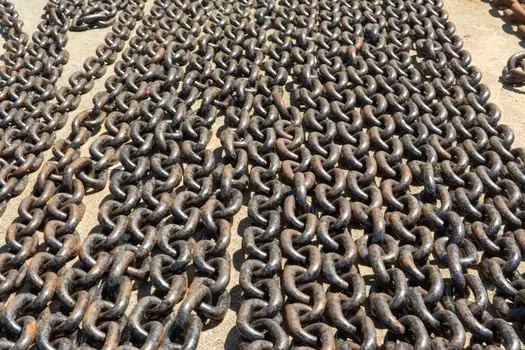
The dominant failure mechanism on any bucket elevator chain is elongation from pin and bushing wear, which is why wear resistance at the pin-bush joint is treated as a primary design parameter and not a secondary one [S3]. On round link chains, uneven elongation shows up as running swing inside the casing and culminates in weld break at the ring, so the corrective action is tensioning, boot bearing inspection and replacement of any chain section that has stretched beyond the allowable pitch growth [S6]. On plate-link and pin-bush chains, the wear is concentrated at the sprocket tooth, so detachable-tooth sprockets were developed in the 1980s to allow the tooth insert to be replaced without removing the sprocket body from the shaft; the cement industry has been the largest adopter of this design [S3].
Build-up of conveyed material at the bottom of the casing accelerates sprocket and chain wear and is the most common root cause of premature replacement on both round link and plate-link elevators; the corrective action is boot cleaning, tighter sealing and verification that the boot bearing is still serviceable [S3]. On heavy-duty plate-link elevators, the rim wheel assembly and the boot bush bearing are the two wear parts that govern the service interval of the whole elevator, and they are stocked as discrete replacement items rather than being machined as part of the chain [S1].
Standards, sourcing and what to verify before ordering
Bucket elevator chain selection is not governed by a single ISO or ASME chain standard in the way transmission roller chain is; instead, the relevant documents are the OEM dimensional tables, the elevator casing geometry and the material specification. The most consistent material markers in current sourcing documents are 45# for plate, 40Cr for pins, sleeves and rollers, and ZG310-570 for sprockets hardened to HRC40-48 at the tooth surface [S2]. On the chain itself, the engineering checkpoints are pitch accuracy, pin-bush hardness, bushing carburized depth and the rated working load, all of which should be cross-checked against the elevator nameplate, not just the chain catalogue [S3][S7].
Round link chain specifications are typically tied to a welded-steel engineering chain standard (ISO chain-class or DIN 766/763/764 wire-rope chain geometry is sometimes referenced in the same product family), while plate-link and pin-bush elevator chains are typically sold against an OEM dimensional table that is not interchangeable with a roller chain part number [S4]. For sourcing, the practical differentiator is whether the supplier ships the full assembly (chain, sprockets, rim wheels, buckets, boot bearings) as a matched set, which is how India-based and China-based plate-link elevator manufacturers are positioning their 2025/2026 product lines [S1][S2].
For buyers comparing alternatives, a useful cross-reference is the taper bush selection guide because many plate-link elevator sprockets are now offered with a taper-bush mounting to simplify field replacement. For plants that already operate belt bucket elevators alongside chain elevators, the PVC vs rubber conveyor belt reference covers the belt-side trade-off in unit handling that often sits next to a chain elevator in the same flow path. Where the question is bucket attachment geometry, the bucket elevator chain family page catalogues the chain and belt formats used in vertical conveying.
The next decision node after chain format is sprocket and rim wheel selection: verify the tooth count against the chain speed band (12 teeth below 45 m/min, 24 teeth above), confirm the tooth surface hardness (HRC40-48 is the current NE-type benchmark), and check whether a detachable-tooth sprocket is offered for the cement or fertilizer service [S2][S3]. From there, the only trackable signals are the next planned elevator shutdown for chain pitch measurement and any vendor announcement on carburized-depth upgrades to the bush, both of which are the leading indicators of the next service interval.
The underlying component specifications are covered under bucket elevator, and taper bush.