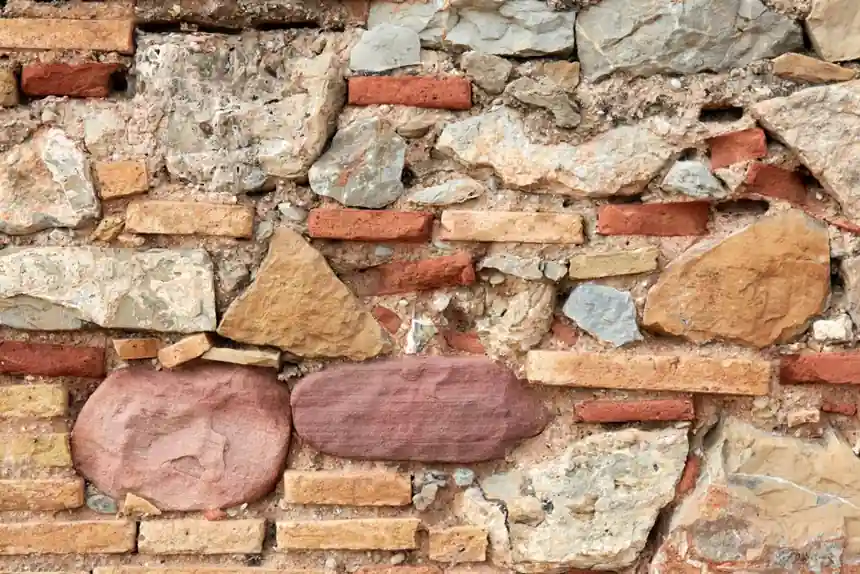
Granite and quartzite flooring in K-12 corridors routinely delivers 50+ years of service in well-maintained educational buildings, outperforming vinyl composition tile and 8-12 year carpet replacement cycles on a per-year life-cycle basis [S2].
Specifier priorities for 2026 school work split into three zones: high-traffic interior floors (granite, quartzite, hard limestone), wet or exterior surfaces (textured/flamed granite, slate, quartzite), and feature or cladding walls (manufactured stone veneer over light gauge framing or CMU backup) [S2][S3]. The 2026 Stone of the Year designation by the Natural Stone Institute went to Virginia Black Granite, signalling continued specifier interest in dense, dark igneous material for institutional work [S1].
Material options and what each one does in a school
Granite is a versatile igneous stone available in light grey, green, brown, and blue tones, with a Mohs hardness of 6 to 7 that resists scuffing from rolling carts, chair legs, and abrasive-soled shoes that visibly damage softer flooring [S2][S4]. Quartzite, a metamorphic equivalent, behaves similarly on hardness and density and is a common pick where a lighter palette is desired. Limestone and travertine bring a warmer, more traditional look but sit lower on the hardness scale and require honed (not polished) finishes on any floor that sees water or food service. Slate is dense, naturally cleft, and routinely used for entry vestibules and restroom floors where its layered texture adds slip resistance without a heavy mechanical finish [S4][S6].
Manufactured stone veneer is a concrete-based cast product, typically 25-50 mm thick, designed to replicate the appearance of full-thickness stone at roughly one-third the dead load on the wall assembly; it is the dominant cladding choice on new school exteriors where budget rules out full-bed natural stone [S3]. The 2025 Mapei technical brief on designing schools with manufactured stone veneer documents the material being specified for both exterior and interior school applications, with detailing driven by substrate type, drainage plane, and movement joints rather than by stone chemistry [S3].
Selection criteria: hardness, water absorption, abrasion, and finish
The four-attribute framework published by Stone Initiatives (Jim Mann) is the cleanest pre-spec gate: stain resistance, strength, abrasion resistance, and durability, each tied to a specific ASTM-style test method [S4]. For a school corridor, ask the quarry or distributor for water absorption (typically below 0.4% by weight for granite and quartzite, 0.5-3% for limestone, 0.1-0.6% for slate), compressive strength (granite commonly 100-250 MPa), flexural strength, and abrasion resistance measured as a volume loss number from a standard abrasion test [S4].
Hardness alone does not decide a school spec. A softer stone in a honed finish can still meet slip-resistance code in a dry corridor, while the hardest granite in a polished finish will fail wet-area code on the first rain. The selection conversation is: pick a stone with the density and absorption to survive 30+ years of wet mopping and chemical cleaners, then assign a finish to the location that meets SCOF targets [S2][S4].
Slip resistance and code thresholds for walking surfaces
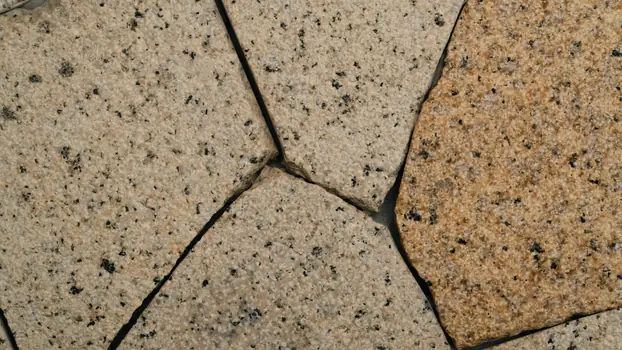
Educational building walking surfaces in the U.S. typically require a minimum Static Coefficient of Friction of 0.5 for level interior walking surfaces and 0.6 for ramps, with higher values expected in wet areas including locker rooms, cafeteria serving lines, and exterior covered entries [S2]. These thresholds are not aspirational; they are the floor of compliance under OSHA general industry rules, the ADA Accessibility Guidelines, and most state building codes that adopt those documents by reference [S2].
Finish selection is what gets the SCOF number, not the stone itself. Polished finishes are reserved for wall applications in schools; honed finishes carry the moderate slip resistance suitable for dry corridors; brushed, flamed, or sandblasted textures are required at entries, food service, locker rooms, and any exterior walking surface [S2]. On an interior slab, a flamed granite entry mat strip that the rest of the lobby runs as honed is a common detailing pattern because it gives a wet-footprint zone with measurable SCOF margin to spare.
Where stone fits, and where it does not
Stone is FOR main entrance lobbies, main corridors, cafeteria servery walls, library reading floors, restroom floors and partitions, and exterior cladding where 50-year service life and minimal maintenance are written into the program [S2]. Stone is NOT FOR gymnasium floors (use maple), running tracks, shower rooms where daily chlorine and standing water are constant (use porcelain tile with high SCOF), or science lab bench tops where reagent attack is routine (use epoxy resin or phenolic).
A secondary decision axis is whether the project is new build or renovation. Manufactured stone veneer dominates new school envelopes because it is light, dimensionally consistent, and ties into standard rain-screen detailing; full-bed natural stone is reserved for flagship entries and donor-named facades where the dead load and foundation cost are acceptable [S3]. For interior renovation of an occupied school, thin stone panel systems and stone-look porcelain compete for the same wall budget; specifiers usually choose real stone where the lifecycle math works out over 20+ years, and porcelain where the design intent is short term.
Comparison of common stones for school floors and walls
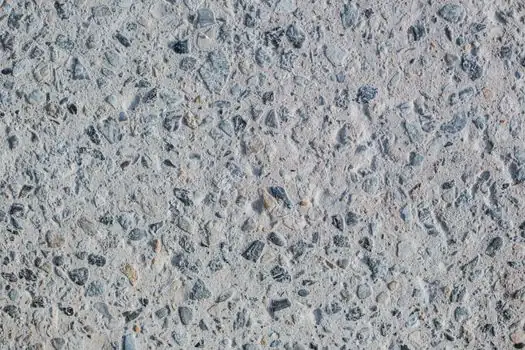
The table below lines up the five materials most often shortlisted for school projects against four decision criteria: Mohs hardness range, typical water absorption, recommended floor finish for wet zones, and expected service life in a maintained school corridor [S2][S4][S6].
Granite scores 6-7 Mohs, under 0.4% absorption, takes a flamed or honed finish in wet zones, and routinely exceeds 50 years of service [S2][S4]. Quartzite is comparable, with the same hardness envelope and slightly lower absorption on dense varieties; its aesthetic is typically lighter and more veined [S4]. Limestone drops to Mohs 3-4 and absorbs 0.5-3% water by weight, so a honed finish is the practical ceiling in any wet exposure, and service life is shorter in heavily cleaned areas; the design win is warmth and tradition, not hardness [S4][S6]. Slate runs 3-4 Mohs with a naturally cleft surface that gives it strong SCOF numbers out of the box, and 0.1-0.6% absorption on the dense metamorphic variants, which is why it is a default pick for restroom floors and entry vestibules [S6]. Travertine, a form of limestone with visible voids, reads warmer and more elegant but is the most porous of the group and is generally restricted to wall and low-traffic feature applications in schools [S6].
Failure modes and constraints specifiers have to plan around
Natural stone variability is the single most common cause of school-floor callbacks. No two pieces are exactly the same, and that variability, not the material itself, is what produces cracking, spalling, staining, and decay when stone is placed without a tested data sheet [S4]. The fix is procedural: require the quarry to ship with a current test report covering absorption, density, compressive strength, flexural strength, and abrasion, and reject lots without one. A growing share of the imported dimensional stone market still arrives without traceable documentation, so the specifier's job is to filter it out before it lands on a school loading dock [S4].
Cleaning chemistry is the second constraint. Institutional floor programs use alkaline strippers, acid descalers in restrooms, and disinfectant rotations, all of which will etch calcium-carbonate stones (limestone, travertine, marble) over time. On a K-12 corridor, this is why granite and quartzite dominate; on a donor lobby where marble is non-negotiable, the spec has to accept a honing and re-polishing cycle on a defined maintenance interval. For manufactured stone veneer exteriors, the binding and pointing mortars are the durability control, not the stone face; the Mapei technical guidance walks through substrate prep, lath, scratch coat, and movement-joint spacing that keep the assembly watertight over the same 30-50 year window [S3].
Standards, sourcing, and verification references

The Natural Stone Institute (NSI), successor to the Marble Institute of America and the Building Stone Institute, is the central U.S. specifier body for natural stone in schools, hospitals, and civic work; its 2026 program calendar includes a Vermont Study Tour, multiple Stone Summits, and a "Basics of Slate Selection, Fabrication, Installation, & Maintenance" continuing-education course on October 1, 2026 [S1]. The NSI also publishes the Dimension Stone Design Manual, which is the reference most U.S. architects cite for anchorage, cladding, and flooring detailing on institutional work [S1]. The National Building Stone Database, maintained by the Use Natural Stone campaign, remains a free index of stones used in American buildings and monuments and is a reasonable starting point for matching a quarry to a project [S5].
For manufactured stone veneer, the controlling documents are the product's ICC-ES evaluation report and the manufacturer's installation guide; Mapei's July 2025 technical article is one of the few 2025-dated sources that lays out the school-specific detailing decisions in plain language [S3]. Pair that with the building envelope's water-management code path (typically a referenced rainscreen and drainage plain standard in the local building code) and you have a defensible wall spec.
Two useful reference nodes to track after the spec is awarded: the Virginia Black Granite Stone of the Year program running through the NSI 2026 calendar, which is a free way to pull updated test data and case studies for a dense igneous material that fits the K-12 corridor use case [S1], and the 2026 Coverings expo in April 2027 (also surfaced in the NSI events feed) for sourcing both natural stone and stone-look porcelain alternatives on the same show floor [S1]. Readers comparing building stone to adjacent spec problems in cold storage or transportation infrastructure will find useful parallels in this spec map of building stone for cold storage warehouses and the broader industrial-material selection logic in our industrial valve selection reference.
For component-level specifications, see building stone, and building pipe hardware.