
Cold storage buildings carry 80-150 ft clear heights, 4,000-8,000 A service feeds, and slab temperatures that cycle through sub-zero setpoints, which rules out most natural stone as a primary load-bearing or envelope material [S2].
Frost heave, condensation, and thermal bridging are the three failure modes that govern every enclosure decision, so the practical question is not "which stone" but "where stone survives at all" and which engineered assemblies replace it where it does not [S1][S3].
Why natural stone is a poor primary envelope in sub-zero buildings
Continuous sub-zero exposure and freeze-thaw cycling make most natural stone unsuitable as a primary wall or floor component in cold storage, where moisture migration through the envelope is the dominant degradation driver [S1].
Insulated concrete, insulated metal panels (IMPs), and continuously insulated slab-on-grade systems are the structural envelope choices cited by cold-storage builders; stone appears at most as a thin decorative cladding separated from the cold zone by a full vapor barrier and continuous insulation [S1][S7]. The building stone category itself is rarely the spec target in this segment, which is why readers are usually steered toward systems that combine foam-glass or XPS underslab insulation with a sealed, fiber-reinforced concrete wearing surface [S3][S6].
Thermal and moisture limits that disqualify common stones
Frost heave mechanics require designers to keep floor subgrades dry and insulated, which means any porous stone in direct contact with the cold slab will accumulate internal ice and spall within a few seasonal cycles [S3][S6].
Layton Construction and IR Pros both list insulated concrete, IMPs, and protected membrane roofs as the canonical envelope, with the slab detailed specifically to "withstand varying temperatures and avoid heaving" rather than to perform as a finished wearing surface [S6][S7]. For spec-first projects, that means selecting stones with low water absorption, documented freeze-thaw ratings, and a separate ventilated or heated drainage plane, or omitting stone from the cold envelope entirely. Where a stone finish is required for branding or forklift abuse zones, dense igneous options such as premium basalt or fine-grained granite are the only realistic candidates, and even then they sit atop a heated, insulated slab rather than bonded to it [S1][S6].
Where stone still earns a place: aprons, plinths, vestibules, and exterior cladding
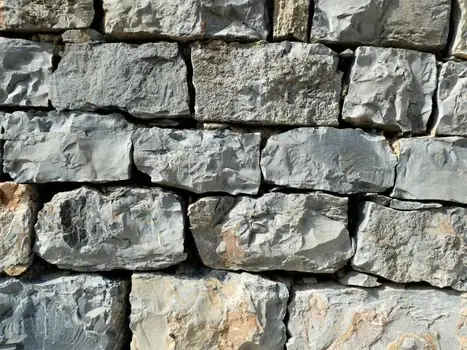
Cold storage design guidance treats the building envelope as a layered system, so stone survives where it stays outside the vapor barrier: exterior cladding, dock aprons, vestibule floors, and plinth bands up to the IMP base reveal [S1][S3].
AR Racking's August 2026 design guidance and Storage Building Company's May 2025 best-practices piece both place the structural envelope on insulated metal or concrete systems, leaving stone as a code-driven exterior finish for impact, weather, and aesthetics, not for thermal control [S4][S8]. For dock aprons and exterior paving, specifiers typically choose hard igneous stones with documented low absorption and high abrasion resistance, installed on a drained, frost-protected base; the same logic shows up in heavy-industrial storage handling zones where forklift abrasion and freeze-thaw cycling are routine [S4][S7].
Comparing candidate materials for the cold envelope
The practical selection matrix for cold storage envelopes compares four material families on cost, thermal performance, moisture tolerance, and forklift/abuse resistance: insulated metal panels, insulated concrete, natural stone, and engineered concrete toppings [S1][S6].
Insulated metal panels win on thermal performance and speed of erection, insulated concrete wins on structural mass and abuse tolerance, engineered concrete toppings with fiber or steel reinforcement win on slab flatness under cyclic thermal load, and natural stone only competes in non-thermal exterior zones where its appearance and impact resistance are needed [S1][S3][S6]. A useful rule of thumb from the design literature: if a surface sits inside the insulated vapor envelope, treat it as a wearing course over a structural concrete slab, not as a stone installation, because the freeze-thaw and condensation loads on that surface are fundamentally different from any interior building application [S1][S6].
Adjacent spec decisions: pallets, racks, and racking in the cold zone
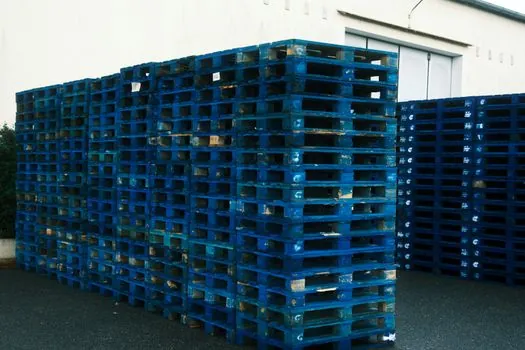
Material choices in the cold envelope are tightly coupled to storage rack and storage cage selection, because rack columns and cage mesh transfer point loads through the slab and define the floor flatness the wearing course must hold [S1][S2].
Automated cold storage buildings run 80-150 ft tall to house AS/RS, which concentrates vertical load and demands tighter floor flatness than a typical 30-40 ft dry warehouse, so the slab design that protects any stone finish must be coordinated with the racking layout from the schematic phase [S2]. Cold-chain pallet selection follows the same logic, with plastic pallets specified by zone, material, and load class rather than by generic catalog code, because sub-zero service drives both resin grade and rack-interface detail [S2].
Adjacent risks: chemical exposure, washdown, and weld-zone static
Many cold storage facilities sit next to food or pharmaceutical lines, which adds washdown chemistry, chloride exposure, and weld-zone static discharge to the material spec, none of which is solved by the stone layer itself [S3][S4].
For facilities with on-site welding, anti-static equipment selection for welding operations is a parallel decision that protects the same insulated envelope from spark and static damage, and the same logic of staying outside the vapor barrier applies. Where cleanability is the driver, the building stone in cleanroom walls case study shows why specifiers reject porous stone in hygienic environments and substitute sealed, non-absorbent assemblies, a pattern that carries directly into pharma-grade cold rooms [S3][S4].
Decision rules for the specifier
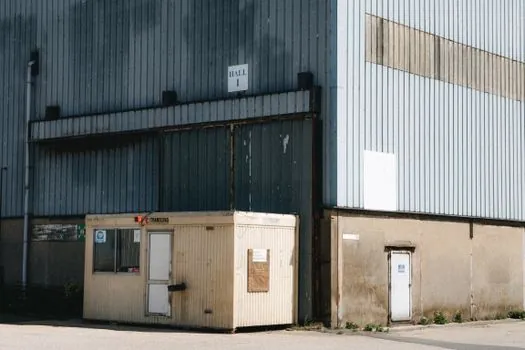
Use natural stone only in zones that sit outside the insulated vapor envelope, and require documented low water absorption plus a freeze-thaw rating that matches the local climate for any exterior or apron application [S1][S3].
Inside the cold envelope, default to insulated metal panels for walls and roofs and to fiber-reinforced, sealed concrete toppings for floors, treating any stone as a finish, not a structure, and integrating the choice with the racking, slab heating, and vapor-barrier layout from the schematic stage forward [S1][S6][S8]. Watch for two trackable signals over the next planning cycle: wider adoption of low-charge ammonia and CO2 refrigeration, which tightens envelope airtightness targets, and growth of 80-150 ft automated cold storage, which raises the bar on slab flatness and therefore on the engineering tolerance any stone finish must meet [S1][S2][S4].