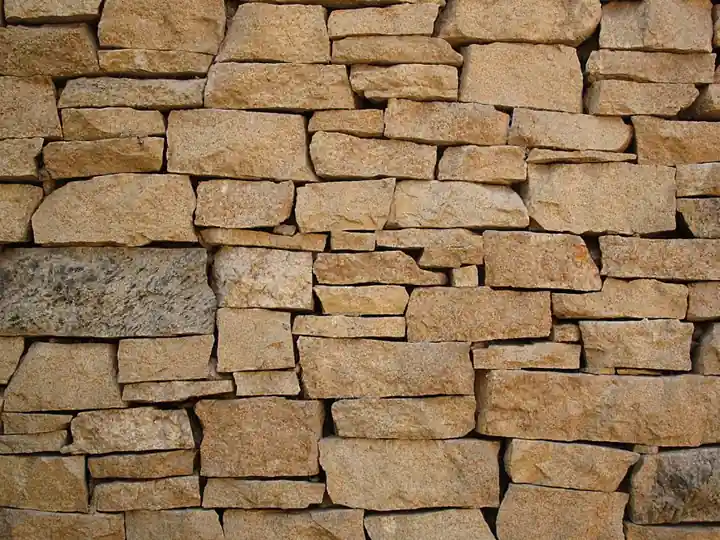
Specifying building stone for data center envelopes demands a tighter set of noncombustibility, fire-resistance, and acoustic-control criteria than a typical commercial facade, because most projects fall under IBC Group F-1 occupancy with NFPA 75 and NFPA 76 referenced by owners and insurers [S1].
LEED v4 or v4.1 BD+C: Data Centers applies to new whole-building data centers where at least 60% of the gross floor area is IT-ready at certification, and as of June 2026, more than 1,948 LEED-certified and registered data centers represent 588 million sq ft (over 54 million sq m) globally [S2]. A cladding decision that looks purely architectural on a residential project can become a code-driven decision on a data hall, and the building stone material choice has to be traced back to those envelopes.
Fire-resistance baseline: IBC Group F-1 and assembly-level ratings
Most data centers are classified as IBC Group F-1 occupancy, with Group S-1 used in some cases, and the required fire-resistance rating for walls, floors, and roofs is set by construction type and setback distance to adjacent property [S1]. Stone cladding is part of an assembly, not a standalone fire barrier, and the rating is established when the stone, substrate, insulation, and fixings are tested together as one listed system.
NFPA 75 (Standard for the Fire Protection of Information Technology Equipment) and NFPA 76 (Standard for the Fire Protection of Telecommunications Facilities) are commonly referenced by owners and insurers, but compliance is ultimately based on the codes adopted by the authority having jurisdiction [S1]. On a data center, that means the stone supplier must hand over an assembly test report (UL, FM, or equivalent) for the exact wall build-up, not just a stone-grade datasheet, and the building pipe hardware penetrations through the same wall have to be firestopped to the same listing.
Noncombustible stone wool behind the stone envelope
Noncombustible stone wool insulation, when specified and installed as part of tested assemblies, supports fire resistance, acoustic control, and thermal stability across the data center building envelope [S1]. Continuous stone wool in the exterior wall reduces thermal bridging and stabilizes interior temperatures, which directly helps control cooling demand in a space that already runs hot from server loads.
Inside the building, partitions and floor-ceiling assemblies must address high equipment noise levels, and effective acoustic control depends on assembly mass, airtight continuity, and the elimination of flanking paths, with stone wool cavity insulation absorbing sound energy within these assemblies [S1]. Stone cladding over a stone wool cavity gives a dense, noncombustible outer layer, but the acoustic number that matters is the partition STC, not the stone's individual density, so the design team should request the full assembly test rather than a single-material rating.
Material options: natural stone, sawn-and-split, and machine-cut
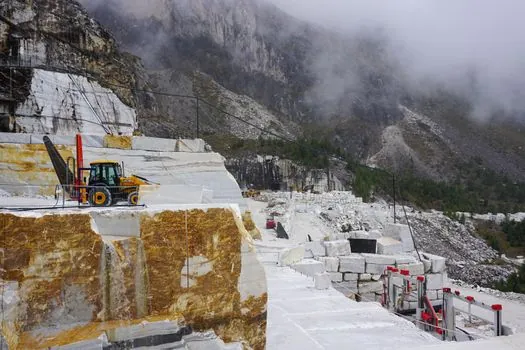
Forest of Dean Pennant Sandstone is offered in cropped, sawn-and-split, sawn-and-dressed, and ashlar forms, with cropped stone at nominal 100mm course width, split stone course heights of 65mm, 140mm, and 215mm at 100mm nominal width, and ashlar course heights up to 450mm at 75-100mm width [S3]. A sawn-and-split face tolerance of -/+ 15mm lets the mason absorb minor variation in modular cladding.
Machine-cut natural stone, as supplied by Mustech Concrete in Kenya, is sourced from quarries and precision-cut to give uniform size, smooth texture, and faster laying with less mortar, and is positioned for residential, commercial, and institutional builds that need consistent modular units [S4]. For U.S. data center shells, dimensional ledges from suppliers such as Mt. Moriah show 2" Ledge at 1.10 tons per pallet (2200 lbs) covering about 100 sq ft, full Ledge at roughly 40 sq ft per ton in 2 tons (4000 lbs) pallets, and 4" Rectangular Builders at about 50 sq ft per ton [S5]. Those pallet weights and coverage rates feed directly into crane, hoist, and on-site logistics planning for a 10-50 MW data hall build.
Mechanical and durability properties the spec must capture
Good building stone is selected on texture and appearance, hardness, density, porosity, and weather resistance, because these together control long-term durability, maintenance cost, and the visual identity of the structure [S6][S8]. A stone that looks right but absorbs more than a few percent by weight will fail under freeze-thaw cycles on a north-facing data center parapet, so water absorption and compressive strength should be on the datasheet before the sample board is even sent out.
Purchasing decisions should weigh quarry consistency, dimensional tolerance, finish type (split face, sawn, dressed, cropped, ashlar), and long-term maintenance, because poor-quality stone can lead to cracking, spalling, and accelerated weathering that drive up lifecycle cost [S7]. Cladding is judged on the basis of texture and appearance, hardness and toughness, density and porosity, and weather resistance, and these four parameters are the same ones a structural engineer will check on the cut-stone data sheet [S9].
Where natural stone fits the data center envelope, and where it does not

Natural stone is well suited to the data center perimeter envelope, equipment yard screen walls, entry lobbies, and acoustic barrier walls around generator yards, because those locations benefit from a noncombustible, dense, weather-resistant skin and from a cladding that does not add fuel load to the FM Approved roof assembly below [S1][S10]. The premium engineered stone veneer category, produced at industrial scale with 2000+ annual output capacity and global delivery programs, is increasingly used on data center exteriors where the spec calls for a 20-30 mm thick modular panel over a steel or concrete back-up wall [S10].
Natural stone is generally not a good fit for hot-aisle containment internals, server-room interior partitions, or any surface inside the data hall, where UL-listed gypsum or concrete block assemblies with mineral wool cavities carry the fire and acoustic ratings more cheaply per square foot, and where the thermal mass of stone works against precise cooling setpoints. For data center projects that also need underground utility routing, the industrial valve and chilled-water piping entering the building should be coordinated with the cladding layout so that stone coursing lines do not clash with pipe penetration sleeves in the same wall zone. A close comparison of building stone choices for residential construction shows the same materials in a lower-stakes code context, which is useful baseline reading for engineers new to data center envelopes.
LEED alignment and sustainability documentation
LEED is the world's first green building rating system to address data centers, and it adapts both BD+C and O+M rating systems to the technology sector, with the goal of consuming less energy and water, using fewer natural resources, and reducing the overall impact of development [S2]. For a BD+C: Data Centers project, the cladding spec has to feed documentation on materials credits, regional sourcing, and embodied carbon, and the quarry or factory certificates have to be available at design review, not at handover.
The LEED v5 BD+C: New Construction path is also available, and LEED BD+C: Core and Shell applies to whole-building data centers where more than 40% of the GFA is incomplete at certification, which is common in phased colocation deliveries [S2]. Choosing the right rating system up front changes which stone supply chain data the LEED reviewer will ask for, and a quarry without an EPD (Environmental Product Declaration) is a frequent cause of credit shortfalls in v4.1 material disclosure submissions.
Comparison of the main cladding options on decision criteria

Across the data center envelope, the realistic stone options line up as follows: natural sandstone (Forest of Dean Pennant, cropped or sawn-and-split) at 65-215mm course height and 100mm nominal width is the most weather-resistant and matches historic UK and EU vernacular [S3]; machine-cut natural stone (uniform modular units, smooth texture) is the most dimensionally consistent and the easiest to lay, which matters on large commercial and institutional sites [S4]; and premium engineered stone veneer (20-30 mm modular panels, 2000+ annual factory output) is the easiest to source globally and the lightest to fix back to structure, but requires a tested rainscreen or cavity assembly to reach the fire rating [S10]. Mt. Moriah-style dimensional ledges and rectangular builders in the 1.10-2.00 tons per pallet range remain a strong U.S. option for landscaping and screen walls but are generally too rustic for a primary data center facade [S5].
The four criteria that drive the call are noncombustibility and assembly fire rating, dimensional tolerance and modular coursing, embodied carbon and LEED documentation, and installed weight on the structure, with natural full-bed stone winning on durability and engineered veneer winning on global supply and weight. Projects that already have a chilled-water and flow meter layout locked in should not let the cladding package push structural steel tonnage past design, because a 100mm nominal full-bed stone at 2.2-2.6 t/m³ is roughly 5-7 times the dead load of an equivalent 30mm engineered veneer over a steel stud back-up wall.
Selection criteria and what to put in the spec
The spec writer should lock down stone type and quarry, finish (split, sawn, dressed, cropped, ashlar), dimensional tolerance in mm, water absorption percentage, compressive strength in MPa, density in kg/m³, and the tested wall assembly reference, plus the fixings and cavity build-up behind the stone [S3][S5][S7]. Coverage rate per ton and pallet weight should be specified so that the contractor can plan hoisting and laydown space without surprise crane picks, and the supplier's sample board has to be retained on site for comparison against delivered lots.
Quality factor language should be copied into the purchase order, because selecting high-quality building stone is one of the most critical decisions in any construction or architectural project, defining visual identity, durability, safety, long-term maintenance, and overall property value, with poor-quality stock leading to cracking, spalling, and accelerated weathering [S7]. For a data center, the safety line is even sharper: a failed cladding panel above a transformer yard is both a life-safety event and an unplanned outage trigger, so the pressure transmitter and gas-detection skids inside the envelope should not be the only life-safety systems on the project team.
Limits, failure modes, and what the spec does not solve
Stone cladding does not by itself give a fire rating, it only contributes to the listed assembly, and a beautiful ashlar face over a combustible backup wall will still fail an IBC F-1 review [S1]. Penetrations for cables, pipes, and services break the continuity of the enclosure and require listed firestop systems matched to the penetrant and the surrounding assembly, with mineral wool safing used only when it is specified as part of the tested system [S1].
Roof-mounted equipment is directly exposed to weather and impact, and selecting complete, tested roof assemblies (often FM Approved) helps manage fire exposure, wind uplift, hail impact, and long-term durability, but that roof assembly is separate from the wall cladding spec and has to be tracked on its own submittal log [S1]. If the data logger room and BMS rack share a wall with the stone-clad lobby, the wall assembly has to be specified for both STC and fire rating together, because adding mass for acoustics can change the fire listing.
Trackable signals for the next spec cycle
Watch the LEED v5 BD+C: New Construction uptake among data center projects through 2026-2027, because the shift in rating system will tighten materials documentation on cladding, including stone EPDs and regional sourcing claims [S2]. Watch the NFPA 75 and NFPA 76 revision cycles for any change to cladding and insulation requirements on Group F-1 and S-1 data halls, since those are the owner- and insurer-referenced standards behind most data center wall assemblies [S1].
Next, confirm with the project AHJ whether the data center wall assembly is being reviewed under IBC F-1 or S-1, and whether NFPA 75 or NFPA 76 is being enforced as a contract reference, because that answer sets the fire rating that the stone cladding assembly has to meet and the test report the supplier has to ship with the delivery.