
Hospitals typically spec 8,000 to 15,000 sq ft of stone per mid-size renovation, split across nurses' station tops, patient-room sills, lobby flooring, restroom vanities, and corridor cladding, with the work run as Division 03/04 submittals against ASTM C615 (granite) and ASTM C503 (marble) [S1].
Healthcare is the single largest end-use for institutional stone fabrication: procurement windows run 12 to 20 weeks for imported slabs, shop-drawing approvals add another 4 to 8 weeks, and inspectors actually check the absorption, flexural strength, and flatness numbers written into the spec [S1]. For a working reference of the materials covered here, see the building stone encyclopedia entry.
Material Type vs Hospital Application: Where Each Stone Earns Its Place
Granite (ASTM C615) is the default for hospital floors, staircases, nurses' station tops, and exterior cladding because of its hardness, low absorption, and 30 to 50 year service life, which is the design horizon administrators actually buy for [S1][S3].
Marble (ASTM C503) belongs in low-traffic interior walls, lobby feature walls, and decorative sills only; spec it where patients sit, not where gurneys roll, because its higher porosity and lower abrasion resistance make it a poor floor candidate under hospital cleaning regimens [S1][S3]. Travertine is most often used for building facades due to its strong adhesion to mortar and weather resistance, but it is not common inside hospitals because of its open porosity and the disinfectants used in daily cleaning [S3]. Engineered quartz (crystal/porcelain stone) carries low water absorption and high resistance to moisture, which is why K-12 and clinical labs spec it for lab counters, cafeteria lines, nurses' stations, and wet-area vanity tops [S1][S3]. The same porosity-vs-strength logic that drives this material split shows up in industrial pipe and valve selection; the building pipe hardware encyclopedia page is a useful cross-reference for engineers used to spec-driven procurement.
The Six Selection Criteria That Decide a Hospital Stone Submittal
Compressive strength, water absorption, color consistency, processing quality, thickness, and environmental resistance are the six quality factors that gate every hospital stone purchase, per current industry guidance published 2025-12-14 [S3].
Compressive strength matters most for floors, staircases, and exterior cladding exposed to wind load and temperature swings; high-quality stone must carry daily use and environmental stress without cracking [S3]. Water absorption drives the wet-area decision: high absorption causes staining, freeze-thaw damage, and surface erosion, while low absorption improves resistance to moisture, frost, and the harsh disinfectants used in hospital housekeeping; professionally processed stones test better on this axis [S3]. Color consistency and surface texture must be inspected slab to slab, looking for uniform color, stable texture, no cracks or weak veins, and no rust or salt deposits, especially for healthcare lobbies and patient-facing walls [S3]. Processing, cutting, and finishing must deliver precise dimensions, uniform thickness, smooth and even polishing, and clean edges without chipping, because the alternative is gaps and seam failures that inspectors will flag [S3]. Standard thickness must match the application: 2 cm for vertical cladding, 3 cm for counter tops, and engineered quartz in 1.2 cm to 2 cm slabs for healthcare vanity tops is now routine. Environmental resistance covers sunlight, temperature cycling, frost, humidity, and air pollution, with exterior hospital cladding the most exposed case [S3].
Stone Grading, Sourcing Lead Time, and Hospital Procurement Reality
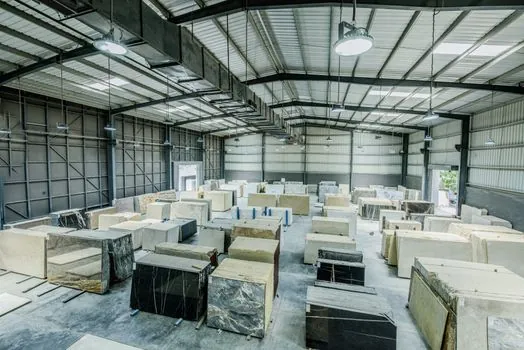
Building stone is sold in three commercial grades: Grade A (uniform color, minimal defects, used in luxury projects), Grade B (economical, acceptable quality), and Export Grade (highest processing and appearance standards), and the grade must be written into the Division 03/04 spec, not picked at the slab yard [S3].
Lead time is where hospital projects differ from residential kitchens. A residential template-to-install cycle runs 2 to 4 weeks; an institutional hospital build carries a 12 to 20 week procurement window for imported stone plus 4 to 8 weeks of shop-drawing review before any slab is cut [S1]. Volume runs to hundreds of slabs per hospital, and payment can lag fabrication by up to a year, so fabricators who do healthcare work need working capital the residential shops do not [S1]. On dimensioned natural building stone, Mt. Moriah's published product data shows pallet coverage in the 40 to 100 sq ft/pallet band, average pallet weight of 2,200 to 4,000 lb, and face heights from 1 in to 14 in depending on profile, which gives a real spec range for comparison across vendors [S4]. Engineered-quartz lead times from Asian fabs are commonly quoted at 6 to 7 days for samples and high on-time delivery rates, per published OEM metrics, but the numbers and country-of-origin must match the submittal sample the architect approved [S10].
Hygienic Surfaces: What Actually Works in Patient-Areas
For nurses' station tops, patient-room sills, and wet-area vanities, the spec should call out a non-porous engineered quartz or porcelain surface with documented chemical resistance to hospital-grade disinfectants, and inspectors should verify the surface against the approved submittal sample, not the supplier's marketing sheet [S1][S2].
Healthcare stone fabricators in the U.S. Midwest explicitly market "durable, hygienic" stone for hospitals, clinics, and dental offices, combining durability with sterile-environment design, and they reference quartzite, marble, and engineered quartz by trade name on completed healthcare installs [S2]. The Natural Stone Institute technical resources flag chemical resistance as a primary driver for quartz in lab settings, and the same logic applies to nurses' stations and exam-room casework [S1]. For exterior cladding on hospital towers, the key checks are ASTM C615 compliance, absorption below the spec ceiling (commonly 0.4% for granite), and bed depth tolerance: a 2 in ledge profile with 1 1/2 in to 2 1/4 in bed depth is a workable retrofit dimension when full-bed-depth stone will not fit the wall assembly, with coverage around 100 sq ft per pallet and average pallet weight of 1.10 tons (2,200 lb) [S4].
What NOT to Specify: Failure Modes Hospital Engineers See
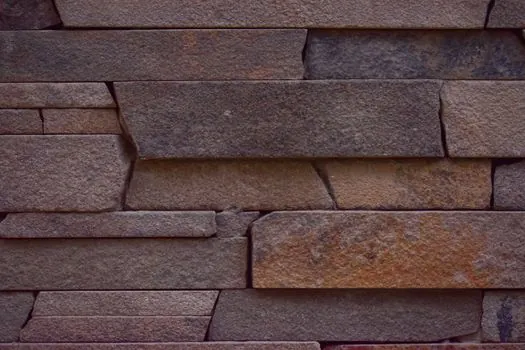
Travertine in patient-area floors, polished marble in corridor high-traffic lanes, and any unsealed natural stone in wet rooms are the three most common failure-mode picks, and each has a documented mechanism: open porosity traps biologicals, soft calcite wears under gurney traffic, and unsealed stone absorbs cleaning chemistry until it etches [S1][S3].
Marble in hospitals should be limited to interior walls and low-traffic floors, not corridors, lobbies with heavy foot traffic, or operating-room-adjacent areas; the wear and etch pattern shows up inside 18 months on a busy floor [S3]. Travertine's adhesion to mortar and weather resistance make it fine for facades but risky inside, where disinfectants and body fluids attack its open pore structure [S3]. K-12 and clinical labs moved to engineered quartz specifically for its non-porous surface and chemical resistance; hospital projects that ignore that lesson end up resealing natural stone every 12 months, which costs more over 20 years than the quartz premium upfront [S1]. Tile-format porcelain ("crystal stone") is the other underused option for wet areas: low water absorption and high moisture resistance, but the spec must call out the rectified edge and grout type, or the seam gap fails the hospital's infection-control audit [S3].
Submittal Mechanics: How Hospital Stone Actually Gets Approved
Hospital stone goes through a four-stage approval: material submittal against ASTM C615 or ASTM C503, shop-drawing review by the architect of record, a physical mock-up panel for color and finish approval, and a pre-installation seam and tolerance check, with each stage carrying a written sign-off before the next one opens [S1].
Institutional jobs run larger, tighter on spec, and slower to approve than residential jobs, and the fabricator answers to a general contractor, an architect of record, a construction manager, and sometimes a separate stone consultant, not the end user [S1]. Tolerances are written into the spec: a 1/16 in seam gap that a homeowner would accept in a kitchen will fail a hospital submittal, because inspectors check it against the ASTM C615 or C503 numbers and the Division 03/04 written tolerances [S1]. The shop must run CNC equipment with documented calibration, maintain ADA knowledge for vanity and counter heights, and keep certified crews, or the submittal bounces and the schedule slips by the full 4 to 8 week shop-drawing cycle [S1]. For engineers used to flow-meter and pressure-transmitter submittals on process jobs, the flow meter and pressure transmitter encyclopedia pages show the same four-stage logic on the instrumentation side and are useful cross-references.
Next signal to track: ASTM C615 and C503 revision activity in 2026, and any Division 03/04 spec updates from large U.S. hospital systems that tighten the absorption or flexural-strength ceiling for granite and marble; both will move hospital stone submittals inside the next 12 months. Related reading: Building Stone for Data Centers: Fire-Rated Cladding Spec Guide for the fire-rated cladding case, and Quartz Material Selection for Rail: Ballast, Composites, Interiors for engineered-quartz comparison data outside healthcare.