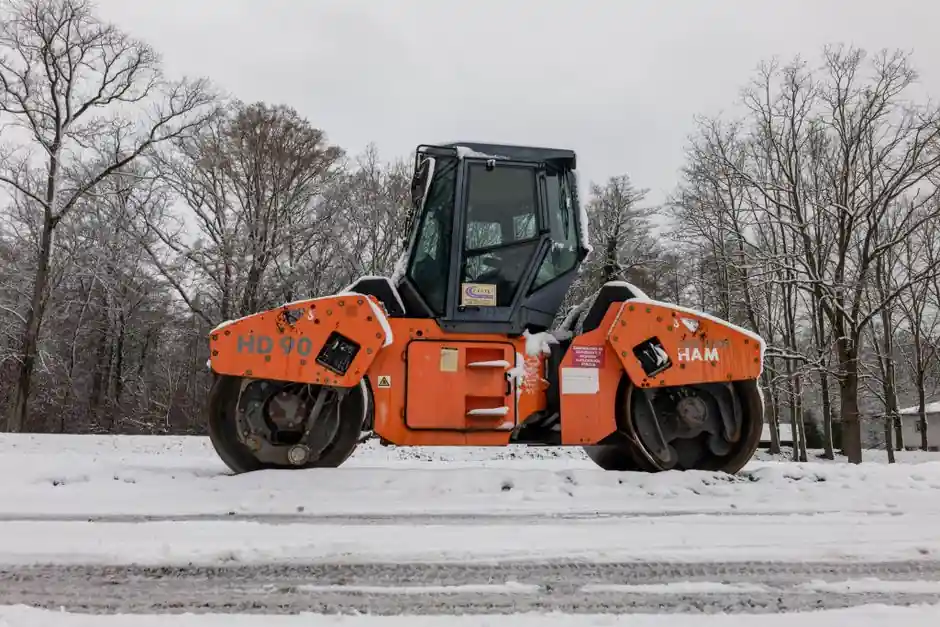
A bulldozer is a tracked earthmoving machine that pushes, spreads, cuts, and rough-grades soil or rock with a front blade, while a road roller is a compactor that densifies placed material through static weight, vibratory drums, or pneumatic tires [S1][S2]. The two machines sit at opposite ends of an earthwork sequence: the dozer prepares and shapes the grade, the roller locks that grade into a load-bearing surface.
Choosing between them is rarely a brand question, it is a phase question. Site clearing, ripping, and cut-and-fill call for a dozer; sub-base lift compaction, asphalt breakdown, and finish rolling call for a roller. Mis-sequencing is the most common reason crews spec the wrong tool [S1][S3].
Primary Function and Ground Interaction
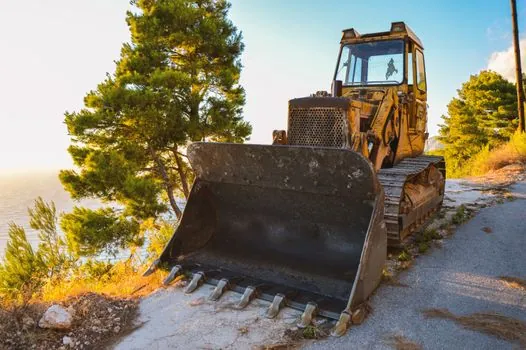
A bulldozer applies horizontal force through the blade to displace material, redistributing cut to fill and clearing vegetation, debris, or overburden; the resulting surface is shaped but not necessarily densified [S1]. A road roller applies vertical pressure and, on vibratory models, dynamic energy, to reduce air voids and raise in-place density of soil, gravel, or asphalt layers [S2][S5].
Dozer blade types, straight (S), universal (U), angle, and combination, are selected by material and cut geometry; a rear ripper (single or multi-shank) fractures hardpan or weathered rock before push-loading [S1]. Roller drums are specified as smooth (asphalt finish), padfoot or sheepsfoot (cohesive soil lifts, higher density per pass due to reduced contact area), or pneumatic-tire (kneading action, surface seal) [S2].
Design and Component Differences
Bulldozers run on continuous steel tracks that distribute weight and provide the tractive effort needed to push full blade loads without excessive slip; the undercarriage, not the engine alone, defines pushing capacity [S1][S3]. Most mid-size and large dozers add hydrostatic drive for infinite speed control and power to both tracks, with ripper attachments for hard-ground breakout [S1].
Road rollers use one or more large cylindrical drums (steel, smooth or padfoot) and, on most modern units, an eccentric-shaft vibratory mechanism that adds 1.5–3.0 kW-class dynamic energy per drum to the static deadweight [S2][S5]. Pneumatic-tire rollers substitute rubber tires for the drum array and rely on tire contact pressure and wheel load to knead and seal the lift. For mine haul-road and large freeway work, a four-wheel compactor with padfoot drum and a dozer-style blade, e.g., the Caterpillar 815/825 series, is a common choice because the blade spreads bulk fill while the padfoot drum compacts it in a single pass [S2].
Decision Criteria: Dozer vs Roller for the Same Site
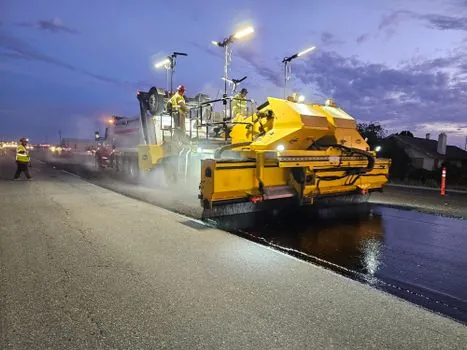
For a fleet planner, the four criteria that decide the buy are: (1) material state at handover (loose cut vs placed lift), (2) required output metric (cubic meters pushed per hour vs density achieved per pass), (3) ground condition (steep, soft, rocky vs graded, dry, lift-by-lift), and (4) finish tolerance (rough grade to ±50 mm vs compacted surface to a specified percent of maximum dry density, typically 95–98% on road subgrade) [S1][S2][S3].
A dozer wins on criteria 1, 3, and 4 when the surface is rough; a roller wins on criteria 2 and 4 when the surface must be dense. Where bulk fill is placed faster than a dedicated roller can compact it, a compactor-dozer hybrid (e.g., 815/825 class) collapses two operations into one and removes a spotting bottleneck from the cycle [S2]. For a deeper look at how roller-bearing selection affects drum vibration systems, see the roller-bearing reference page.
Use Cases: Who Needs Which Machine
Bulldozers are the right tool for mine overburden stripping, road-cuts through rock or hard clay, land clearing for forestry and agriculture, and rough grading ahead of a motor-grader pass; they also serve as recovery and push-support units for scrapers and off-highway trucks [S3][S5]. A dozer's versatility is its main selling point: one machine can clear, rip, push, spread, and rough-grade across a full job [S1].
Road rollers are the right tool for subgrade and sub-base lift compaction, base-course finishing, asphalt breakdown and intermediate rolling, and trench backfill compaction on utility and structural foundations [S2][S4][S5]. Static rollers handle finish work on hot-mix asphalt where vibration could fracture aggregate, while vibratory rollers carry the bulk of soil and base-course work. Pneumatic-tire rollers are typically reserved for the final seal pass on asphalt and for sealing clay-lift surfaces. For jobs where a single crew needs to spread and compact in one pass, a compactor-dozer covers the role, as detailed in this spec note on mining dump truck selection for road construction: payload, haul road, and cycle match.
Limitations and Failure Modes
A bulldozer cannot densify what it pushes; a layer left unrolled will settle under traffic and fail the proof-roll, no matter how cleanly it was graded [S1][S2]. A road roller cannot move material laterally in any useful volume; a roller chasing a poorly placed lift simply re-distributes fines and creates a smooth but under-dense surface [S2].
Dozer undercarriage wear is the dominant cost driver on tracked machines, especially in rocky or highly abrasive soils, and chain, sprocket, and roller maintenance is a major share of owning cost. On rollers, vibratory bearing failure and drum-shell cracking from over-compaction of stiff bases are the most common shop-killed components; padfoot tips also wear and must be re-welded or replaced as the contact area grows and density-per-pass falls. For conveyor-fed aggregate operations that feed either machine, a roller-conveyor spec note covers matching belt speed to drum loading.
Workflow Sequencing on a Typical Road Job
On a greenfield road, the standard sequence is: (1) dozer clearing and topsoil strip, (2) dozer (or scraper-assisted) cut-and-fill to rough grade, (3) motor grader finish grade to design cross-fall, (4) padfoot roller compaction of subgrade lifts, (5) smooth-drum vibratory roller on base-course lifts, (6) pneumatic-tire or static roller on asphalt finish layers [S1][S3][S4]. The grader sits between the dozer and roller in this chain, handling fine shaping that neither the dozer nor the roller can deliver efficiently.
Skipping the roller step because the surface "looks tight" is the most common cause of early pavement failure, including rutting, settlement at utility trenches, and water-pumping at the base-asphalt interface [S2]. Conversely, sending a roller onto a lift that has not been graded to tolerance forces the operator to chase thickness with the drum, which over-compacts thin spots and under-compacts thick ones.
Selection Logic and Trackable Signals
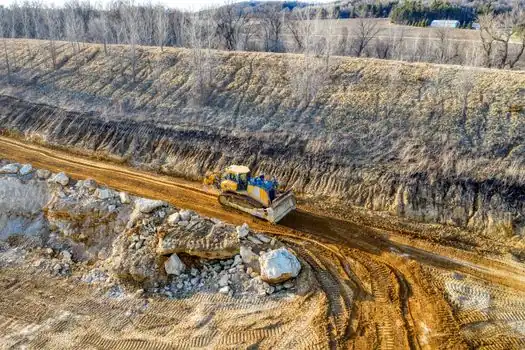
For a new site, the rule of thumb is one dozer per active cut face, one motor grader per 600–800 m of finished grade per shift, and one roller per 200–300 m³ of placed lift per hour, scaled to lift thickness and material type [S1][S3][S4]. If lift placement is outrunning compaction, the bottleneck is roller capacity, and adding a compactor-dozer or a second vibratory unit is the lower-cost fix compared to slowing the dozers.
Trackable signals to watch over the next planning cycle: OEM updates to padfoot drum geometry on soil compactors (tip area and tip count directly affect lift density), wider adoption of hydrostatic drive on mid-size dozers (cuts fuel use in low-load clearing work), and tighter spec'ing of vibratory amplitude/frequency pairs to match lift thickness rather than using one default setting across the fleet [S2][S5].