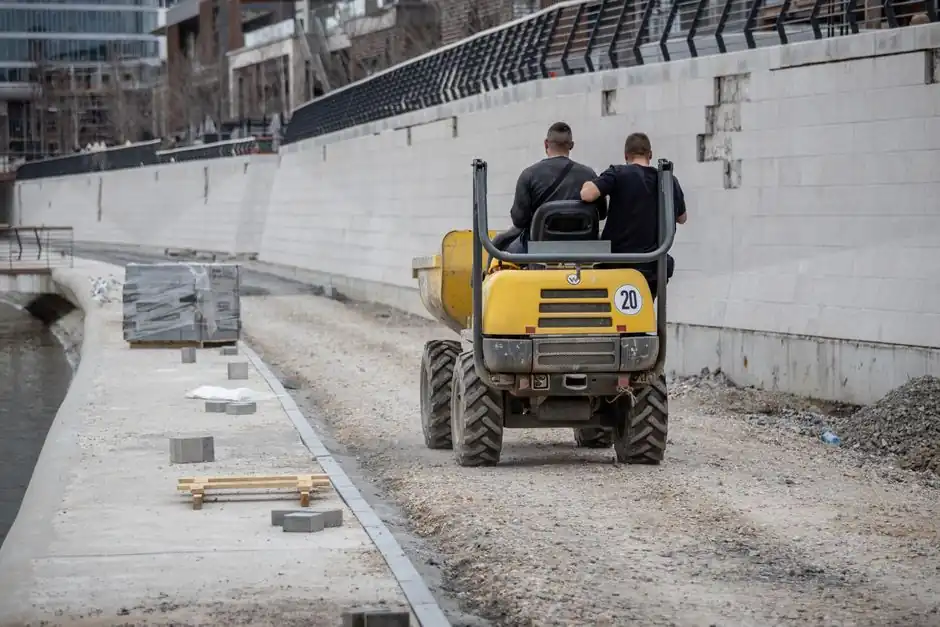
A 32,000 lb payload tier marks the practical lower edge of mining-class haulers for roadbed work, with rigid frame machines reaching beyond 300 tonnes in ultra-class configurations [S4][S5].
The right pick depends on three hard constraints: the subgrade you actually have on day one, the daily tonnage your paving train must consume, and whether the truck must also run public roads. Get any of these wrong and the fleet either burns fuel standing still or destroys the very alignment it is supposed to build.
Why payload class sets the entire decision tree
Mining dump trucks are typically parked in three payload bands: 30-40 t mid-size, 90-150 t rigid frame, and 200-300+ t ultra-class, with the first band already pushing into on-road Class 8 territory above 33,000 lb [S2][S5]. For a single 7 m wide two-lane roadbed, the cycle math usually starts at 800-1,200 t per paving shift for subbase stone alone, which is the threshold where a single rigid hauler out-cycles a fleet of highway 6x4 dumps.
If daily volume sits below 600 t, the capital and tire wear of a rigid 100 t class unit cannot be amortized, and a 40-45 t articulated dump truck (ADT) becomes the economic floor. Sany's 2026 type guide also fixes the drive-form split for road construction haul: 4x2 for short light moves, 6x4 for urban spoil, and 8x4 multi-axle as the core large-tonnage configuration where axle-load limits apply [S2].
Rigid frame haulers vs ADTs: the haul-road fork
Volvo's January 2026 overburden guidance frames the choice in a single line: rigid haulers only pay on "stable, firm and meticulously maintained" haul roads, while ADTs tolerate soft, steep, inconsistent terrain by default [S1]. A new road corridor is, by definition, inconsistent terrain for the first 6-18 months of the project, until the embankment reaches design compaction.
The practical comparison reads:
Rigid frame truck: 90-300+ t payload, lower cost-per-ton on long cycles, demands high-quality haul road, sensitive to thick mud, not street-legal [S5].
Articulated dump truck (ADT): 25-45 t payload, permanent all-wheel drive, oscillating hitch, runs soft ground and grades above 12%, works as multi-purpose machine between paving seasons [S1][S5].
On-road Class 8 dump: 15-32 t payload, 6x4 or 8x4 chassis, homologated for public roads, cheapest per unit, lowest ground pressure per ton but slowest cycle in off-pit conditions [S2][S5].
For a greenfield road job, the typical fleet is one ADT-heavy set during earthworks and drainage, then a partial swap to rigid haulers once the subgrade is trafficable, with on-road Class 8 trucks feeding the paver from the batch plant.
Matching truck type to the four stages of road construction
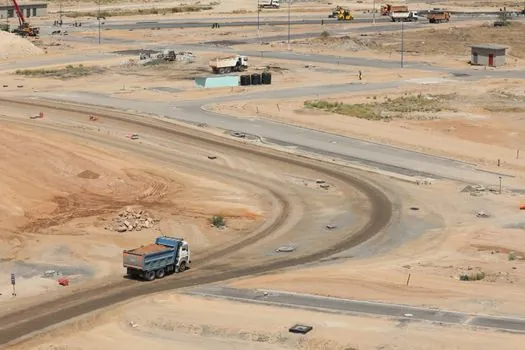
Stage 1, clearing and bulk earthworks: 30-45 t ADTs move 800-1,500 m3 per shift on uncleared ground because the 6x6 permanent drive and articulated frame absorb stumps and ruts that would high-center a rigid unit [S1][S5]. EquipmentShare's 2025 industry breakdown puts 32,000 lb load capacity at the practical floor for "large-scale construction projects and road maintenance" [S4].
Stage 2, subbase and cement stabilization: 40-100 t rigid haulers start to make sense once the haul road is graded and compacted, because cycle time on a 2-4 km loop drops by 25-40% versus an ADT on the same alignment [S1].
Stage 3, base course and asphalt feed: on-road 6x4 or 8x4 dumps (Class 7-8) take over from the batch plant to the paver, because the 26,001-33,000 lb (Class 7) and 33,000+ lb (Class 8) tiers meet public-road axle limits without permits [S2].
Stage 4, shoulder finishing and clean-up: smaller standard dump trucks up to 16 t and belly dumps at 28 t handle windrow material and shoulder aggregate, with the belly dump's 28 t capacity specifically called out as the road-construction workhorse for aggregate spreading [S7].
Selection criteria engineers should lock in writing
Haul road quality is the single most expensive variable. Volvo's analysis ties the rigid truck's superior cost-per-ton to "substantial and continuous capital investment" in the road itself, while an ADT substitutes that capex for tire and driveline wear [S1]. For a 2 km access built on clay, the roadbed cost to make it rigid-truck-friendly typically runs 3-5x the ADT's annual tire budget.
Dump mechanism should match material behavior. Rear-dump bodies handle blasted rock and sticky clay, side-dump trailers spread base aggregate in a single pass without a grader, and bottom-dump (belly dump) units place windrow aggregate for immediate spreading, which is why the 28 t belly dump is singled out for paving support [S7]. For roadbed rock, a heavy-duty rear tipping body on a rigid frame remains the default [S5].
Drive configuration and axle load must satisfy both the mine and the public-road authority. Multi-axle 8x4 layouts distribute load to stay inside bridge and pavement limits when the same truck feeds both the pit and a municipal batch plant [S2]. A machine that is over-axle on the public road is over-legal, regardless of how well it cycles on-site.
Use cases where a mining dump truck is the wrong tool

For urban street reconstruction under 500 t per shift, a single Class 7 dump on a 6x4 chassis cycles faster, needs no pilot truck, and avoids the off-highway tire cost that dominates ADT operating expense [S2][S4]. For tunnel or underground drainage work, neither rigid nor ADT is specified; underground dump trucks are a separate design with reduced height and diesel particulate filters for confined-space operation [S5].
For short-term spot haul under 6 months, renting an ADT fleet from a third party avoids capex but introduces "safety and logistical challenges from managing external crews and unfamiliar equipment," per Volvo's 2026 framing [S1]. On owner-operator road jobs, that trade-off usually breaks against rental.
For a deeper look at how dump trucks pair with the paving side of the fleet, the dump truck selection map for port and terminal work applies a similar payload-vs-terrain matrix to a different haul cycle, and the road roller spec map for cold-weather work covers the compaction stage that follows the trucks.
Sourcing, standards, and the data behind the decision
Dump truck payload tiers used in this article trace to Sany's December 2025 classification by GVWR class (Class 1-8) and to Sibo's May 2026 mining/construction category split, which lists rigid, articulated, underground, and on-road as the four primary structural types [S2][S5]. Caterpillar's off-highway truck product page confirms the same four-bucket taxonomy across mining, quarry, and construction duty cycles [S3].
Haul-road investment logic and the rigid-vs-ADT economic break-even come from Volvo Construction Equipment's January 2026 overburden selection guide [S1]. The 32,000 lb payload floor for large-scale road work and the belly-dump 28 t capacity for paving support both come from 2025 industry references [S4][S7].
Two trackable signals to watch before the next equipment buy: ADT manufacturer extension of electric-drive prototypes into the 40-45 t class, and any tightening of public-road axle-load enforcement that would push more contractors toward 8x4 multi-axle configs to stay legal at higher gross weights. For related equipment beyond the haul fleet, truck-mounted crane selection for mining covers the lifting side of the same job site.
For component-level specifications, see mining dump truck, dump truck, and road roller.