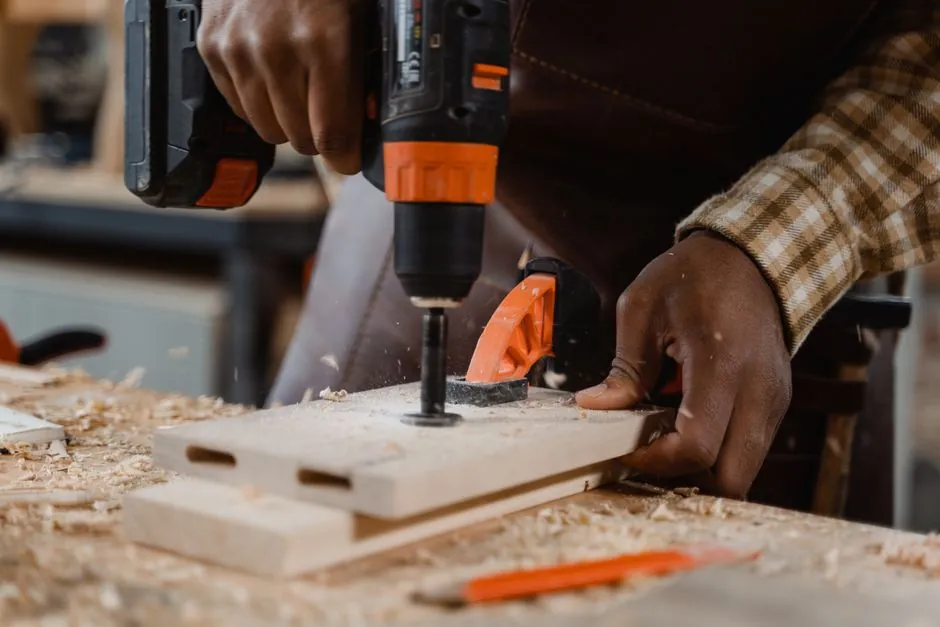
Granite ranks 6 to 7 on the Mohs hardness scale, sits well above the cutting ability of standard HSS twist drills, and reacts badly to percussive shock, so a hammer drill's hammer action will chip or crack the stone, while a rotary-mode hammer drill paired with a diamond-tipped bit is the field-proven combination for clean holes [S2][S1].
The short answer: yes, a hammer drill can produce a hole in granite, but only when the hammer mechanism is switched off and the tool is used as a straight rotary drill with a diamond-impregnated bit or diamond core saw, with water as the cutting fluid and a flat plywood or MDF backing under the workpiece [S2][S1].
Hammer Action vs Rotary Action on Granite
Granite's quartz content (typically 20-40% by volume) makes it both abrasive and brittle, so the percussive blows of a hammer drill in hammer mode tend to propagate micro-cracks along grain boundaries, and field reports describe tiles and 12-inch marker blanks cracking at or near the edge when the hammer function is left engaged [S1]. For the same reason, the recommended tool is a high-torque rotary drill at low speed, and where a hammer drill is the only tool on site, the published guidance is unambiguous: turn the hammer selector to rotary-only before touching the stone [S2]. This single change converts the tool from a granite-cracking risk into an acceptable, if slow, drive for a diamond bit.
Standard household corded drills (typically 280-500 W, no hammer mode) lack the rotational torque to keep a diamond bit engaged without skating, and they overheat diamond segments within seconds, so for holes larger than about 6 mm in true granite, a variable-speed drill rated above roughly 600 W is the practical floor [S2]. Angle grinders with 4.5-inch diamond cutting wheels are usable for slotting or enlarging an existing hole, but starting a clean, round hole with a grinder is described as high-risk because the disc walks on the polished stone surface [S2].
Bit Selection: Diamond vs Carbide on Granite
Carbide-tipped masonry bits are designed for brick and concrete with compressive strengths in the 10-40 MPa range, and they will dull within a few holes on granite, which tests at 100-250 MPa compressive strength; field accounts report burning through 4 bits to complete 5 holes in granite, with a fourth of the bits failing per hole on average [S1][S2]. Diamond-tipped bits and diamond core hole saws use industrial diamond grit (Mohs 10) to abrade rather than cut the stone, and they are the only practical choice for repeated holes in true granite [S2][S3].
A typical specification set for a 6-10 mm pilot bit in granite is a sintered diamond-impregnated crown with a continuous or segmented rim, run at 600-1,200 RPM no-load, with feed pressure light enough that the operator feels the bit grinding rather than riding on the surface [S2][S4]. For diameters above roughly 25 mm, such as faucet or pipe penetrations, a diamond core hole saw is the standard tool because the annular cutting geometry removes a kerf rather than the full slug, cutting both time and bit wear [S2].
Technique: Pilot Hole, Water Cooling, and Backing
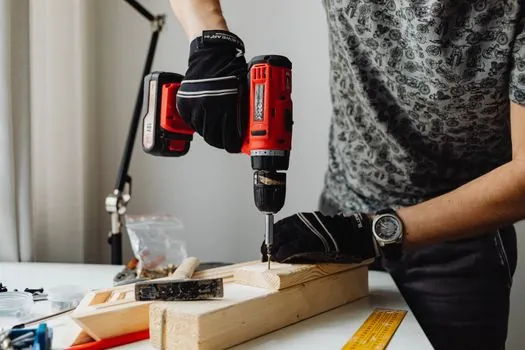
The first sentence of any competent how-to on granite drilling is the same: keep the diamond bit wet, because the diamond bond fails above roughly 600-800 C and dry drilling on granite will destroy the bit in under a minute [S2][S3][S4]. A common shop-built method is a clay or plumber's-putty dam built around the marked hole location, holding a reservoir of water that feeds the cutting zone throughout the pass, with one experienced fabricator reporting 3-4 clean holes per Hitachi diamond bit on marble and similar life on a single granite hole attempt [S1]. Turpentine is also cited as a coolant for diamond core drills when water is unsuitable, though water remains the default [S1].
Starting the hole is the highest-risk step: the bit wants to skate on the polished surface, so a Dremel or rotary tool with a ball-shaped diamond burr is used to put a shallow divot at the target location before the main bit engages [S1]. A flat plywood or MDF sacrificial board is placed under the workpiece so the bit exits into a compressible material rather than blowing out the back face of the stone, and the workpiece is clamped or weighted to prevent rotation [S1][S2]. Drilling pressure is described as "boredom light," the point at which the operator feels the urge to push harder is exactly where bits snap and stone cracks [S1].
Failure Modes and When Not to Use a Hammer Drill
Edge proximity is the single most common cause of granite cracking: a hole within roughly 25-40 mm of a finished edge, particularly on a 12 mm tile, will almost always fracture the slab when a hammer drill is used in hammer mode, and a fabricator with multiple failed projects specifically warns "DON'T use a hammer drill" for through-holes in 12-inch granite tile markers [S1]. The same constraint applies to any thin section: tiles, splashbacks, and pre-cut countertop off-cuts below about 20 mm thickness are treated as hammer-no-go even with diamond bits, because flexure under percussive load will spall the back face [S1].
Overheating is the second failure mode and the most common reason for shortened diamond-bit life: once the segment matrix glazes, the bit polishes the stone without cutting and the operator compensates with more force, which then cracks the workpiece [S1][S3]. The diagnostic signal is loss of cutting dust (slurry turning to clear water or no water at all), and the corrective action is to stop, re-flood the dam, and let the bit cool before resuming, because pushing through a glazed bit is what destroys both the tool and the hole [S2][S3].
Comparison: Tool Options for Drilling Granite
On a 6-10 mm through-hole in 20-30 mm granite, the practical tool choices line up against four criteria: cracking risk, bit life, hole quality, and operator skill required, and the matrix is consistent across manufacturer and field sources [S1][S2].
Standard corded drill with HSS bit: high cracking risk (bit skate + no abrasive), zero effective bit life on granite, poor hole quality, low skill, not recommended [S2]. Hammer drill in hammer mode with carbide masonry bit: high cracking risk, 1-2 holes per bit, fair hole quality, low skill, explicitly cautioned against for tiles and edges [S1][S2]. Rotary drill (or hammer drill, hammer OFF) with diamond-tipped bit, water cooled: low cracking risk, 3-10 holes per bit depending on diameter and granite hardness, good hole quality, moderate skill, recommended [S1][S2][S3]. Drill press with diamond core saw, water fed: very low cracking risk (controlled feed), 20+ holes per core, excellent roundness, low-to-moderate skill, best for repeatable production runs [S1].
Standards, PPE, and Shop Setup
No single ISO or EN standard governs hand-held drilling of dimension stone, but the cutting-fluid and dust-control practices overlap with general abrasive-wheel guidance, and the consistent PPE recommendation across sources is safety glasses, a dust mask or respirator (silica dust is a respiratory hazard and granite dust is classified as a silica-containing nuisance dust), hearing protection during any hammer-mode drilling, and wet cutting wherever the dust would otherwise be airborne [S2][S3]. For tile and stone cutting adjacent to installed countertops, the broader EN 12492 versus EN 397 helmet standard decision map covers head protection, though for a stationary shop drilling granite, a basic impact-rated hard hat is generally not the controlling PPE; the respirator is.
Workpiece support matters as much as tool choice: a wobbly tile is a cracked tile, and every documented successful job uses a flat plywood, MDF, or rigid-foam backing board under the stone, with the workpiece either clamped or weighted to prevent rotation when the bit breaks through [S1]. On a fixed installation such as a mounted countertop, a sacrificial wood plate hot-glued or taped over the drill zone serves the same function and prevents spalling on the visible face [S2].
Verdict and Field Signals to Watch
For anyone asking the original question, the field answer is consistent: a hammer drill in hammer mode will not reliably drill through granite without cracking it, and the safe, repeatable path is a rotary-mode drill with a diamond bit, water cooling, low RPM, and a backing board, with the same answer from fabricators, tool makers, and stone-shop guides [S1][S2][S3]. If the only tool available is a hammer drill, switching off the hammer function is non-negotiable, and if a carbide bit is the only bit available, expect to burn through several per hole and accept that the edge-distance and thickness limits tighten accordingly [S1][S2].
Trackable signals: water turning from grey slurry to clear indicates the diamond bond is glazing and the bit is about to fail, and a sudden drop in feed resistance mid-hole usually means the bit has chipped or the workpiece has micro-cracked and the pass should be stopped for inspection. The related EN 14052 vs EN 397 helmet spec decision map for 2026 procurement covers head protection for the broader stone-shop environment, while measuring existing surface slope with a laser level is the usual upstream step before any faucet or sink penetration is laid out on a granite top.
For the relevant spec sheets and selection criteria, see impact drill, pressure transmitter, and flow meter.