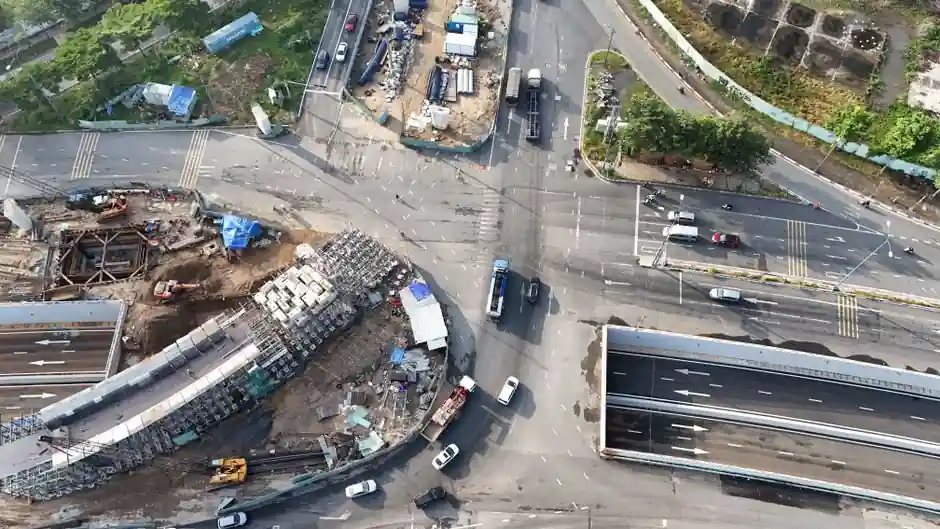
For road maintenance crews, the term "climbing formwork" almost always means a misread: most pavement, kerb, and deck-slab repairs are horizontal work, and a cantilever climbing formwork array is designed for vertical, repetitive wall pours, not for thin-bonded overlays or joint replacements [S1][S3].
Where road maintenance genuinely meets climbing formwork is on the vertical concrete attached to a road: bridge piers, pier caps, abutment walls, headwalls, MSE wingwalls, and tall retaining structures. On those elements, the choice between crane-climbed jump form, self-climbing (automatic) form, and single-sided climbing form is driven by pour height, repetition, fresh-concrete pressure, and crane availability, not by the road surface itself [S1][S4].
What a climbing formwork actually is on a road job
A climbing formwork assembly mounts a large wall form on a climbing scaffold, with brackets anchored into the previous lift so wind load, dead load, and fresh-concrete pressure are transferred into the already-cured concrete rather than into opposing ties [S1]. On a road maintenance project, that means the first pour establishes the anchor pattern, and every subsequent lift re-uses the same suspension shoes, screws, and bracket geometry, producing a seamless wall finish that is hard to match with handset gang forms [S1][S4].
For an abutment wall or pier shaft, the typical lift is 3.0–4.2 m, the form panel is ganged to full wall height (commonly 10–14 ft / 3.0–4.3 m in US practice), and the bracket spacing follows the anchor layout left from the previous pour [S4]. A self-climbing system can raise one floor height in 30–60 minutes once the concrete has cured to the stripping strength specified by the form supplier [S4].
Road maintenance tasks where climbing formwork is the right call
Climbing formwork earns its cost on road jobs when four conditions stack up: pour height above roughly 6 m, repetition of at least 3–4 identical lifts, a wall geometry that is straight or only gently varying, and a site where crane time is expensive or weather windows are short [S1][S4][S3]. On a 12 m pier shaft with five identical 2.4 m lifts, a self-climbing system removes 4–5 crane picks per day and lets rebar, embed, and concrete placement continue in wind conditions that would shut down a crane-climbed jump form [S1].
It is also a strong fit for bridge piers over live traffic, where falling-object risk rules out loose scaffolding and where the climbing platform itself acts as a full-height safety screen [S1][S4]. For an MSE wingwall or tall headwall, single-sided climbing formwork is often the only option, because fresh-concrete pressure is transferred into the previous lift through wall struts rather than through ties to an opposing form, which is critical when one face of the wall is against an existing embankment or structure [S1].
Tasks where climbing formwork is the wrong tool
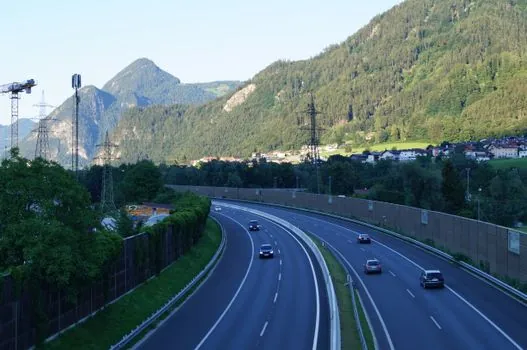
Cantilever climbing formwork is a poor match for deck-slab soffit repairs, parapet patching, kerb replacement, or thin bonded overlays: the work is horizontal or near-horizontal, the repetition count is too low to recover bracket and anchor costs, and the access logic is scaffolding or gantry, not climbing brackets anchored in a previous lift [S3][S4]. A slip form paver or conventional handset form is faster and cheaper for any pour shorter than roughly 4 m or any element with fewer than 3 repeats [S4].
It is also the wrong tool on a single, non-repetitive repair, on a wall with many openings or step-outs, or on a site where the concrete mix cannot reach the early-strength stripping value the climbing system's cycle time assumes. If the spec calls for a 24-hour cure before stripping and the schedule demands a 12-hour cycle, no climbing system will save the project, and a handset gang form is the honest answer [S4].
Selection criteria: crane-climbed, self-climbing, and single-sided compared
The three main options line up against four decision criteria that matter on a road maintenance contract:
Crane-climbed (jump form) is the simplest and least expensive hardware, but it ties up the tower crane for every form move, which is tolerable on a low-rise abutment (under 8 m) and painful on a tall pier where the crane is needed for rebar cages and pier-cap falsework [S1][S4]. Self-climbing (automatic) form uses hydraulic rams anchored to the cured concrete to lift scaffold, formwork, and secondary formwork in one motion, frees the crane for other lifts, and tolerates higher winds, but adds hydraulic power packs, rail systems, and pre-assembly yard space [S1][S5][S6]. A typical self-climbing system raises one floor height in 30–60 minutes versus a crane pick cycle of 15–30 minutes plus rigging, but the real saving is the cumulative 4–6 hours of crane time per day on a tall pier [S4].
Single-sided climbing formwork transfers fresh-concrete pressure through wall struts into the previous lift, making it the only workable climbing option when one face of the wall is against existing ground or structure, which is common on dam retrofits, sluice upgrades, and headwall extensions next to an active road embankment [S1]. For tall, repetitive piers in open air, the self-climbing hydraulic system is the higher-spec default; for short abutment walls with crane access, crane-climbed jump form is the rational pick [S1][S4][S5].
Loading, cycle time, and safety screens: the numbers that decide the spec
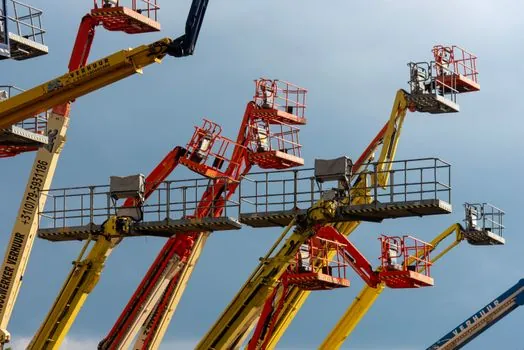
Design capacity is the first number a spec engineer should pin down: the formwork assembly must carry the hydrostatic fresh-concrete pressure for the full lift height, plus wind load on the form face and the working platforms, plus live load from the crew, rebar, and embed plates [S1][S3]. A 4.0 m lift at standard concrete density and a 1.5–2.0 m/h placement rate produces lateral pressures in the 60–80 kN/m² range at the base of the form, which is what drives the bracket spacing and tie pattern in the supplier's calc note [S1].
Cycle time is the second number: on a self-climbing system the climbing mechanism is rated for one floor height per 30–60 minute cycle, with the hydraulic jacks or electric motors anchored to rails or shoes left in the previous lift, so the bottleneck is concrete strength at stripping rather than the climb itself [S4][S6]. Safety screens wrap the full platform perimeter on tall pier work; on road jobs over live traffic they are not optional, and they are the reason a climbing system is preferred over loose tubular scaffolding on a pier within 2–3 m of a traffic lane [S1][S4].
On-site checks before the first pour
Before the first pour, verify three things against the supplier's submittal: that the anchor pattern cast into the kicker matches the climbing bracket geometry to within the supplier's tolerance (commonly ±5 mm on position), that the stripping-strength concrete mix has been validated by cube or cylinder tests at the same ambient conditions the pour will happen in, and that the hydraulic power pack on a self-climbing unit has a redundant manual override for power-loss scenarios [S1][S4][S6].
On a road maintenance contract, also confirm that the climbing sequence is locked into the traffic-management plan: a climbing cycle that swings formwork over a live lane needs a full road closure permit, and on many highways the only available window is night-time, which sets the concrete supply, lighting, and crew-shift plan well before the first bracket is bolted on [S3][S4].
Failure modes and when to stop, not repair
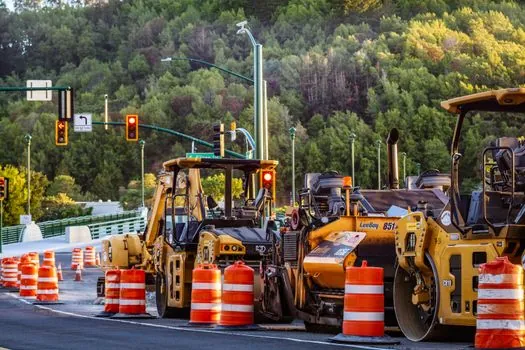
The two failure modes that end a climbing formwork cycle on a road job are anchor pull-out from under-cured concrete and hydraulic-jack drift on a self-climber [S1][S4]. Anchor pull-out is identified by concrete spalling around the suspension shoe or by visible elongation of the anchor under load; the corrective action is to stop climbing, back the form down to the previous safe anchor, and re-pour the affected lift, not to weld or plate over a pulled anchor. Hydraulic-jack drift shows up as a form that is not plumb after a climb; if re-plumbing takes more than two attempts, the jack seals or rail guides are suspect and the unit should be taken out of service rather than forced, because a leaning 4 m form on a pier over live traffic is an immediate collapse hazard [S1][S4].
Replace, do not repair, any climbing bracket that shows cracks at the weld between the shoe plate and the gusset, and replace any anchor cone that has been loaded more than once beyond its rated cycle count. The supplier's inspection log on each bracket is the legal record the safety inspector will ask for, so keep it on site, not in the head office [S1][S4].
Linking the climbing formwork spec to adjacent road maintenance tools
The climbing formwork decision does not sit alone: on the same road job, stud welder selection governs the shear-stud embeds cast into the deck soffit, and rebar coupler selection governs the splices inside the pier shaft the climbing formwork is shaping, so the cycle-time and bar-pattern assumptions have to be agreed across both submittals. A 30–60 minute climb cycle assumes rebar is pre-assembled and lifted in cages; if couplers cannot pass the splice test at the rate the climbing cycle demands, the bottleneck moves from the formwork to the rebar, and the spec is the right place to catch that. [S1]
Trackable signals to watch on the next 60–90 days: any road authority tender that lists a pier height above 8 m alongside a night-only traffic-management window is a near-certain self-climbing specification, and any abutment-wall tender that calls for one face against existing embankment is a single-sided climbing formwork specification. Suppliers who publish a generic climbing-formwork anchor calc note in imperial and SI units, with bracket spacing for 60, 80, and 100 kN/m² fresh-concrete pressure, are the ones whose submittals will clear review on the first pass [S1][S4][S5].
Spec-level background on the components involved: road roller, and asrs system.