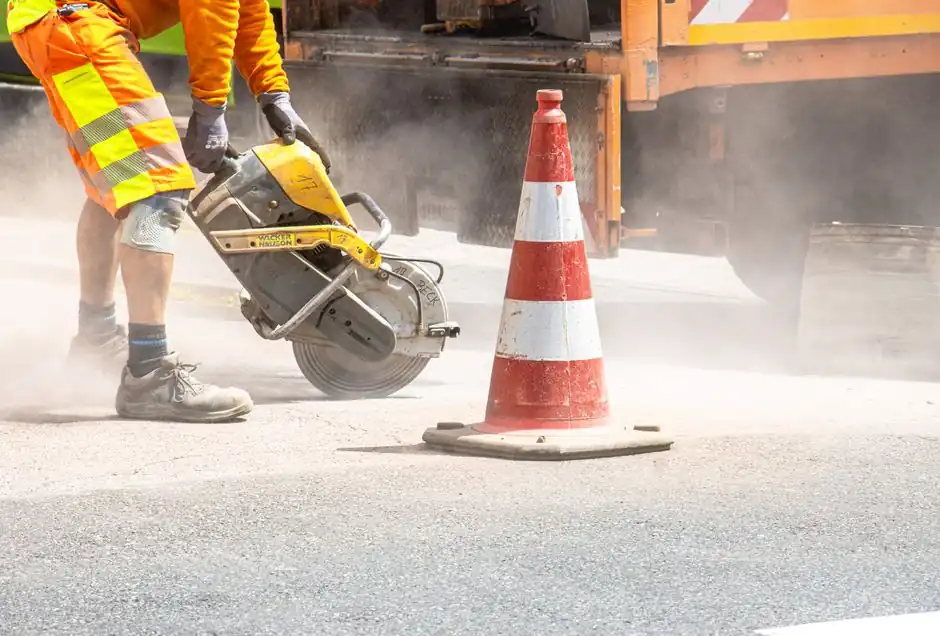
For road maintenance work involving shear connectors, traffic sign bases, and bridge deck rehabilitation, the Iowa Department of Transportation Instructional Memorandum 558 mandates that only automatically timed stud welding equipment (welding stud gun) be used on Iowa projects, with any manual stick or GMAW approach restricted to specifically qualified welders [S1].
Selection hinges on three concrete variables: stud diameter (typically M10 to M25 for road hardware), base material thickness (commonly 6–20 mm plate or rebar anchorage), and the welding process family (capacitor-discharge versus drawn-arc). The Sunbelt Stud Welding selection chart maps these parameters directly to current and time ranges, with a 1/2 in (≈12.7 mm) stud typically requiring 450–650 A weld current and a 0.20–0.40 s weld time window on standard mild steel [S2].
Process Family: Capacitor-Discharge vs Drawn-Arc
Capacitor-discharge (CD) stud welders operate at low voltage (typically 30–200 V DC stored in a capacitor bank) with very short weld times (1–6 ms for contact CD, up to 20–100 ms for drawn-gap CD), making them suited to studs from roughly M3 up to about M10 (3/16 in to 3/8 in) on thin sheet down to 0.5 mm [S2].
They handle studs from about M10 (3/8 in) up to M25 (1 in) and larger, and are the standard process for structural shear studs on bridge decks and heavy road hardware where the base material is typically 6 mm or thicker [S2]. IM 558 explicitly routes the road/bridge category toward this arc-stud process because the ferrule-controlled fillet geometry is what the Iowa DOT inspector expects to verify [S1].
Stud Diameter, Current, and Time Mapping
Selecting a stud welder by current and time is more reliable than picking by nameplate kVA. The published arc stud welder selection chart places each stud diameter on a specific set point: a 3/8 in (M10) stud typically welds at 300–500 A for 0.15–0.30 s; a 1/2 in (M12.7) stud at 450–650 A for 0.20–0.40 s; a 5/8 in (M16) stud at 600–900 A for 0.30–0.55 s; a 3/4 in (M19) stud at 800–1100 A for 0.40–0.70 s; and a 7/8 in (M22) stud at 1000–1400 A for 0.50–0.90 s on mild steel [S2]. These windows are the practical acceptance band a process engineer should verify on a test plate before any production welding begins.
For road maintenance specifically, the most common stud diameters fall in the 3/8 in to 5/8 in (M10–M16) range for sign post bases, delineator anchors, and light structural attachments. A unit rated at 1500 A continuous duty covers this range comfortably with a 20–25% margin; under-rated 800 A light-industrial units will struggle to maintain set-point current when a 1/2 in stud is run in series on dirty or scaled plate. Holding current under load is the spec that separates a true stud welding power source from a repurposed stick welder.
Base Material and Surface Condition Limits

Drawn-arc stud welding onto mild steel (ASTM A36, A572), stainless steel (304/316), and rebar anchorage plates is standard, but the base material must meet minimum thickness rules: the stud diameter should not exceed about 1/3 of the base plate thickness when welded to plain plate, otherwise the heat sink pulls current below the set point and produces cold welds [S2].
For road maintenance work over existing asphalt or composite pavement decks, the stud is almost always being welded to a steel plate or structural steel embedment rather than directly to concrete, so the limiting factor becomes the embedment thickness rather than the substrate. Inspectors under IM 558 verify base-metal condition (clean, free of rust scale, oil, and curing compound) before approving a stud for production welding, because contamination above roughly 50 µm will deflect the arc and cause porosity or undercut at the fillet [S1].
Welder and Equipment Qualification per AWS D1.1
AWS D1.1 clause 7.7.4 specifies that stud welding operator qualification is performed on a daily basis to qualify the process, welder, and equipment, and any change in stud gun, lead length, or power source requires requalification before production welds continue [S3]. This is a per-shift, per-welder, per-equipment rule, not a one-time welder card, and it applies to stud gun operators specifically rather than manual or semiautomatic welders (those fall under Section 4 Part C qualification).
For road projects in Iowa, the daily qualification record typically includes a verification test (bend test or torque test) of the first stud of each shift on a test plate of the same material and thickness as production. Acceptance is a 30° bend without separation of the weld, or a defined torque value scaled to stud diameter. If the stud fails the verification test, the operator, gun, and power source combination must be requalified before any further production studs are placed [S1][S3]. This is also why the IM 558 wording restricts the equipment class on the project: it removes the ambiguity of "is the operator really a stud welding operator or just a stick welder holding a gun."
Selection Criteria Comparison
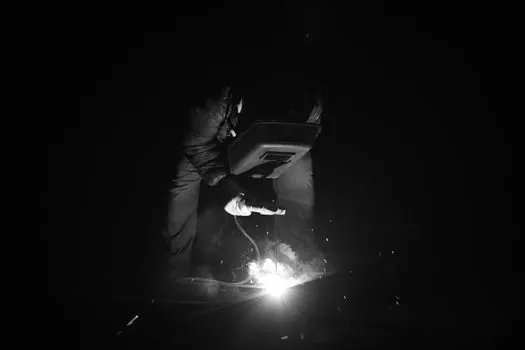
On duty cycle, a 1500 A drawn-arc unit sustains 8–12 studs per minute in production; a typical CD unit sustains 1–2 studs per minute due to the recharge cycle. [S3]
For cost-of-ownership, CD welders are cheaper (entry units below the price of a quality drawn-arc), but the stud consumable cost is similar. The replacement parts list is longer on a drawn-arc gun (chucks, legs, ferrule grips) and that is where a road maintenance fleet tends to lose productivity, not at the power source. For background on how this compares to other arc welding processes used in structural and road work, see the arc welder selection reference.
Failure Modes and When to Replace, Not Repair
The most common field failure on a stud welder in road maintenance is a drooping weld current under load, which presents as cold welds (no fillet, stud peels off with a 30° bend), excessive spatter, or arc blow on long lead runs. Root cause is usually a worn stud gun chuck, a loose connection at the grounding clamp, or lead lengths beyond roughly 30 m that have not been compensated with a current bump [S2][S3]. Corrective action is to re-cable, re-clamp, and re-qualify per AWS D1.1 clause 7.7.4 before continuing production; do not push more studs through a failing gun to make shift numbers.
Second most common is porosity at the fillet, which on a road deck almost always traces to surface contamination (oil, curing compound, rust scale above ~50 µm) or to welding over standing water. The corrective action is to grind clean, dry, and re-qualify; if porosity persists, the base material may be out of chemistry range and the job should be escalated to a CWI rather than re-attempted with bumped current [S1]. When the stud gun itself shows a cracked lift or pitted contact tips, the gun is at end-of-service-life for that application and should be replaced, not rebuilt in the field. For comparison with compaction equipment often used on the same road maintenance job, see the road roller operating envelope reference.
For a broader view of how stud welding interacts with on-site cutting and drilling tools during pavement rehabilitation, the impact drill selection map for bridge construction covers the adjacent tooling decisions on a similar job. The next signal to track is any DOT specification update (Iowa and neighbouring states) referencing AWS D1.1 clause 7.7.4 explicitly in the special provisions, since that is where the daily-qualification language is being sharpened in 2026 lettings.
The underlying component specifications are covered under stud welder.