
Container format and closure geometry decide 70 percent of the capping and sealing machine specification in 2026, with cap diameter tolerance, neck finish standard and torque ceiling driving the head choice ahead of throughput alone [S4]. Buyers should treat the capping sealing machine category as four distinct sub-machines — spindle, chuck, snap-capper and induction sealer — rather than one interchangeable block.
IndustryARC's 2026 equipment market study covers filling, capping and sealing as a single packaging block used for bottles, PET containers, laminate tubes and pouches, with the equipment base spanning semi-automatic bench units through fully servo-driven monoblocs [S4]. Chinese OEM Likai ships dedicated full-automatic aluminium-foil induction sealers and semi-automatic induction heads as separate product lines, confirming the format-driven split [S3].
Container Format and Neck Finish as the First Gate
PET bottle, glass bottle, aluminium can, laminate tube and spouted pouch each route to a different head. Urmachine, with 20-plus years on packaging lines, lists tube filling-and-sealing machines, capping machines and monobloc fillers as separate catalogue families, not configurable options of one chassis [S1]. Hosngpack echoes the split: capsule fillers, sachet sealers and portable cappers are sold as distinct product categories, not as field-convertible variants [S2].
For laminate tubes specifically, the dominant 2026 architecture is a filling machine coupled to a hot-air or ultrasonic tail-sealer — Chinese tube-filling-sealing-machine builds handle paste, ointment and high-viscosity fluid with closed or semi-closed filling, leak-free tail seal and inline batch/date coding in a single pass [S6]. The 28-50 mm plastic and laminate tube range covers most pharmaceutical, cosmetic and food packs and dictates the sealer jaw width and barrel bore before torque or cap-choice enters the conversation [S6].
Cap Type and Sealing Principle Compared
Four sealing principles cover roughly 95 percent of 2026 line-side capping demand; a fifth — vacuum gas-flush — is added when product shelf-life needs oxygen displacement under 1 percent residual O2 [S4]. Selection is principle-led, then head-led, then control-led.
1. Spindle (rotary) cappers apply continuous rotation torque to screw caps, typically PP or HDPE closures on PET. Torque range 4-25 inch-pounds covers most 20-100 mm caps; servo-driven spindles hold ±2 percent torque repeatability and reject caps outside an adjustable window.
2. Chuck cappers use a chuck-and-basket arrangement to press and torque ROPP aluminium caps, common on glass bottles for spirits, edible oil and pharma syrups. Changeover between cap diameters needs a chuck-and-basket set per diameter family.
3. Snap and press cappers apply vertical force only, used for flip-tops, pump dispensers and trigger sprayers where over-torque damages the closure.
4. Induction sealers bond an aluminium-foil liner to the bottle mouth via an electromagnetic field, delivering tamper-evidence and a hermetic seal under the cap. Likai ships both full-automatic conveyors and semi-automatic bench units, with coil power and head height the two principal set-points [S3]. Pactec India's cap-sealing range adds carton-tape sealing heads for secondary pack integration, showing how a 2026 line often runs primary and secondary sealing on one frame [S5].
For coding and traceability on the same line, an inline coding machine — inkjet, laser or thermal-transfer — is normally specified alongside the sealer and shares the conveyor, guarding and reject logic.
Throughput, Automation Tier and Changeover
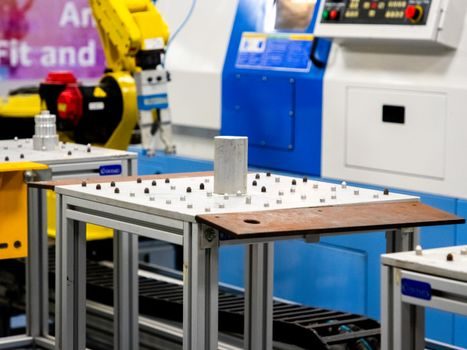
IndustryARC's market view puts semi-automatic capping at the entry tier for outputs up to roughly 20 containers per minute, automatic single-head units in the 30-60 cpm band, and multi-spindle monoblocs above 80 cpm, with fully servo lines reaching 200-plus cpm on standardised PET bottle formats [S4]. Urmachine's 2026 catalogue covers semi-automatic induction sealers, automatic spindle cappers and full-automatic aluminium-foil sealers as three distinct price and footprint bands rather than a single upgradeable model [S1][S3].
Changeover time is the hidden cost driver: spindle machines with servo torque control typically change cap size in 5-10 minutes via recipe recall, while chuck cappers need a physical chuck-and-basket swap and can take 20-40 minutes. For SKUs above 8 per shift, specify quick-change chucks and recipe-driven servo packs as standard, not options.
Material Compatibility, CIP/SIP and Hygienic Build
Stainless grade, surface finish and seal geometry are not optional. Pharmaceutical and dairy lines typically require 316L stainless contact parts with Ra ≤ 0.8 µm finish, sanitary tri-clamp connections and IP66 or higher control enclosures; food lines can accept 304 stainless at Ra ≤ 1.6 µm. Induction coil cooling, where the coil head runs hot in continuous duty, should be plumbed to plant cooling water or a closed-loop chiller to keep coil temperature under 80 °C and prevent liner distortion [S3].
CIP (clean-in-place) capability requires that fluid paths — including the induction coil housing on seal-through units — be drainable and that the capper head withdraw or cover during CIP. SIP (steam-in-place) is restricted to specific pharma builds; verify that elastomers are steam-grade EPDM or PTFE and that any servo motors in the spray zone are IP69K-rated or mechanically shielded.
Standards, Safety and Compliance Hooks
For explosive atmospheres, induction sealers and alcohol-based product lines often fall under ATEX 2014/34/EU or IECEx zoning for the coil and conveyor area, which dictates motor classification, cable glands and bonding. Food-contact compliance follows regional frameworks — FDA 21 CFR for the US market, EU 1935/2004 and EU 10/2011 for the EU, GB 4806 series for China — and these cascade into the gasket, hose and conveyor-belt material certificates. GMP lines add documentation lots, calibration traceability and validation protocols (IQ/OQ/PQ) on torque, induction temperature and seal strength [S4].
CE marking under the Machinery Directive 2006/42/EC, EMC Directive 2014/30/EU and Low-Voltage Directive 2014/35/EU is the baseline for European shipment; PACTEc's documentation set for its cap-sealing range follows the same pattern for Indian and export builds [S5].
Common Failure Modes and Selection Traps
Four traps cause most 2026 capper under-performance: (a) specifying torque ceiling on the spindle without checking the lowest-SKU cap, leaving small closures under-gripped; (b) under-sizing induction coil power, which forces the line to slow down to reach seal temperature and strands 20-30 percent of nameplate throughput; (c) ignoring cap-geometry variation between suppliers — a 28 mm PP cap from vendor A and vendor B can need different chuck profiles; (d) running a chuck capper into snap-cap duty, which chews the closure and the sealing washer in the cap. [S1]
For laminate tubes, a related trap is specifying a core machine — used to feed pre-formed tube shells — at the wrong orientation, which starves the sealer and forces an oversized buffer table. The tube-filling-sealing build typically needs 0.4-0.6 MPa clean compressed air, a 6-8 bar cooling-water supply for hot-air tail-seal variants, and a stable infeed at 30-60 tubes/min before any throughput uplift is possible [S6].
Sourcing Levers and Total Cost Bands

2026 sourcing is driven by three levers: country of manufacture (China domestic OEMs at $3,000-15,000 for semi-auto induction sealers, $25,000-80,000 for full-automatic monoblocs; European builds typically 1.8-2.5x at equivalent spec), automation tier (semi-auto vs full-auto) and standards package (GMP docs, ATEX coil zone, CIP/SIP). The IndustryARC report values the global filling-capping-sealing equipment market as a multi-billion-dollar segment with mid-single-digit CAGR through the forecast window, with Asia-Pacific the largest regional bloc [S4].
For a 2026 build-out that pairs a capper with upstream dosing, specify the cutting machine and tube/notch trimmer on the same vendor frame to share guarding and reject logic. Plan the first FAT (factory acceptance test) with the vendor's line in China or India, validate torque, induction temperature and seal strength on product samples, and budget 8-12 weeks for shipment, installation and site acceptance on a full-automatic monobloc.
Track these signals over the next quarter: ATEX coil-zone component prices after the EU 2026 standards review, servo-spindle retrofit kit availability from Chinese OEMs Urmachine, Likai and Hosngpack [S1][S2][S3], and any new IndustryARC regional update to the filling-capping-sealing equipment forecast [S4].
For related coverage, see Coding Machine 2026 Price & Cost Guide: Technology, Spec and Sourcing Levers.