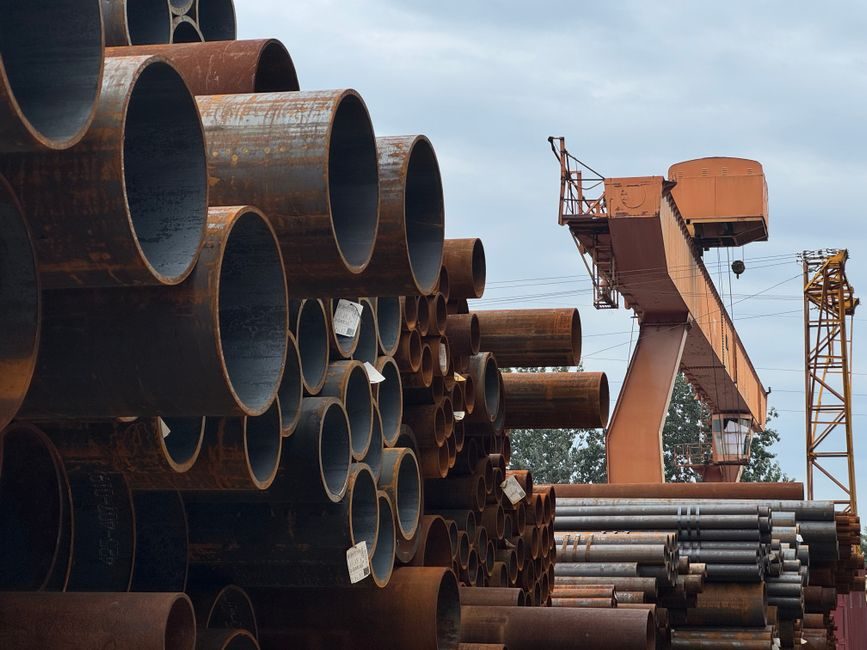
Carbon steel plate and alloy steel plate are stocked as separate SKUs by the same distributors because they answer different design problems: carbon grades (ASTM A36, A516 Gr.60/70, A572 Gr.50) cover ambient-temperature structural and moderate-pressure service, while alloy grades (SA387 Gr.5/11/22, 25CrMo4, AISI 4140) carry Cr, Mo, and sometimes Ni to hold strength above 400 °C and resist HIC / SSC in wet H₂S [S3][S8].
Current Asian mill listings on 2026-07-16 show ASTM A36 / S45C / 1025 hot-rolled carbon plate at roughly USD 500–700 per ton FOB and 25CrMo4 alloy plate at USD 785 per ton FOB with 3–300 mm thickness and 1000–3000 mm width [S2][S7]. The price gap, typically 30–80 %, reflects the alloying content and the controlled-rolling / Q+T delivery condition, not a quality premium on the base iron [S2].
Definition and Chemistry Boundary
By the working definition most spec writers use, carbon steel plate contains less than the alloying thresholds that would reclassify it as alloy steel — manganese above 1.65 %, copper above 0.60 %, or specified minimums for Cr, Ni, Mo, V, B [S8]. The Chinese structural-alloy reference Sogou Baike states that adding alloy elements shifts the microstructure from ferrite-pearlite to uniform sorbite / bainite / fine pearlite after quenching and tempering, raising tensile strength and the yield-to-tensile ratio to roughly 0.85 [S8].
Common plate grades stay in well-known bands: ASTM A36 sits at 250 MPa min yield for general structure, ASTM A516 Gr.70 is the dominant low-temperature pressure-vessel plate at 260 MPa min yield, and SA387 Gr.11/22 (1.25 Cr-0.5 Mo and 2.25 Cr-1 Mo) are the workhorses for fired heaters and boiler headers between 400 °C and 600 °C [S3]. Sourcing 25CrMo4 (EN 10083) at 3–300 mm thickness and 1000–3000 mm width is routine from Taian Henson Metal and similar Shandong mills, with delivery options covering hot-rolled, controlled-rolling, normalizing, annealing, tempering, quenching, and Q+T [S2].
Selection Criteria Buyers Must Lock First
Lock four inputs before opening a catalogue: design temperature, design pressure, H₂S partial pressure in service, and impact-test temperature. A516 Gr.70 with NACE MR0175 dual certification covers the bulk of hydrocracker and amine-contactor shells; SA387 Gr.11 CL.2 is specified when skin temperatures cross 400 °C in furnace tubes; AR400 / AR500 abrasion-resistant plate is chosen for chutes and truck liners where hardness, not strength at temperature, drives life [S3].
Buyers comparing A36 versus 25CrMo4 should run a three-line decision: temperature window, sour-service exposure, and required post-weld heat treatment (PWHT). 25CrMo4 in the 3–300 mm thickness band is routinely delivered in the Q+T condition and is the default when PWHT is impractical on thick sections, while A36 is acceptable only when the code allows its as-rolled or normalized state [S2][S8]. Cross-reference standards explicitly: ASME II Part A for chemistry, ASME II Part D for allowable stress at temperature, and NACE MR0175 / ISO 15156 for sour service [S3].
Direct Comparison on Four Decision Criteria

Lining the two families against typical buyer criteria gives a concrete matrix. Cost: carbon plate A36 / S45C is roughly USD 500–700 per ton FOB versus 25CrMo4 at USD 785 per ton FOB as listed in 2026-07; alloy plate premiums expand to 2–3× once you move into SA387 Gr.22 or AISI 4140 [S2][S5][S7]. Temperature ceiling: carbon grades (A516, A36) are derated sharply above 400 °C by ASME II Part D; alloy Cr-Mo grades hold useful creep strength to 600 °C for Gr.22 and 550 °C for Gr.11 [S3][S8].
Corrosion / HIC resistance: A516 Gr.60 / Gr.70 are offered in NACE MR0175 + HIC-tested variants by Indian stockists such as RPF Pipes & Fittings; alloy plate gains its resistance from Cr and Mo content, not from any HIC test, so HIC testing is still ordered separately for sour reactors [S3]. Fabrication: carbon plate is easily cold-formed, hot-formed, and welded with standard E7018 / ER70S procedures; alloy plate demands preheat (typically 150–200 °C for 25CrMo4 and SA387 Gr.11), controlled interpass temperature, and PWHT at 620–680 °C depending on grade thickness, which adds shop time and qualified weld procedures [S2][S8].
Who Each Family Is For, and Who It Is Not For
Specify carbon plate (A36, A516, A572 Gr.50, S355J2 N) for storage-tank shells, building columns, ship hulls, low-pressure separators operating below 400 °C, and general structural frames where ductility and weldability dominate the design [S3]. It is the wrong choice for fired-heater tubes, hydrocracker reactor shells above 400 °C, ammonia / urea reactors needing corrosion-resistant Cr-Mo, and any wet H₂S service that exceeds NACE MR0175 limits for carbon steel [S3].
Specify alloy plate (SA387 Gr.5/11/22, 25CrMo4, AISI 4140) for boiler drums, hot-reformer headers, hydrogen reactors, and pressure parts where ASME code cases require Cr-Mo for creep life [S3][S8]. It is the wrong choice when the buyer is price-driven on a non-pressurized walkway, when the section can be cold-formed from thinner coil (where carbon fiber market or aluminum comparisons may be irrelevant here, but sourcing cost is), and when the mill cannot deliver the required Q+T condition in the thickness band ordered [S2].
Mill Supply and Lead-Time Reality in July 2026
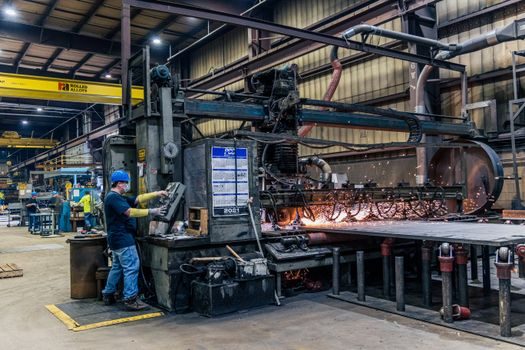
Henan Xinsteel Group on 2026-07-02 advertised 10,000 tons per month capacity of carbon steel plate, boiler plate, high-strength plate, shipbuilding plate, weathering plate, oil-platform plate, and low-alloy plate with a 20-ton MOQ — a useful benchmark that the dominant Chinese mills still treat carbon plate as the volume product and alloy plate as a configured SKU [S1]. Taian Henson Metal on 2026-02-28 lists 25CrMo4 at a 1-ton MOQ, showing the long tail of smaller Shandong mills still willing to quote single-ton lots for alloy grades, but typically with 30–45 day lead times versus 7–15 days for A36 / S355J2 N from the larger mills [S1][S2].
Huaxiao-alloy, active on 2026-07-25, sells both Inconel / Hastelloy / Monel / Incoloy and carbon-steel plate side by side, signalling that the same trading houses now stock both families and can bundle mixed-MOQ shipments for EPC contractors [S6]. For procurement teams running tenders in late July 2026, the practical move is to split the RFQ: bulk carbon grades (A36, A516 Gr.70) to the high-volume mills like Henan Xinsteel, and alloy grades (25CrMo4, SA387 Gr.11/22) to mills that publish Q+T delivery options and NACE + HIC test certificates [S1][S2][S3].
Common Failure Modes and Specification Traps
The most expensive mistake on carbon plate is ordering A516 Gr.70 without the supplementary HIC test (S8 test in ASTM A516) and discovering that the wet H₂S service rejects the heat within 18 months; the fix is to specify A516 Gr.70 (NACE + HIC) at the RFQ stage and require the test report in the inspection schedule [S3]. The most expensive mistake on alloy plate is omitting the Q+T condition and receiving a normalized plate that fails the through-thickness Charpy requirement on thick sections, since 25CrMo4 over 50 mm is rarely acceptable in the as-hot-rolled condition for pressure-vessel service [S2][S8].
A secondary trap is the alloy-vs-low-alloy boundary: EN 10025 S355J2 N is sometimes called "low-alloy" by stockists but it remains a carbon-manganese steel with no intentional Cr-Mo content, so it should not be substituted for SA387 Gr.11 in a fired-heater context [S3]. Always verify the heat-analysis certificate against the named grade, and pin the delivery condition (Normalized, N+T, Q+T) in the purchase order, not in a verbal agreement [S2].
Sourcing Standards and Verification Checklist
For any plate order above 20 tons, request mill test certificates to EN 10204 3.1 (or 3.2 for sour service) showing C, Mn, Si, P, S, Cr, Mo, Ni, V, and CE / PCM values; the CE / PCM number is the cleanest predictor of cold-cracking risk during welding and should sit below 0.45 for most carbon-plate weld procedures [S2][S3]. For sour service, require a NACE MR0175 / ISO 15156 compliance statement on the certificate, and for HIC-sensitive units, require ASTM A516 S8 test results showing CLR, CTR, and CSR below the agreed thresholds [S3].
For high-temperature alloy plate, pin ASME II Part A grade (SA-387), class (1 or 2), and the impact-test temperature in the enquiry, then verify that the delivery condition matches the order (normalized, normalized-and-tempered, or quenched-and-tempered) [S3][S8]. Independent third-party inspection (SGS, BV, TÜV) is standard for export shipments out of China in July 2026 and adds 0.3–0.8 % to the landed cost but recovers the buyer's exposure on disputed heats [S1][S2]. Track these three signals as you finalise orders: mill spot price of A36 6 mm plate in Shanghai (USD 510–560 per ton range in mid-July), 25CrMo4 20 mm Q+T plate ex-Taian (USD 780–820 range), and the RMB / USD rate on the day the mill fixes the contract.
Spec-level background on the components involved: carbon steel, steel plate, and carbon fiber.