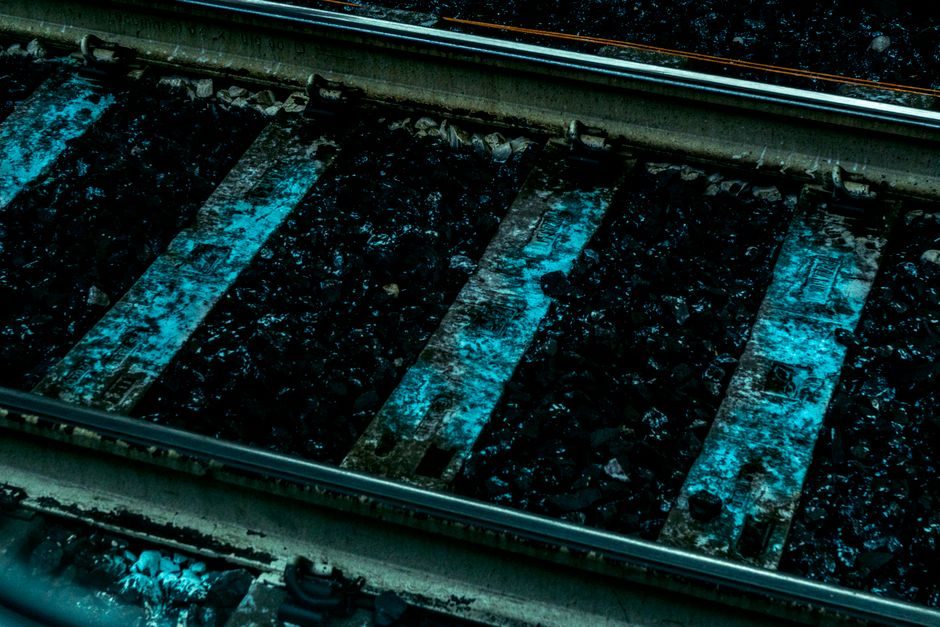
Rail remains one of the largest single end-uses of carbon steel, with the track, axle, wheel and railcar body markets consuming medium- and high-carbon grades alongside weathering variants for both infrastructure and rolling stock [S2][S5].
Procurement engineers in 2026 are balancing three constraints simultaneously: AREMA / EN 13674-1 rail-head chemistry, sour-service-free weldability for bogie frames, and lifecycle corrosion allowances of 25-40 years for freight wagons — a narrower band than the broader construction market served by the carbon steel construction grade map.
Carbon-Content Bands and Where Each Lands on a Train
Low-carbon steel at AISI 1018 (~0.18% C) is the default for cold-formed railcar body panels, coupler shanks and brake hardware where weldability and impact toughness dominate over hardness [S2]. Medium-carbon AISI 1045 (~0.45% C) covers railway axles, gears, and rail-web sections because it responds predictably to quench-and-temper: typical published tensile values sit in the 570-700 MPa range after heat treatment, with elongation around 16% [S2][S5].
High-carbon grades AISI 1060 (~0.60% C) and AISI 1095 (~0.95% C) are reserved for springs, clutch discs and cutting-edged rail maintenance tools, not for primary structural rail components, because their carbon equivalent pushes them out of the weldable envelope for heavy-section bogie fabrication [S2]. The 0.6% C threshold is the practical ceiling for most rail welding procedures; above it, preheat and post-weld heat treatment become mandatory and lifing costs climb.
Rail-Head and Rail-Section Standards
For the running rail itself, procurement is governed by geometry-and-steel combined standards rather than the AISI system: AREMA Chapter 4 in North America and EN 13674-1 in Europe set both the section profile and the chemistry/tensile envelope for pearlitic rail steel, with R260 / R350HT grade designations replacing the old 900A / 1100 MPa naming [S5].
Head-hardened rail (R350HT) is produced by either inline heat treatment of the head after rolling or by selective alloying with Cr and Mn, pushing surface hardness into the 350-400 HBW band to resist wear on tight-curve, heavy-haul tonnage lines. Standard carbon rail (R260) sits closer to 260 HBW and is the volume grade for mixed-traffic mainlines; the choice between them is a tonnage-per-year versus capital-cost calculation, not a chemistry debate.
Wheels, Axles, and Bogie-Frame Welding
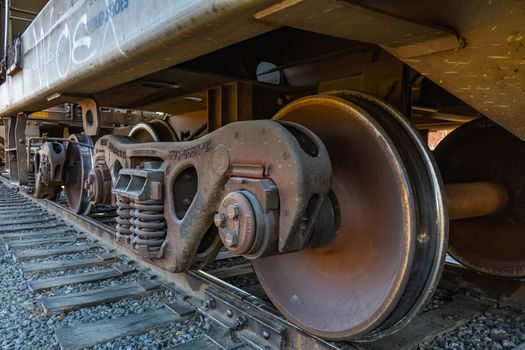
Railway axles are the textbook AISI 1045 / AISI 4140 comparison: the carbon-steel grade gives a lower-cost, easily machined blank that meets EN 13261 / AAR M-101 impact requirements at -20 °C after normalizing, while alloyed variants add nickel-chromium-molybdenum for higher tonnage per wheel set. Wheel centres are similarly split between carbon steel grades (AAR M-107 Class B/C) and alloyed variants for premium service [S6].
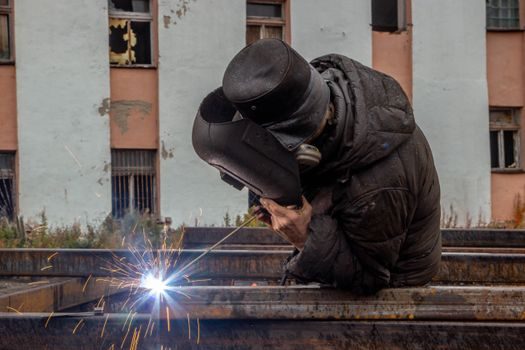
Welding procedure choice is driven by carbon equivalent (CEV) more than by the grade name: AWS E70xx / ER70S-x filler metals (matching the E60xx-E70xx tensile classes per the Carbon Steel Handbook [S6]) are the workhorse for bogie-frame and draft-gear fabrication in low- and medium-carbon base metals. The Carbon Steel Handbook also flags E6xT-x / E7xT-x flux-cored wires for field welding of rail joints, where deposition rate and positional tolerance outweigh matching the exact base-metal tensile [S6].
Weathering and Corrosion-Resistant Options for Railcars
ASTM A606 Type 4 is the canonical weathering carbon steel for railcar bodies and hopper wagons: a low-carbon base with copper, chromium and nickel additions that delivers 4-6× the atmospheric corrosion resistance of plain carbon steel once the protective oxide patina stabilises [S4]. This is the same family that has been the default for intermodal container side panels and structural arches on the North American freight network.
Where higher corrosion margins are required — coal wagons, ore cars, and any rolling stock running through coastal salt corridors — the alternative is ferritic stainless 1.4003 (12% Cr), which competes directly with carbon steel on price but extends vehicle life and cuts maintenance, per the Outokumpu rail datasheet [S3]. For passenger and metro car bodies, austenitic 1.4318 / 301LN and lean duplex grades have displaced much of the carbon-steel bodywork because the weight saving from thinner gauge (high strength-to-weight) offsets higher unit material cost over the life cycle [S3].
Selection Criteria: A Side-by-Side for Procurement
Use the table below as a first-cut filter; final calls always go back to the named standard for the application. [S2]
Comparison criteria across the four common rail-relevant carbon-steel families: (1) AISI 1018 low-carbon — best for cold-formed railcar panels and coupler hardware, weldability excellent, hardness low (~70 HRB), CEV typically below 0.35; (2) AISI 1045 medium-carbon — the axle and gear default, weldable with preheat, hardness 170-220 HB after quench-and-temper, Rm 570-700 MPa; (3) ASTM A606 Type 4 weathering — atmospheric corrosion resistance 4-6× plain carbon, used on freight railcars and bridges, weldable with matching filler, paint-free in service; (4) AREMA R260 / R350HT rail steel — for running rail only, R350HT is head-hardened to 350-400 HBW for heavy-haul curves, R260 is the standard mainline grade at ~260 HBW [S2][S4][S5].
Who Should Specify Carbon Steel vs Stainless for Rail
Specify carbon steel when: tonnage dominates the unit-cost equation, weldability is non-negotiable (bogie frames, draft gears, brake rigging), or the application is a wear surface that will be re-profiled (rails, crossings, switch points). Specify stainless when: tare weight is a paid-for kWh-per-tonne metric (metro, light rail, high-speed passenger), or the service environment is chloride-laden or sulphurous, where the 25-40 year paint-cycle of carbon steel stops being economic [S3].
The same logic maps onto the oil-and-gas rail logistics chain covered in the carbon-steel oil-and-gas spec map: sour-service (NACE MR0175) environments are the bright line where carbon steel is excluded in favour of alloyed or stainless options. For sour crude unit trains or hydrogen-blend fuel logistics, the same gating logic applies even if the regulatory wording differs.
Common Failure Modes and Engineering Constraints
Three failure modes drive most carbon-steel rail warranty disputes: (a) rolling-contact fatigue (RCF) head checks on heavy-haul rail, mitigated by head-hardened R350HT and periodic grinding; (b) hydrogen-induced cracking in welded bogie components, controlled by CEV limits and post-weld hydrogen bake-out; and (c) stress-corrosion cracking at axle journal fillets, where surface finish and residual stress management matter more than grade [S2][S6].
Design-side constraints: maximum CEV of 0.45-0.50 for weldable bogie steels, -20 °C or -40 °C Charpy impact minimums depending on climate zone (AAR M-101 vs EN 13261), and hardness ceilings around 350 HBW for machinable axles. Push past any of these and the next-lower-cost material class flips to alloyed steel or stainless.
Procurement and Sourcing Signals to Track
Trackable signals through the next buying cycle: ArcelorMittal South Africa's continued positioning as sub-Saharan Africa's largest producer (5 Mt installed crude-steel capacity, ~10,000 employees, 6 production parks) makes it a bellwether for African rail procurement pricing [S1]. For European high-speed and metro, follow the published references from major OEMs (Alstom, CAF, Bombardier) where Outokumpu temper-rolled 301LN / 1.4318 and lean duplex 1.4003 displace carbon steel on weight grounds — every kilo removed from a metro car body compounds into kWh savings over the asset's 30-40 year life [S3]. Watch the R260 / R350HT split in tender documents: a rising R350HT share on a tender signals heavy-haul intent; a flat R260 share means mixed-traffic mainline renewals.
Spec-level background on the components involved: carbon fiber.