
ASTM A36 remains the default carbon structural steel for riveted, bolted, and welded building and bridge construction, with A572 Grade 50 specified where higher strength is needed [S3].
Selection hinges on three numbers — yield strength, tensile strength, and carbon content — plus the forming route (hot-rolled, cold-rolled, or galvanized) that shapes weldability and ductility [S2]. This article maps the common construction grades side-by-side, shows where each one earns its place, and flags the standards an engineer should cite in the purchase spec.
ASTM Structural Grades: A36, A572, A588, A992, A709
ASTM A36 covers carbon structural shapes used in riveted, bolted, or welded bridges, buildings, and general structural purposes [S3]. A572 extends the same fabricating routes to five high-strength low-alloy grades; Grade 50 (yield 345 MPa) is the workhorse for high-rise framing and long-span beams where A36's 250 MPa yield would force heavier sections [S3].
For unpainted bridge exposure, A588 delivers atmospheric corrosion resistance roughly 2-4x that of plain carbon steel via its Cu-Cr-Ni chemistry, trading a small cost premium for eliminated repaint cycles [S3]. A992 is the dedicated spec for rolled W-shapes used in building framing — its 345-450 MPa yield/tensile window and tighter flange-thickness tolerances make it the preferred callout for modern steel buildings [S3]. A709 consolidates bridge-specific requirements across seven grades in four yield strengths for both carbon and HSLA shapes [S3].
Pressure-Vessel and Plate Grades: A515, A516, A514
When carbon steel enters a boiler or process vessel, the spec switches from A36/A572 to the A515/A516 family. A515 covers carbon-silicon plates for intermediate-and-higher-temperature service in welded boilers, supplied in three strength grades [S3]. A516 targets moderate-and-lower-temperature service where improved notch toughness matters more than high-temperature strength, again in four grades with stepped strength levels [S3].
For high-yield plate applications such as welded bridge members under heavy wheel loads, A514 specifies quenched-and-tempered alloy plate (note: technically alloy, not carbon, but routinely grouped with carbon-plate specs in construction procurement) with a minimum yield of 690 MPa [S3]. The chemistry and heat treatment behind A514 is what allows thinner plates to carry the same load — useful when dead weight governs the design. A515 and A516 remain the right pick when the vessel sees sustained elevated temperature or when Charpy V-notch testing at -46 °C is on the data sheet.
Forming Process vs. Mechanical Property Trade-off
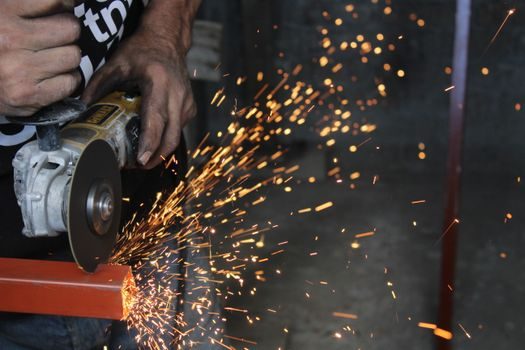
Hot-rolled carbon grades such as Q235 (yield ≥235 MPa, tensile 375-500 MPa, HB ~120) and Q275 (yield ≥275 MPa, tensile 410-540 MPa) dominate Chinese structural supply and are cross-referenced to ASTM A36/A572 in mill certificates [S2]. Cold-rolled sheet — SPCC, A366, A715, SAPH440 — pushes surface finish and dimensional tolerance tighter but caps section thickness, so it appears more in light-gauge framing, automotive, and appliance than in primary building structure [S2].
Carbon content dictates the weldability-versus-strength trade. Low-carbon (≤0.25% C) grades weld readily with no preheat; medium-carbon (0.25-0.60% C) needs preheat and post-weld heat treatment to avoid HAZ cracking; high-carbon (>0.60% C) is generally avoided in field-welded construction because the risk of cold cracking outweighs the strength gain [S2]. Galvanized carbon wire per ASTM A641/A641M-19(2025) and double-twisted gabion mesh per A975-24 sit at the ancillary end of the construction spec list — used for MSE wall soil reinforcement, gabion retaining structures, and chain-link fence fabric rather than primary framing [S1].
Comparison Table: Construction Carbon Steels at a Glance
The table below lines up the five most-cited construction grades against yield, tensile, and typical use. Numbers come from the ASTM spec sheets and supplier data summarized in [S3]; the hot-rolled Q235/Q275 row is sourced from [S2] for cross-region procurement.
Welding, Galvanizing, and Compatibility with Adjacent Materials
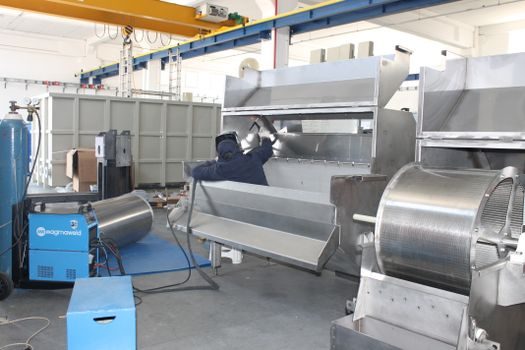
Welding procedure specs (WPS) for carbon-to-carbon and carbon-to-stainless joints are covered by AWS B2.1 documents, which give qualified ranges for shield-metal-arc welding of carbon steel to austenitic stainless in the as-welded condition with or without backing [S8]. Galvanized carbon wire per A641/A641M-19(2025) preserves the zinc coating through the drawing and weaving steps needed for gabion, fence, and wire-mesh reinforcement used in MSE walls and slope protection [S1].
When carbon steel framing or carbon steel reinforcement sits inside a slab-on-grade, the slab design picks up its own fiber reinforcement spec — see the data-center slab spec map for a worked example of how steel fiber dosage and slab thickness are tied to the floor's load case. For hospital and school buildings, the concrete fiber selection spec map shows the same interplay from a different occupancy angle.
Selection Criteria and Where A36 Is Not the Answer
Pick A36 when the member is a generic shape, base plate, or gusset under static load with no weight or corrosion driver. Pick A572 Gr.50 when the design calc drops section size by at least one W-shape step and the tonnage savings outweigh the per-ton premium. Pick A588 when the bridge or architectural element will not be repainted and a 50-100 year service life is on the drawing. Pick A992 for rolled W-shapes in seismic or wind-governed building frames — its tighter chemical and mechanical envelope is what makes the RBS (reduced beam section) connection details work. [S3]
A36 is the wrong call for cryogenic service (use A516 Gr.70 with -46 °C Charpy), for any member subject to quenching-and-tempering requirements (use A514), or where the structural shape is a W-shape in a modern building frame (use A992). Carbon steel is also the wrong material for any element that sees chloride exposure without a coating system — even A588 needs a drain detail to keep water from sitting in the joint. Engineers who default to "A36 for everything" over-spec by 10-25% on tonnage and miss the corrosion premium that A588 would have paid for in paint savings.
Standards, Sourcing, and the 2026 Procurement Checklist
For any 2026 construction procurement, the purchase spec should cite: ASTM A36/A572/A588/A992/A709 for shapes, ASTM A515/A516 for pressure-vessel plate, AWS B2.1 for welded joints, and the appropriate galvanized-wire standard (A641/A641M-19(2025) for wire, A975-24 for gabion mesh) when the scope includes MSE walls or gabion retaining structures [S1][S8]. Mill test reports (MTRs) should report both the heat analysis and the mechanical properties to the revision year on the spec — the 2025 re-approval of A641 and the 2024 issue of A1115/A1115M are the latest in the wire/earthwork chain [S1].
Two signals to watch through the rest of 2026: (1) the Steel Bridge Group's 7th-issue Guidance Notes (P185), published in 2025, continue to refine through-thickness property requirements for tension members — engineers specifying steel for bridge girders should review Guidance Note 3.02 before signing the next MTR [S6]; (2) the harmonized grade composition guide ASTM A1040-17(2022) is the cleanest cross-reference between ASTM, EN, and JIS structural grades when a project pulls from multiple regional mills [S1]. Together these documents give a procurement engineer a defensible trail from spec clause to delivered plate. For slab-on-grade projects adjacent to carbon-steel column bases, the concrete fiber selection spec map for data center slabs covers the floor side of the same detail.
Spec-level background on the components involved: carbon fiber, and alloy steel.