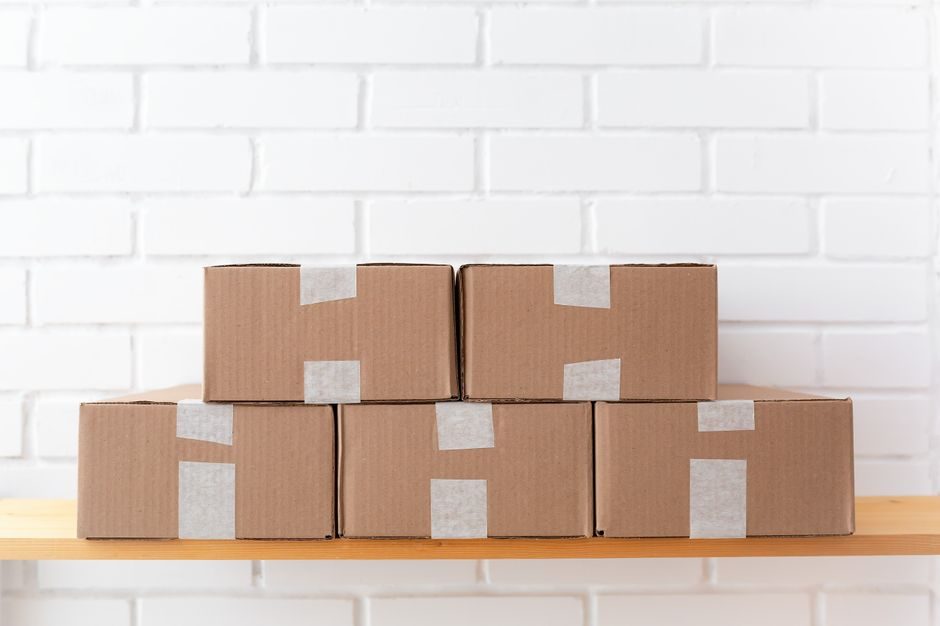
Carton sealers fall into manual, semi-automatic, and fully automatic classes differentiated by drive topology (side-belt vs. bottom-belt), case size envelope, and rated throughput in cases per minute, with 50-series FXJ/FXC platforms dominating the semi-auto segment sold across 15,304 active Chinese suppliers as of May 2026 [S5].
End-of-line packaging automation links the sealer upstream to a carton erecting machine and downstream to a palletizer or stretch wrapper, so the sealer's case-per-minute rating must match the surrounding cells or the line becomes starvated or backed up [S3].
Manual and Semi-Automatic Sealers: Where Side-Belt and Bottom-Belt Topologies Split
Manual carton sealers use the operator to fold the top four flaps before the unit drives pressure-sensitive BOPP or reinforced gummed tape across the seam; throughput is operator-bound and typically lands in the 4-8 cases/min range for uniform RSC cases [S2].
Semi-automatic units such as the FXC5050 (Wenzhou Dingxin) and the legacy FJ-6050 platform use 50 mm wide side-drive belts or bottom-drive belts with two tape heads to seal top and bottom flaps simultaneously after manual flap folding, hitting 15-25 cases/min on uniform RSC geometry [S1][S2]. The same builder lists 60-series chassis (FXJ-6050, FXJ-7050) that cover the long-axis case envelope typical of e-commerce and hardware shippers, where the adjustable height/width rail replaces dedicated tooling [S1].
Selection between side-belt and bottom-belt is a stability call: bottom-belt designs hold taller, lighter cases (cosmetics, empty-can shippers) square under the tape head, while side-belt designs grip heavy cases (≥15 kg filled) where vertical clamp pressure is the limiting factor [S6]. Both share the same BOPP/kraft tape roll format, 48-72 mm width, 38-50 mm core ID, with a 50-series tape head covering ~80% of corrugated-case tape specs.
Fully Automatic Case Erector-Sealer Cells: Throughput, Integration, and Spec Boundaries
Fully automatic cells combine a carton erecting machine feeding a sealer through a powered conveyor; rated throughput clusters in the 30-80 cases/min band depending on blank magazine, flap-folding geometry, and tape-head count (1 vs. 2) [S3]. Shandong Youyue packages the erector, parallel-robot packer, and sealer as a matched end-of-line cell, with the sealer sized to match the erector's cycles rather than to peak marketing figures [S3].
The case erector is the bottleneck: a single-station erector in the 25-35 cases/min band pairs cleanly with a 30-case/min sealer, while a rotary erector in the 50-80 cases/min band requires a dual-head sealer with redundant tape-roll changeover to avoid starvation [S3]. Case material must be a slotted RSC with burst strength ≥ 10 ECT (Edge Crush Test) to survive the erector's vacuum-cup pickup and the sealer's compression rail without flap spring-back; below that threshold, jams climb sharply [S6].
Shanghai Speed Packing, founded July 2004 and ISO 9001-certified, sells case erectors, carton sealing machine lines, shrink machines, and strapping machines as an integrated catalog, signalling that single-machine sourcing is being displaced by cell-level sourcing on Chinese B2B channels [S4].
Drive, Tape, and Material Specs That Drive the Decision
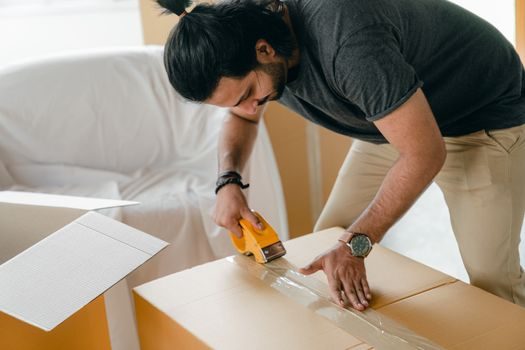
Three specs decide fit before price: drive topology, case size envelope, and tape consumable. The FXC/FXJ 50-series frames cover L200-600 mm × W150-500 mm × H150-500 mm case envelopes with manual width/height adjustment, suiting job-shop and contract-pack operations running mixed SKUs [S1][S2].
Consumable tape spec: BOPP acrylic-adhesive film 48-72 mm wide, 25-50 µm caliper, on a 76 mm core for the 50-series head; reinforced kraft gummed tape is an alternative for export-grade heavy cases where filament fibre tensile strength matters more than line speed [S5]. For a detailed drive-and-throughput spec breakdown, the Carton Sealing Machine Selection: Drive, Size, and Throughput Specs walkthrough covers the same FXC/FXJ envelope against rotary-erector throughput targets.
Comparison passage — three sealer classes against four decision criteria: (1) Manual sealer — throughput 4-8 cases/min, footprint ~0.5 m², capex lowest, changeover ≤1 min via rail slide, fits sub-200 cases/shift operations. (2) Semi-auto side/bottom-belt — throughput 15-25 cases/min, footprint ~1.2 m², capex low-to-mid, changeover 2-5 min, fits 200-2,000 cases/shift mixed-SKU lines. (3) Fully auto erector-sealer cell — throughput 30-80 cases/min, footprint 6-15 m² incl. conveyors, capex mid-to-high, changeover 10-20 min, fits dedicated ≥5,000 cases/shift lines with stable SKU mix [S1][S3][S5].
Industry Fit and Failure Modes Engineers Hit on Real Lines
Food & beverage, garment, building-material shops, and pharmaceutical contract packers are the four largest pullers of 50-series semi-auto sealers; the FXC5050 listing names those verticals explicitly [S1]. For a comparison against complementary end-of-line tech, the Stretch Wrapping Machine vs Vacuum Packaging Machine: Spec-First Decision Map covers what runs downstream of the sealer on a palletizing line.
Failure mode 1: flap spring-back on thin-walled corrugated (<6 ECT) — the compression rail can't hold the flap flat under the tape head, causing fish-mouth seals and tape re-feed faults [S6]. Failure mode 2: tape tension drift on gummed-kraft water-activated systems where the water reservoir runs low, leaving adhesive under-activated and seal strength below the ~2.5 N/cm typical target. Failure mode 3: case-height changeover drift on bottom-belt units where the upper compression rail wasn't re-zeroed after an SKU change, leading to crushed lightweight cases.
Sealer class is therefore NOT a fit for: (a) operations under 100 cases/shift where manual taping is faster payback; (b) freeze-pack or cold-chain lines where acrylic BOPP adhesive loses below 0 °C and a hot-melt or rubber-based adhesive system is required; (c) hazmat/UN-certified cases that need a specific serial-numbered closure tested per UN packaging performance criteria rather than a generic pressure-sensitive tape.
2026 Sourcing Signals from the Chinese B2B Catalog
Made-in-China.com listed 15,304 active suppliers under its "Carton Sealing" product taxonomy as of 16 May 2026, with top product lines split between full carton sealing machines, corrugated transport mailers, BOPP packing tape, self-adhesive gummed kraft paper tape, and coding/printing peripherals [S5]. That supplier count grew on the back of the "Carton Sealing Machine FJ-6050" half-year long-running product page, indicating the 50-series platform has become a commodity reference design [S2].
Wenzhou Dingxin expanded its catalog beyond sealers into sealing washer and tube-filling-sealing peripherals, with the DXDF-40II automatic auger powder filler running on PET/plated AL/PE, PET/PE, and NYLON heat-seal laminations — a spec line that tells engineers the Wenzhou cluster is consolidating horizontal integration across sealer and form-fill-seal platforms [S1]. For peripheral coding, the coding machine category runs alongside sealers in most end-of-line cells, and the carton box specification sets the upstream case-construction limits the sealer must accept.
Trackable next signal: monitor whether the 50-series platform migrates from solenoid-driven to servo-driven tape heads — the same servomotor transition that hit the auger-filler segment (DXDF-40II) tends to follow the sealer segment by 12-18 months for tape-tension and head-stroke accuracy, with the largest pay-off in 60+ cases/min auto cells. A second signal to watch is BOPP tape caliper convergence to 35 µm as a standard, replacing the current 25/40/50 µm mix that forces procurement to hold three SKUs.