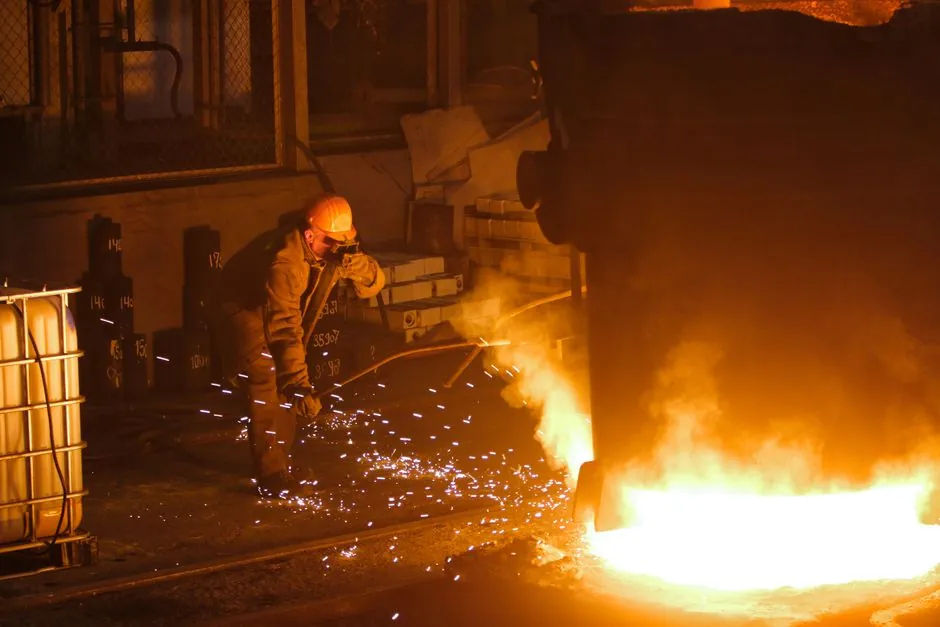
Cast iron is specified as an iron-carbon-silicon alloy with carbon content greater than 2% (typically 2-4%) and silicon at 1-3%, the silicon improving molten-metal fluidity and casting performance [S3][S2].
That composition places cast iron outside the steel family (steel: less than 2% carbon) and makes it solidify as a heterogeneous alloy with more than one microconstituent, which is the metallurgical basis for choosing it for engine blocks, gear housings, brake drums, pump bodies, and wind-turbine component castings [S3][S2].
The four engineering cast iron families and where they sit in energy equipment
Gray iron, ductile (nodular) iron, white iron, and malleable iron are the four common engineering families, distinguished by the form carbon takes in the matrix: graphite flakes, graphite nodules, iron carbide, and temper graphite respectively [S3][S2]. Gray iron is the workhorse for energy equipment housings, diesel engine blocks, cylinder liners, and brake discs for trains, where compressive strength (three to five times its tensile strength), vibration damping, and low cost dominate the requirement [S3][S2]. Ductile iron is specified where higher tensile strength and impact resistance are required without leaving the cast-iron family. White iron is chosen for abrasive-wear service such as slurry-pump liners and grinding-mill liners, where iron carbide (Fe3C) is the wear-resistant phase. Malleable iron is used for thin-section castings that need a measure of ductility after a long anneal.
Specifying gray iron by class, cross-section, and test bar
Gray iron is specified by a two-digit ASTM-style class number that equals the minimum tensile strength in ksi: Class 20 means 20,000 psi minimum tensile strength, with Class 30, 40, 45, 50, 60 going up in roughly 10,000 psi steps for higher-strength uses such as diesel cylinder heads and heavy machine tool beds [S3]. A second required parameter is the test bar cross-section, which must match or relate to the critical section of the finished part, because gray iron's strength is highly sensitive to cooling rate and section thickness [S3]. A thin section in a Class 30 iron can out-perform a thick section in a nominally higher class if the cooling rate chills the graphite flake structure. This is why a 10 mm gear-cover rib and a 100 mm gearbox housing should not be called out by the same class without re-checking the test bar.
Comparative matrix: gray vs ductile vs white vs malleable for energy service
The four families line up against four decision criteria as follows. Compressive strength: gray iron is the leader, three to five times its own tensile strength, which is why it is selected for engine blocks and cylinder liners running under high cyclic compression [S3]. Tensile strength and impact resistance: ductile iron dominates because its spheroidal graphite removes the stress-concentrating flake geometry, opening it to crankshafts, hubs, and high-pressure valve bodies. Wear and abrasion resistance: white iron leads, given its iron-carbide matrix, and is the default for ash-handling piping, slurry pumps, and crusher liners in coal-fired power plants. Vibration damping: gray iron is again the top performer, with damping rising as graphite-flake content increases, which is why precision machine-tool beds, motor housings, and turbine-generator bearing housings lean gray [S3]. Machinability tracks with graphite content, so gray and ductile iron both machine well; white iron is abrasive and expensive to machine, which often dictates that wear surfaces are cast-in rather than post-machined. Engineers reading the cast iron grades for defense selection reference and the cast iron selection for rail castings map will recognize the same gray-versus-ductile-versus-white trade-off re-cast for blast and rolling-stock service; for marine service, the same logic reappears in the cast iron selection for marine engineering reference.
Heat treatment and surface hardening routes available to cast iron
Flame hardening, induction hardening, and furnace heating followed by oil quench can all be applied to cast iron to add a martensitic case to the surface, which is then tempered for machinability plus maximum strength and wear resistance [S3]. For gray iron this is normally a localized surface treatment, applied to cylinder bores, cam-ring contact faces, and gear tooth flanks where wear dominates, leaving the bulk graphite-flake structure intact to keep damping. For ductile iron, the same austempering route produces austempered ductile iron (ADI), a separate sub-grade class with tensile strength often in the 60-120 ksi range, used for high-duty gear and chain components. Hardness can also be lifted with alloying additions such as chromium, molybdenum, or vanadium when heat treatment is impractical for a thick section.
Castability, fluidity, and why energy equipment designers stay in the cast-iron family

Molten cast iron is more fluid than molten steel, melts at a lower temperature, and reacts less with molding aggregate, which is why the same foundry can pour complex internal cooling passages in an engine block or a thin-wall gearbox rib that would be impractical in cast steel [S3]. The trade-off is that cast irons cannot be rolled or forged, so any shape change beyond the as-cast form is by machining, and the alloy has no distinct yield point under classical definitions, which means gray iron should not be specified where gradual plastic deformation is preferred over sudden fracture [S3]. For most energy equipment, the absence of a yield point is a feature: it gives a clean break mode under overload rather than a bending, ductile-yield event, which is desirable in protective housings.
Selection criteria checklist for energy equipment castings
Specify in this order: (1) service class: wear, structural, pressure-tight, or thermal; (2) family: gray for damping and compression, ductile for tensile and impact, white for abrasion, malleable for thin-section ductility; (3) ASTM class and test bar cross-section matched to the heaviest wall of the part; (4) alloying additions (Cr, Mo, Ni, Cu) only when section size, heat-treatment response, or corrosion environment demands it; (5) required surface or through-hardness, which sets whether flame, induction, or austempering is in scope; (6) machinability budget, since harder carbides and white iron can flip the cost balance away from raw material; (7) dimensional tolerance and NDT plan, which on safety-relevant castings is typically magnetic-particle or ultrasonic to ASTM E709 / E114 standards for sub-surface defects in the energy sector. [S3]
Trackable signals for the next node: watch for revision activity on ASTM A48 (gray iron), A536 (ductile iron), and A532 (white iron) for any class-number or test-bar geometry update, and watch for utility-scale wind-turbine hub and gearbox housing spec sheets to confirm whether ADI is displacing forged steel in the 5-15 MW range.
The underlying component specifications are covered under cast iron, energy management, and energy meter.