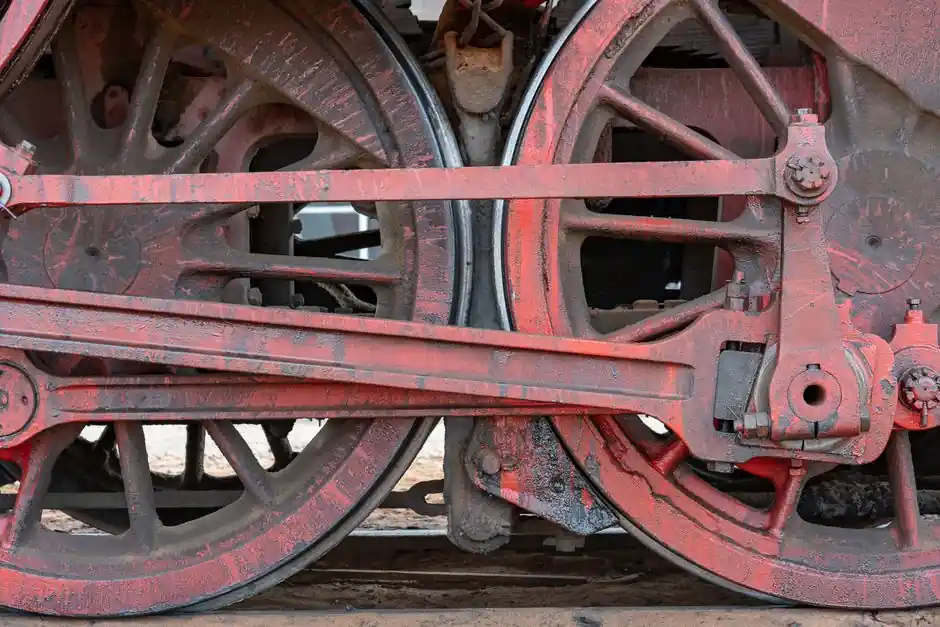
Rail industry castings are specified from a narrow band of materials: ductile (spheroidal graphite) iron for safety-critical structural parts, gray iron for vibration-damped housings, malleable iron for heavy-duty bearing and chain surfaces, and cast or austenitic manganese steel where impact plus abrasion dominate [S1][S3].
Selection is driven by load type, wear, low-temperature toughness, fatigue, and corrosion, not by raw cost, because field failures on bogies, couplers, and frogs create unplanned downtime costs that dwarf material premiums [S3].
Material Family Map: What Cast Iron Actually Covers
Cast iron is any iron-carbon alloy above 2% carbon, almost always with 1-3% silicon, which improves fluidity and casting performance; steels sit below 2% carbon and solidify as a single-phase austenitic structure, which is why cast iron is heterogeneous and breaks into distinct families [S2].
The families that matter for rail are gray iron (graphite flakes, high damping, brittle), ductile or spheroidal graphite iron (graphite nodules, high strength and toughness), malleable iron (tempered white-iron matrix, used historically for heavy-duty bearing surfaces, chains, sprockets, connecting rods, drive train and axle components, and railroad rolling-stock parts), white iron (abrasion resistant, brittle), and compacted graphite iron, which sits between gray and ductile [S1][S2].
For railway castings, ductile iron and gray iron dominate the spec sheets, with cast steel and manganese steel as the substitutes where ductile iron's strength-to-weight no longer holds [S3].
Ductile Iron: The Default for Safety-Critical Rail Parts
Spheroidal graphite iron's spherical graphite form, achieved by liquid-state modification with magnesium or rare-earth alloys, gives a lower stress concentration than the lamellar graphite of gray iron, and tensile and yield properties that compete with forged carbon and low-alloy steels [S4].
The grades named in railway use are EN GJS 400-18 LT, EN GJS 400-15, EN GJS 500-7, and EN GJS-600-3, where the number after GJS is the minimum tensile strength in MPa and the suffix indicates elongation; the LT suffix on 400-18 LT is a low-temperature impact guarantee [S4].
For ductile iron, the Rp0.2 / Rm ratio sits in the 0.6-0.75 range, against 0.55-0.6 for cast steels, and fatigue strength rises with tensile strength under both harmonic and impact-cyclic loading, which is why the material has steadily displaced cast and forged steel in bogie, coupler, and brake components [S4].
Typical applications in a railway casting buyer's checklist are coupler knuckles, bogie frames, brake discs, and yokes, all of which need the combination of tensile strength above 400 MPa, elongation above 15% in the 400-series grades, and certified impact toughness at sub-zero ambient [S3][S4].
Gray Iron: Where Damping Beats Toughness
Gray iron's compressive strength runs three to five times its tensile strength, and it has no distinct yield point, so it is selected where predictable plastic deformation is undesirable and vibration damping is the priority [S2].
For rail, that translates into gear housings, brake cylinders, and other complex-shaped, low-stress covers where the graphite flake structure damps gear-mesh noise and machine vibration, and where the machinability of the soft ferrite-pearlite matrix keeps tooling cost low [S2][S3].
Gray iron is specified by ASTM-style two-digit class numbers tied to minimum tensile strength, for example Class 20 is a 20,000 psi (about 138 MPa) minimum tensile, and the spec also ties to a test bar cross-section because strength is highly sensitive to section thickness [S2].
Gray iron should not be used where impact loading, cold-climate brittle fracture, or fatigue-driven cracks are risks, since its impact strength sits below that of most other cast ferrous metals [S2].
Malleable Iron: The Historical Workhorse for Bearing and Axle Hardware
Malleable iron is produced by heat-treating white iron to convert the brittle carbide matrix into a ferrite-plus-tempered-carbon structure, giving a useful middle ground between gray iron's damping and ductile iron's strength [S1].
It is the traditional material for heavy-duty bearing surfaces, chains, sprockets, connecting rods, drive train and axle components, and railroad rolling-stock hardware where a tough, machinable, wear-tolerant casting is required without going to full ductile-iron cost [S1].
In a current rail spec, malleable iron has largely been replaced by ductile iron for new bogie and coupler designs, but it remains in maintenance-of-way hardware, freight-car fittings, and some heritage rolling-stock specifications where dimensional replacement matters more than redesign [S1][S3].
Selection Criteria Side-by-Side
Match the part to the dominant failure mode first, then the secondary mode, then cost and lead time [S3].
Ductile iron (EN GJS 400-18 LT to 600-3): tensile 400-600 MPa, elongation 3-18%, excellent toughness down to -20°C and below on LT grades, good wear resistance, moderate cost; specified for coupler knuckles, bogie frames, brake discs, yokes [S3][S4].
Gray iron (ASTM Class 20 to 40+): tensile 138-276 MPa minimum, very high damping, brittle, low cost; specified for gear housings, brake cylinders, covers [S2][S3].
Cast steel (e.g. ZG230-450, about 230 MPa yield, 450 MPa tensile): higher impact and fatigue margin than ductile iron at higher cost and longer lead time; specified for side frames, bolsters, and large structural parts [S3].
Austenitic manganese steel and low-alloy cast steels: work-harden under impact, very high abrasion resistance; specified for crossings, frogs, switch points [S3].
For an in-depth look at how material selection intersects with total cost in a related heavy-industry context, see Nickel Alloy TCO math for 2026; for surface protection once the casting is in service, industrial coating types and specs is a useful companion reference.
Where Cast Iron Fails in Rail Service
Gray iron fails by brittle fracture under impact, especially in cold climates, and is sensitive to section size because cooling rate changes the graphite flake distribution and pulls strength down in heavy sections [S2][S3].
Ductile iron can lose its impact guarantee if the chemistry drifts outside the narrow window that gives fully spheroidised graphite, and LT grades must be Charpy-verified at the contractually specified sub-zero temperature, not just at room temperature [S4].
Malleable iron is constrained by heat-treatment cycle time and section-thickness limits, and is being progressively delisted in favour of as-cast ductile iron, so spares and repair welds are harder to source [S1].
Across all families, the rail buyer's first check on a submittal should be the EN/ASTM grade, the test-bar cross-section, and the impact test temperature; the second should be the foundry's record on rail-class certification, because the metallurgy is more complex than steel's and small chemistry drifts change the failure mode [S2][S3].
Standards and Sourcing Anchors
Rail buyers should anchor the spec to EN 1563 for ductile iron grade designations, to EN 1561 for gray iron, and to the relevant AAR M-series chapters for North American freight-car castings; the EN GJS 400-18 LT and similar designations used by European foundries map directly into ASTM A536 grades for ductile iron and ASTM A48 classes for gray iron [S3][S4].
Traceable signals to watch over the next sourcing cycle are the foundry's melt-cert records showing Mg or Ce treatment for graphite nodularity, the Charpy test certificate for the LT grade at the actual service temperature, and the radiographic or ultrasonic inspection level agreed on the drawing, since these are where ductile-iron rail castings are typically rejected at incoming inspection [S3][S4].
The underlying component specifications are covered under cast iron, pressure transmitter, and flow meter.