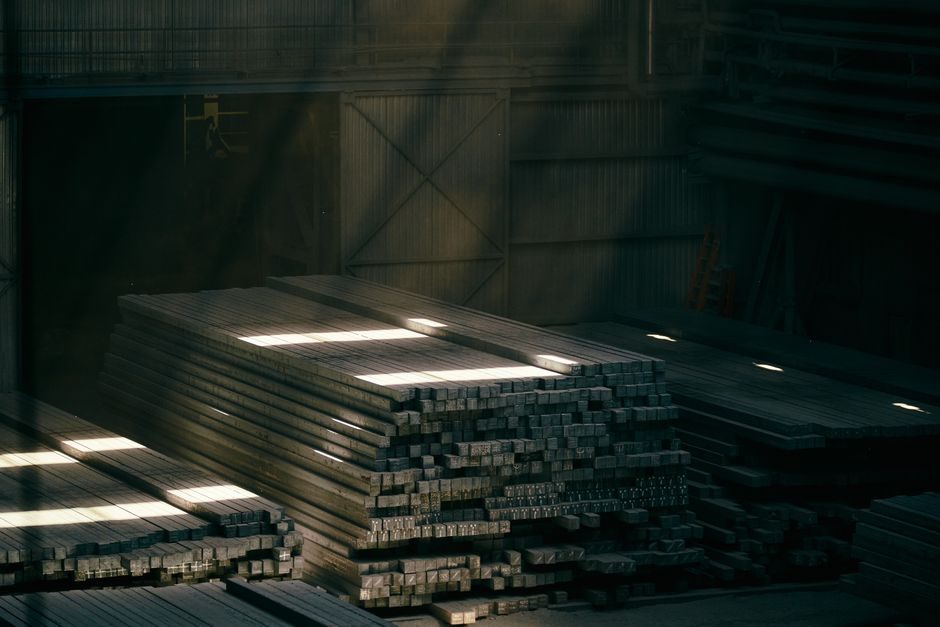
Cast iron is an iron-carbon alloy containing so much carbon that the material becomes brittle and cannot be wrought, so it must be shaped by casting [S1][S2]; commercial grades carry roughly 2.
0-4.0 wt% C and a graphite or carbide phase that drives machinability and damping [S5]. Titanium alloy is a separate material class — Ti as the base element, density near 4.5 g/cm³, Young's modulus around 45 GPa, and alloying additions such as Al, V, Mo, Sn and Zr that produce α, β and α+β grades [S5]. The two materials share a casting route but diverge on every other engineering axis that matters to a specifier: cost per kg, specific strength, corrosion behaviour, and the temperature window in which they remain serviceable.
Composition, Microstructure and Forming Route
Cast iron is defined by carbon content of 2.0-4.0 wt%, with silicon 1-3 wt% as the principal graphitiser and Mn, S, P as residual control elements; grey, ductile (SG), compacted-graphite, white and high-alloy variants sit under the same umbrella [S5]. Because the matrix is brittle at room temperature, the only realistic primary-forming route is foundry casting; subsequent shaping is done by machining, grinding or powder-coat finishing rather than forging [S1][S2].
Titanium alloys exist as commercially pure (CP) grades and as alloyed families: α (e.g. Ti-5Al-2.5Sn), α+β (Ti-6Al-4V, the workhorse), and β (Ti-10V-2Fe-3Al) [S3]. Forming routes include vacuum arc remelting plus forging, investment casting, additive powder-bed fusion, and diffusion bonding — the last studied in the Ti/low-alloy carbon steel system where a TiC interfacial layer forms and grows with thermal exposure [S3]. The carbon-steel side of that study ran 0.3 wt% C, illustrating how aggressively Ti reacts with even lean carbon sources once a thermal cycle is imposed.
Density, Modulus and Specific Strength
Cast iron density sits near 7.1 g/cm³ (grey/SG), Young's modulus around 100-170 GPa depending on graphite morphology, and tensile strength typically 150-400 MPa for grey grades and 350-700 MPa for ductile [S5]. The cost of carrying 1 kg of cast iron in a structure is therefore relatively low per kg, but the strength-to-weight ratio is poor compared with Ti.
Titanium alloys run 4.43-4.85 g/cm³ density, modulus ~45 GPa as alloyed, and tensile strength from ~240 MPa (CP grade 2) to 1100+ MPa (β-annealed Ti-10V-2Fe-3Al) [S5]. Specific strength (strength/density) of Ti-6Al-4V is roughly 1.7-2.5× that of ductile iron at similar section size; the lower modulus is a separate design input that affects deflection and spring-back, not just weight. For moving masses, fatigue-critical parts and corrosion-exposed load frames, this gap is the reason Ti gets specified despite the cost premium.
Corrosion, Temperature and Wear Envelope
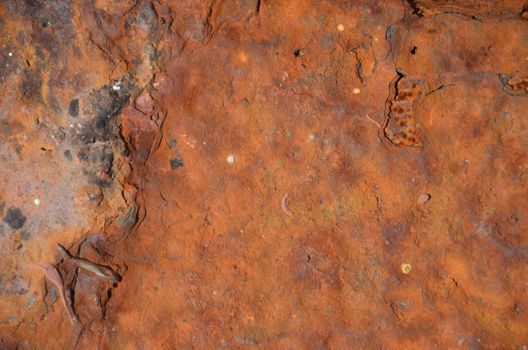
Cast iron corrosion resistance is grade-dependent: grey iron rusts in mild atmospheres unless coated, while high-Si (≥14% Si) and high-Cr (≥20% Cr) austenitic cast irons are specified for sulphuric, nitric and oxidising acid service [S4][S5]. Damping capacity of grey iron is one of its genuine technical advantages — internal graphite flakes convert vibration into heat, which is why lathe beds, engine blocks and pump housings are still cast iron.
Titanium alloys carry a passive TiO₂ film that is stable across pH 3-12 and across most chloride-bearing waters, including seawater and bleach environments where stainless steels pit [S5]. Service ceiling for CP Ti is ~330 °C; for Ti-6Al-4V it extends to roughly 315-400 °C depending on creep allowance; for β grades the operating window is narrower and oxidation-limited. Cast iron is rated to higher peak temperatures in non-cyclic service (grey iron in furnace fittings runs 400-600 °C), but the Ti grade is roughly 40% lighter for the same stiffness-limited bracket.
Cost, Machinability and Joining
Cast iron raw-material cost tracks the iron ore, scrap steel, coke and ferroalloy chain; current 2026 spot bands for the engineering grades sit a small multiple above mild steel scrap. The cost advantage is in net-shape casting: ductile iron yields near-finish pump housings, gear blanks and valve bodies with minimal machining, and the graphite flakes/chips break short, which is why cast iron is the reference "free-machining" benchmark. [S1]
Titanium alloy cost is dominated by Kroll-process sponge, vacuum arc remelting, and the energy needed to keep the melt below oxygen and nitrogen pickup thresholds. As a rule of thumb used in industrial sourcing, Ti-6Al-4V billet runs roughly 10-20× the price of equivalent ductile iron in the same billing unit, before machining is added. Joining differs sharply: cast iron is routinely welded with nickel-iron (Ni-Fe) rods but cannot be hammer-welded or forged, whereas Ti grades are welded under inert gas (GTAW/GMAW with trailing shield) and diffusion-bonded in solid state — the same reaction that forms TiC against low-alloy carbon steel [S3].
Selection Gates: When Each Material Wins
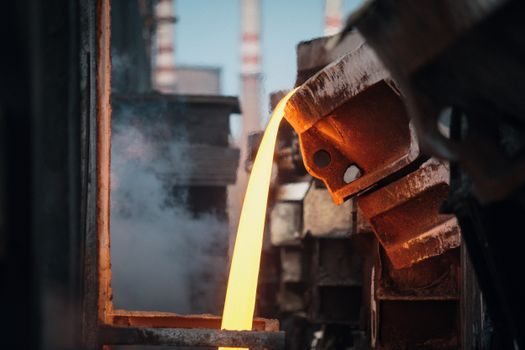
Specify cast iron when the part is a static or damped load frame (lathe bed, gear housing, brake drum, pump casing, manhole cover, drain pipe), the section is medium-to-thick, the surface will be painted or cathodically protected, and cost per cubic centimetre of geometry is the dominant driver. It is the wrong material for parts that must flex repeatedly under load, ride in a chloride splash zone without coating, or save mass in a moving assembly. [S2]
Specify titanium alloy when the design has a hard mass, corrosion, or biocompatibility constraint that cast iron cannot meet — seawater piping, aircraft structural fittings, medical implants, chemical-plant agitators in oxidising acid, condenser tubes in brackish cooling water. Avoid Ti for large static castings that only need damping and stiffness, sliding wear pairs without lubrication, or any geometry where the cost of Ti-6Al-4V billet cannot be amortised across a functional benefit.
Adjacent Material Choices Worth Naming
If the real driver is corrosion in a thinner section, stainless steel and aluminum alloy brackets beat Ti on cost even though they trail on specific strength; aluminium gives ~2.7 g/cm³ density with tensile strength 200-500 MPa across the 2xxx/6xxx/7xxx families, which is enough for many non-critical brackets that do not need Ti's corrosion envelope. For high-temperature load frames above 400 °C, nickel alloy (Inconel 625/718, Hastelloy C-series) is the right escalation step rather than Ti or Fe-C cast iron, given creep life rather than raw strength. Buyers tracking the 2026 spot market can also compare cast iron against the published carbon steel price bands since ductile iron and carbon steel compete head-to-head on most general-engineering brackets. [S3]
Next node to track: the 2026 spot price differential between ductile iron ASTM A536 grade 65-45-12 and Ti-6Al-4V ASTM B348 grade 5, expressed per kg of finished machined part rather than per kg of bar stock. Second signal: any new ISO/ASTM revision covering additive-manufactured Ti-6Al-4V powder (spatter limits, oxygen ceiling, HIP cycle), since that is the route most likely to narrow the cost gap with cast iron over the next reporting cycle.