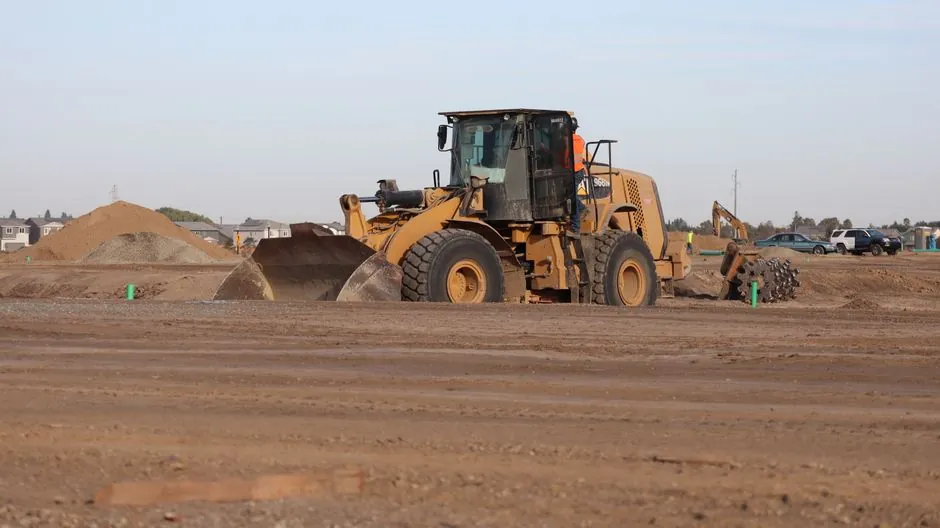
A rotary laser level on a grading job does one job: it replaces string lines, water levels, and optical transits with a single 360° reference plane that every machine and rodman on the site can read in real time [S1][S4]. The unit spins a diode laser at 100–1,100 RPM so the beam visually (or electronically) defines a level horizontal plane, and a hand-held laser detector on a grade rod beeps when the rod is at the target elevation [S1][S5]. That single plane is what contractors use to set sub-grade for pads, dig footings, check slope on driveways, and verify final grade against plan elevation [S2][S3].
On a typical site the instrument is set on a tripod at a known elevation (or benchmarked off a hub), self-levels, and shoots a beam that any operator with a detector and rod can read across hundreds of feet, which is why rotary lasers are the modern workhorse for grading, foundations, slab forms, and deck post elevations [S2][S6].
What the Tool Actually Does on Site
A rotary laser level is not a single dot or a line, it is a continuously rotating beam that sweeps out a full horizontal (or vertical) reference plane around the instrument, giving every crew member the same datum to work from at the same time [S1][S4]. In grading work that plane becomes the target: cut to it, fill to it, or set forms to it, and the result is a consistent elevation across the whole pad, road, or trench [S2][S7].
The beam itself is a focused diode laser (red at about 635 nm or green at about 532 nm), and a smaller diode aperture means a tighter, more precise point of level, which is one of the spec-level reasons price scales with optical quality [S1][S5]. Green is roughly 400% more visible to the eye than red at the same power, but it draws more current, so on a long day of grading where battery life matters more than naked-eye visibility, red is still the workhorse choice [S1][S5].
How the Crew Reads the Beam: Detector, Rod, and Elevation
Outside, you cannot see the beam with the naked eye in daylight, so the crew uses a laser detector clamped to a grade rod: the detector beeps or flashes as it moves through the beam, and the elevation where the beep locks tells the rodman how far above or below target the ground is at that point [S1][S7]. That reading is the cut or fill figure that gets walked to the dozer or skid-steer operator, which is why a single instrument can drive a grading spread across a whole site without re-stringing [S2][S6].
Operating range on a grading job is therefore not the visible range, it is the detector range. A heavy-duty dual-slope unit like the Topcon RL-200 2S rates 3,600 ft diameter with its LS-100D detector and holds 3/64 in per 100 ft accuracy, while a general-purpose self-leveling unit like the Topcon RL-SV2S rates 800 m diameter with detector and 1/16 in per 100 ft accuracy, and either is enough to cover most residential or commercial pads from a single setup [S3].
Self-Leveling vs Manual: Accuracy Bands That Matter for Grade

Rotary lasers level themselves three ways, and the leveling method sets the accuracy band you can hit on grade [S1]. Manual leveling against a bubble vial typically delivers about 1/8 in per 30 ft, pendulum self-leveling typically delivers about 1/8 in per 100 ft, and electronic (servo-motor) self-leveling typically delivers about 1/16 in per 100 ft, which is the band most site grading and slab work is actually spec'd to [S1][S2].
Self-leveling range is the other spec that decides whether the unit is useful on rough pad work: a 5° self-leveling window (as on the RL-SV2S) means the tripod does not have to be perfectly nailed down for the beam to settle to true level, which speeds up every setup on a rough site [S3]. Outside that window the unit typically alarms and stops spinning, a deliberate feature that prevents a bad datum from silently walking a whole grading job off elevation [S1].
Single-Slope vs Dual-Slope for Drainage, Pitches, and Driveways
Single and dual slope rotary lasers are both used to hold a consistent pitch across a large area, and the difference is which axes the beam can be tilted on [S3]. A single-slope unit tilts the plane on one axis, which covers a one-way driveway fall or a basic drainage run; a dual-slope unit tilts on both X and Y axes independently, so the crew can "walk the line" vertically on the X axis to align metal track and "angle the line" horizontally on the Y axis to set slope on a parking lot or sports field, without re-positioning the instrument [S3].
For pure rough grading where the goal is one consistent plane of sub-grade, a single-slope self-leveling unit is the most common pick because it is cheaper and the workflow is simpler [S2][S3]. For pad-and-drainage work where the final surface has to sheet water to a curb or inlet at a specified percentage, dual-slope is the right call because the operator can dial the percentage in directly and walk the rod to check both axes without math [S3].
Machine Control and Mounted Receivers on Earthmoving
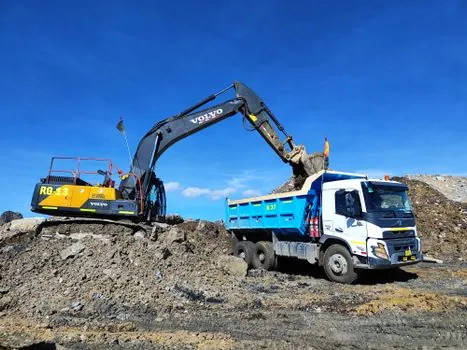
Rotary lasers do not only drive hand-rod work; on grading equipment a receiver is mounted to the mast of a dozer, grader, or skid-steer, and the beam tells the hydraulic or operator-control system where the blade is relative to target elevation, which is the basis of entry-level 2D machine control [S3][S6]. That same principle scales to automatic blade control on motor graders and to indicate-only setups on excavators, where a rod-mounted detector tells the operator how deep to dig to grade without a second person on the ground [S3][S6].
For deeper engineering context on a rotary laser level used in machine-control mode, the trade-off versus 3D GPS or total-station systems is range and complexity: a single laser plane is cheap, fast to set up, and works under tree canopy, but it can only deliver one reference surface per setup, so complex multi-plane sites require multiple setups or a step up to a 2D/3D system [S6].
Power, Classification, and What to Spec for a Grading Crew
Most grading lasers are Class IIIA, between 1 mW and 5 mW of optical power, which is eye-safe for accidental exposure but should not be stared into, and brighter (closer to 5 mW) units are also the more expensive tier of the market [S1]. Rotation speed is typically 300/600/900 RPM, with the higher RPM used when the beam is being read by a fast electronic detector on machine-control masts and the lower RPM used for visible indoor reference work [S1][S3].
Ingress protection is a real spec for outdoor grading: a unit like the Leica Rugby 640G carries an IP67 rating, meaning it survives temporary immersion, and runs up to about 70 hours on a battery set, both of which matter on a muddy site where the instrument lives in the truck bed between setups [S3]. If you want a deeper background read on the optics themselves, the laser level encyclopedia page covers the diode and wavelength side in more detail.
Limitations and Failure Modes to Plan Around
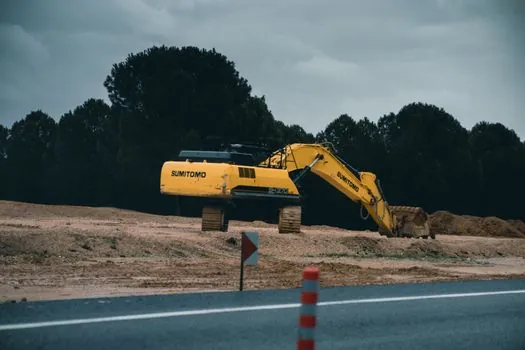
Three things consistently trip up rotary laser grading work: line-of-sight, sunlight on the detector, and vibration. The beam is a straight line, so the detector has to actually see the instrument, which means a dozer blade, a stockpile, or a deep cut can shadow the rod and force a re-setup [S2][S6]. Bright sun washes out the detector sensor, which is why the better detectors carry a tall rod-clamp housing and a loud, unmistakable tone, and why a shaded hood over the sensor is not optional on a July grading day [S1][S3].
Vibration on a dozer or compactor can knock a manually leveled unit out of true, which is why production grading almost always uses a self-leveling or electronic self-leveling instrument and checks the calibration against a known hub at the start of every shift [S1][S2]. For a cross-reference on a related optical/measurement tool, the laser profiler page covers how spinning-beam sensors are used in a very different, surface-inspection role.
Where a Rotary Laser Fits vs Other Leveling Methods
Compared to an optical transit or builder's level, a rotary laser lets a one-person rod read elevation anywhere on the site within range, without the operator having to look through a scope and call out readings, which is why rotary is the modern default and "transit" is mostly historical trade slang now [S2][S4]. Compared to GPS or total-station 3D machine control, a rotary laser is much cheaper, sets up in minutes, and works under canopy, but it only defines one plane, so complex sites with multiple finished grades need multiple setups or a 3D system [S2][S6].
The fit, in plain terms: rotary laser is the right tool for residential and light commercial grading, slab and foundation work, single- and dual-slope pads, drainage runs, and as the reference for entry-level 2D machine control; it is the wrong tool when you need a finished floor certified to tighter than 1/16 in per 100 ft over a long run, when the site has no line-of-sight from a single setup, or when multiple non-coplanar finished elevations must be held simultaneously, which is when a survey-grade instrument or 3D machine control earns its keep [S2][S3][S6].
Trackable signals to watch over the next planning cycle: the spread of self-leveling range beyond the current 5° class typical of mid-tier units, and the migration of green-beam diode stacks into IP67-rated outdoor housings at price points closer to today's red-beam mid-tier, both of which would shift buying math on grading crews that currently standardize on red for battery life [S3][S5]. For related coverage of optical-sensor spec trade-offs, see this side-by-side on telescopic boom length vs section count on truck cranes, which uses a similar accuracy-versus-range framing for a different machine.
The underlying component specifications are covered under rotary encoder.