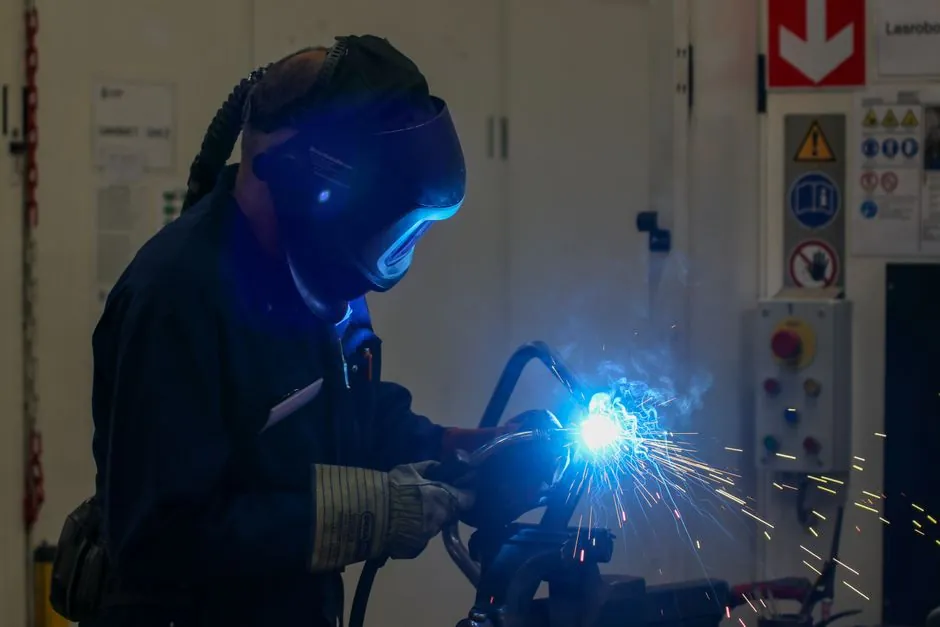
Arc force (also labelled Dig or Arc Control on different OEM panels) is the MMA inverter's automatic, short-duration current boost that fires when arc voltage collapses, and it exists to keep a short arc alive without sticking the electrode [S1][S2][S5].
It is one of three related stick-welding aids: Hot Start (ignition surge), Arc Force (running-arc surge on short arc), and Anti-Stick (electronic short-circuit current clamp), packaged together on most modern inverter stick machines and sometimes on MIG/MAG sets in stick mode [S2][S5].
What Arc Force Actually Does in the Arc Loop
Arc force is a temporary increase of the output current during welding when the arc is too short, providing extra amperage for roughly 0.5 s in a typical OEM envelope to keep the arc from extinguishing [S4]. The inverter monitors arc voltage continuously, and when voltage drops below the threshold that signals an imminent short, the control loop adds current proportional to the depth of the voltage dip, then returns the output to the set welding current once arc length normalises [S1][S3][S5].
Mechanically, this raises the electromagnetic "push" of the arc, which gives better penetration into the root, a more fluid puddle, and tighter arc stiffness when the welder's hand drift or electrode burn-off shortens the gap [S6]. It is a dynamic, closed-loop adjustment, not a steady offset on top of the amperage knob, and that distinction is what separates it from a plain current increase [S5].
Arc Force vs Hot Start vs Anti-Stick: A Decision Table
Hot Start fires only at arc strike (typically 0.25–0.5 s at roughly 15% over the set current, scaling to 20–30% for E6010/E6011 and 5–10% for stainless), Arc Force fires whenever the running arc shortens, and Anti-Stick clamps the short-circuit current if the electrode actually freezes to the plate so the operator can break it free without damaging the holder or cable [S2][S3][S4].
Welders familiar with multi-process inverter packages will recognise the same three-aid pattern on arc welder product pages, where the controls are typically grouped as "Hot Start / Arc Force / Anti-Stick" and tuned per electrode class [S2][S4].
How to Set Arc Force by Electrode and Joint

Higher arc-force values produce a more aggressive, digging arc suited to root passes and poor fit-up on cellulosic rods (E6010, E6011), while lower values give a softer arc suited to sheet metal and rutile-coated E6013 work where spatter control matters [S3][S5]. Lincoln Electric's OEM guidance for general-purpose stick work is to set the arc-force knob to minimum for a smooth, low-spatter arc on rutile and basic electrodes, and to maximum for a crisper arc with deeper penetration, with a single knob covering the full rutile/basic/cellulose range [S4].
A practical starting matrix, drawn from the same OEM and trade guidance: E6010/E6011 cellulosic pipes and dirty steel use high arc force with Hot Start 0.3–0.6 s at 20–30% over set current; E7018 low-hydrogen structural runs use moderate arc force with Hot Start 0.2–0.4 s at 10–15%; stainless electrodes use low arc force with Hot Start 0.2–0.3 s at 5–10% to avoid overheating and discolouration [S3]. These settings should be treated as starting points, not absolutes, because the right balance also depends on cable length, work clamp resistance, and operator arc-length discipline [S3][S5].
Where Arc Force Helps and Where It Hurts
Arc force earns its keep on cellulosic pipe welding (E6010/E6011), out-of-position work, root passes with poor fit-up, and any situation where the welder is dragging a tight arc to force metal into a tight joint, exactly the conditions where a plain constant-current (CC) stick machine would constantly stick the electrode [S1][S3][S5].
It is counterproductive on thin sheet (under about 1.5 mm of steel or stainless), where the extra current spike blows through the base metal, and on overhead or vertical-up cover passes where a softer arc gives better bead contour and less spatter; on those joints, minimum arc force with a slightly higher open-circuit voltage is the better choice [S3][S4]. The same trade-off shows up when an arc welder is used for light fabrication versus pipe code work, and the OEM knob position is the cheapest way to switch between the two personalities without changing rods.
Limits, Failure Modes, and Sourcing Notes
Arc force is a software/firmware control-loop function, not a hardware accessory, so its presence and tunability depend on the inverter's control board: older transformer stick welders have no arc force at all (they rely on the natural CC droop curve), and entry-level inverter sticks sometimes offer a fixed arc-force value with no user knob [S4][S5]. When the boost is mis-sized, two failure modes dominate: too little arc force produces repeated electrode sticking and arc outages on E6010/E7018 root passes, while too much arc force drives excessive spatter, deeper-than-intended penetration, and possible undercut on thinner plate [S3][S5].
Training bodies such as the CWB Group publish dedicated arc-force video modules for stick welders, which is a useful signal that the parameter is treated as a standard curriculum item, not a marketing toggle, for code welding [S7]. Operators on multi-process inverter packages that include variable-frequency drive-style power stages for the stick output should expect arc-force behaviour to vary with the generator/inverter headroom, especially on motor-generator sets where RPM sag under load can mask the arc-voltage dip the control loop is watching for [S4].
Standards, Training, and Where to Verify the Spec
No single ISO or AWS standard pins down a numerical "arc force" value, because the parameter is OEM-defined inside the welding power source's closed-loop controller; instead, the relevant code requirements sit on the procedure side (AWS D1.1, ASME IX, API 1104) and the machine qualification side, with arc force treated as a machine feature the welder is trained to use rather than a calibrated variable [S4][S7]. For procurement, the practical verification path is to confirm the inverter's spec sheet lists "adjustable arc force" (not just "hot start"), check the knob range, and validate behaviour on a known E6010 root pass before signing off on a production run [S4][S5].
Adjacent welding-process selection on multi-process inverters (MIG/MAG, lift-TIG, stick) is covered in the welding and cutting tool reference, and the same closed-loop current-boost logic that drives arc force is what enables smoother lift-TIG starts on machines that market "Hot Start in TIG mode" as a feature [S3][S4].
Trackable signals to watch over the next quarter: OEM firmware notes publishing arc-force and hot-start envelopes per electrode class (Lincoln, Miller, ESAB, Kemppi), and welding-programme updates from CWB and AWS that standardise training language around the three-aid model rather than the older "Hot Start only" framing [S4][S7].
Related analysis: Aluminum Die Casting Machine Energy Cost Per Shot on Servo-Hydraulic Drives.