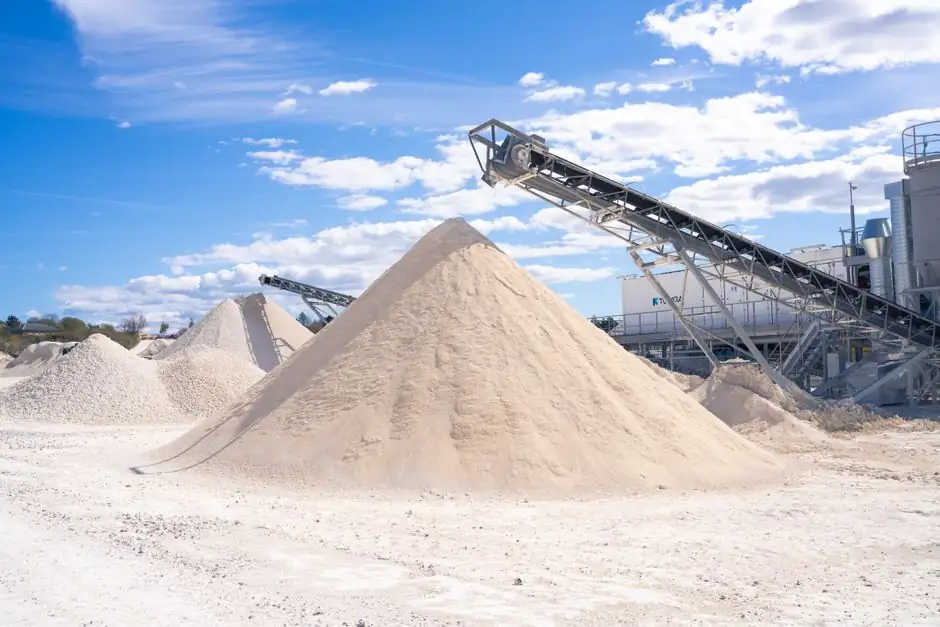
CEMA surcharge angle (As) governs the upper bound of the load cross-section on a moving belt, and it is set by the material's flowability, not by belt speed or idler choice; published tables range from 5 deg for very flat wet-sticky clay to 30 deg for irregular stringy fibrous interlocking material [S1][S2].
For conveyor capacity the cross-sectional area A in Q = A x v x density x 3.6 is bounded below by the troughing idler geometry (0, 20, 35, or 45 deg) and above by the surcharge angle of the specific bulk solid, with the 35 deg 3-roll idler used on roughly 80 percent of mining and aggregate conveyors [S2].
Definition and Why the Moving Belt Changes the Pile Geometry
The angle of repose (Ar) is measured from a stationary, freely formed pile and reflects static inter-particle friction, while the angle of surcharge (As) is measured on a moving or disturbed belt and reflects kinetic friction, the property that actually controls how much material rides on the belt between idlers [S1][S4].
PPI's idler selection guide states the working rule: As is normally 5 deg to 15 deg less than Ar, with very small rounded wet or dry particles dropping to a 5 deg surcharge against a 35-39 deg repose, and irregular stringy fibrous interlocking material staying at 30 deg surcharge against a 0-19 deg repose band [S1]. BisonConvey's 40-material reference tightens that band to 5–10 deg below repose, and gives worked pairs such as alumina 22 deg / 10 deg, dry sand 30 deg / 18 deg, and wet sand 45 deg / 25 deg [S3].
CEMA Bands, With a Comparison Across Flowability Classes
Five flowability bands drive every CEMA lookup: very small rounded wet or dry particles (As 5 deg, Ar 35–39 deg), rounded dry polished medium-weight particles (As 10 deg, Ar 30–34 deg), irregular granular or lumpy medium-weight material (As 20 deg, Ar 20–29 deg), typical common materials (As 25 deg, Ar 20–29 deg), and irregular stringy fibrous interlocking material (As 30 deg, Ar 0–19 deg) [S1][S2].
Across a 40-material reference, abrasiveness does not track surcharge: alumina carries a 10 deg As but a "Very High" abrasion class, anthracite coal carries a 15 deg As at "Low" abrasion, and wet sand pushes to 25 deg As at "Very High" abrasion, so cover grade, pulley lagging, and idler shell thickness must be selected independently of As [S3]. A side-by-side view for designers:
Flowability class vs CEMA surcharge vs typical materials: free-flowing rounded (As 5–10 deg) covers dry sand 18 deg, alumina 10 deg, anthracite 15 deg; medium-flow granular (As 15–22 deg) covers limestone 20 deg, iron-ore crushed 22 deg, copper ore 25 deg; poor-flow wet or fibrous (As 25 deg) covers wet clay 25 deg, wood chips 25 deg, wet sand 25 deg, fly ash 22 deg [S3][S1].
Who Should Use As (and Who Should Not)

Use As for belt cross-section sizing in the CEMA Q = A x v x density x 3.6 formula, for trough-angle selection between 20 deg, 35 deg, and 45 deg idlers, and for skirtboard height in the load zone, because that is the live geometry the belt actually carries under vibration and motion [S2][S5].
Do not use As for bin, hopper, or stockpile volume, where the static angle of repose is the correct parameter, and do not use As to set the maximum conveyor incline, where the angle of slide (material on belt with belt stopped, often 60–80 percent of As) is the right limit, per general CEMA practice and the S1 note that As is "often the maximum incline of the conveyor" only as a rough first cut [S1][S5]. For load-zone chute and skirtboard design, use loose bulk density, not the vibrated compacted density used with As, otherwise the chute will be undersized for the in-service volume of the bulk solid [S5].
Selection Criteria, From Material Test to Belt Cross-Section
Step 1: determine the material's lump size, density (lb/ft3 or kg/m3), and angle of repose Ar from a lab test, not from a generic table, because CEMA Standard 550 properties are material-specific and a wrong Ar propagates a wrong As [S1][S5].
Step 2: apply the 5–15 deg reduction to Ar to get As, with the lower end of the band used for rounded free-flowing solids and the higher end (closer to Ar) used for lumpy or stringy material that locks together on the belt [S1][S3]. Step 3: pick the trough angle: 35 deg is the workhorse for about 80 percent of mining and aggregate service, 20 deg is used for fines and dusty material where carryback is a concern, 45 deg is used for high-capacity lumpy material, and 0 deg is reserved for picking and inspection [S2]. Step 4: cross-check the resulting A against the CEMA belt-width table and adjust belt speed to hit the required t/h, accepting the documented 10–15 percent variance between calculated and actual capacity for sag, loading impact, and edge clearance [S2].
Limitations, Failure Modes, and Field Signals
The CEMA As method is an estimate, not a guarantee: actual throughput typically varies 10–15 percent from the calculated value due to belt sag, loading impact, lump size, and edge clearance, so critical duty conveyors should be validated with field measurement of t/h against the calculated value [S2].
Common failure modes trace back to misapplied As: spillage at the load zone when the chute was sized against compacted density instead of loose bulk density, carryback on the return run when As was set from a rounded-particle default on lumpy ore, and belt mistracking at the transition when the surcharge changes between the loaded trough and the flat tail section, which is why S8 notes the surcharge angle is "deduced to a minimum" at the belt edge and transition point, and recommends moderate trough angles for big lumps [S8]. Toolgrit's 2026 design guide restates the operating band of 5–15 deg below Ar and ties belt speed limits to material type, reinforcing that As is a sizing input, not a stand-alone control parameter [S6].
Standards, Sourcing, and Test Anchors
CEMA Standard 550 is the governing reference for the basic bulk-solid properties used with As, including bulk density, loose bulk density, angle of repose, and surcharge angle, and the international parallel is ISO 5048 for capacity cross-section, which uses a similar area method with slightly different edge-distance assumptions [S2][S5].
Property data is published in three practical forms: the CEMA Belt Conveyors for Bulk Materials 7th edition tables (the canonical source), OEM idler-selection tables such as the PPI guide that compresses the table into five As bands against five Ar bands, and online material-property references such as BisonConvey that list paired Ar and As for 40 common bulk solids with abrasiveness class [S1][S2][S3]. Martin Engineering's bulk-material-science work, used in coal-handling power plants, drives the same three properties back to lab measurement rather than table lookups, which is the only way to handle material outside the CEMA table [S5].
Track two signals going forward: the next CEMA revision of Standard 550 and the 7th-edition Belt Conveyors for Bulk Materials errata, both of which can shift the As bands or tighten the 5–15 deg reduction rule, and field-versus-calculated capacity audits on existing conveyors, which feed back into whether the 10–15 percent CEMA variance band is still realistic for modern high-speed belts. For engineers spec'ing belt conveyors adjacent to chemical material transfer lines, the finishing material of the chute lining and the magnetic material choice for head-pulleys interact with the load zone geometry set by As, not with As directly. Related coverage on bulk-solids handling trade-offs sits in this cement-binder spec decision piece, which applies similar flowability reasoning to a different bulk-handling problem.