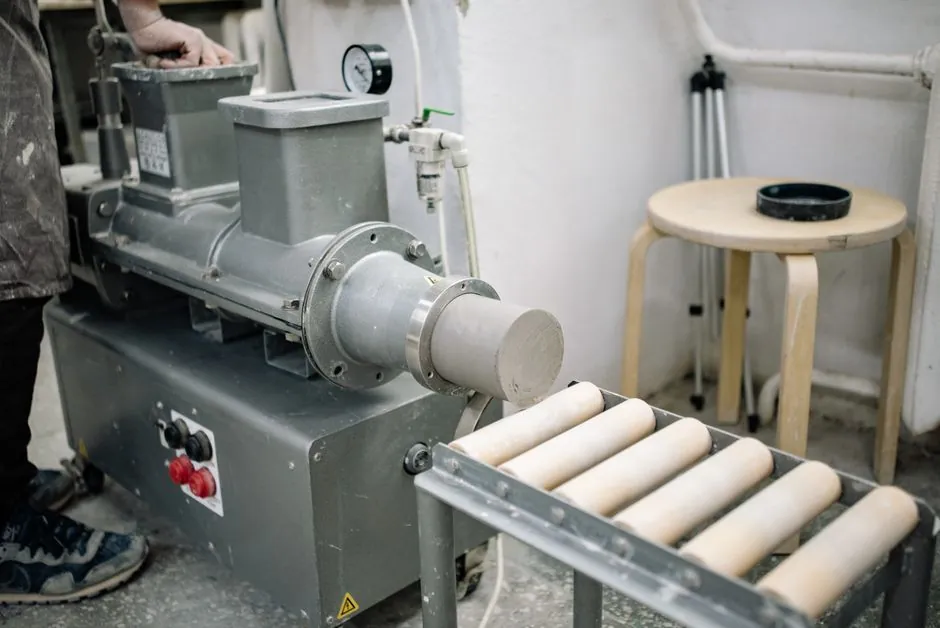
ANSI/CEMA 350-2021 (Screw Conveyors for Bulk Materials) is paired with ANSI/CEMA 550-2020 (Classification and Definitions of Bulk Material) to convert a material's physical behaviour into a screw conveyor build: a 4-part material characteristic code such as 94A10026M maps to a component series 1D, 2D (heavy-duty), or 3D [S1][S2][S3]. The code is not a strength rating; it is a lookup that drives flight thickness, hanger bearing spacing, trough gauge, and drive sizing decisions per the CEMA 350 tables.
The 2021 edition of CEMA 350 remains the current American National Standard for screw conveyors as of 2026-09-22, alongside companion CEMA 300-2021 (dimensional standards) and CEMA 102-2022 (conveyor terms and definitions) [S3]. Engineers specifying a new unit should treat the alphanumeric code as the input and the 1D/2D/3D designation as the output, then verify shaft diameter, trough gauge, and hanger type against the CEMA 300 dimensional tables before release.
Anatomy of a CEMA 350 material code (e.g., 94A10026M)
The CEMA 350 material characteristic code is read as four concatenated fields that together describe a bulk solid: the first two digits (94 in the example) encode the material's flowability and lump size class; the letter (A) is the abrasiveness code drawn from the CEMA 550 abrasion series; the next block (10026) carries density, particle size, and moisture/flow modifier data; and the trailing letter (M) flags a special handling condition such as mildly corrosive, sticky, or mixed particle distribution [S2]. Each field is keyed to a column in the ANSI/CEMA 550-2020 material tables, and CEMA explicitly ties the engineering basis of all bulk material conveyor work to that classification step [S1].
Abrasion is the field that most often swings the specification, because the CEMA 350 component series are selected against the abrasion letter, not the full code. A code whose abrasion letter is in the low range maps to 1D light-duty components; mid-range letters map to 2D heavy-duty; high-range letters force 3D extra-heavy-duty with heavier gauge trough, thicker flighting, and reduced hanger spacing [S2][S5]. When the code's trailing modifier flags a corrosive or sticky material, the standard still uses the abrasion letter to size mechanical components, then layers material-of-construction choices (stainless, AR plate, special coatings) on top of that mechanical base.
Component series 1D, 2D, 3D: which code field actually drives the selection
The component series is selected from the CEMA 350 component tables, not from the full code: the abrasion letter from the material code is the input that maps to series 1D, 2D, or 3D [S2]. Series 1D (light-duty) is paired with codes whose abrasion letter is low, and is used for powders and free-flowing granular materials such as grain, grain by-products, flour, animal feed, plastics pellets, and detergent powders [S5]. Series 2D (heavy-duty) is the workhorse selection, applied to animal feed milling, wood processing, chemical industry service, and municipal/industrial environmental applications [S5].
Series 3D (extra-heavy-duty) is reserved for the highest-abrasion service: cement, lime, gypsum, sand, and mining industry materials [S5]. Within a given series, the remaining fields of the material code (density, lump size, modifier) tighten the trough loading, flight pitch, and shaft diameter choice using the CEMA 300-2021 dimensional tables, which currently cover 6, 9, 12, 14, 16, 18, 20, and 24 inch diameters with U-trough and standard shaft sizes of 1-1/2, 2, 2-7/16, 3, and 3-7/16 inch diameters on 2-bolt drilling [S5]. Sizes outside that envelope are not covered by an established CEMA standard and revert to engineered special design.
Material class vs CEMA B/C/D load rating: do not confuse the two systems

The CEMA load-class letters B, C, and D used by some idler and bulk-handling suppliers are a capacity/series rating for components such as idlers, screws, and pulleys, where CEMA B covers low-to-medium capacity, CEMA C covers medium-to-high capacity typical of bulk heavy materials, and CEMA D covers the heaviest service [S6]. That letter scale is a different system from the CEMA 350/550 material characteristic code and from the 1D/2D/3D component series; using a CEMA D idler on a Group 1 (1D) screw is normal, because the two systems rate different things.
Specifying engineers should keep three CEMA documents in front of them when a bulk material arrives: ANSI/CEMA 550-2020 to look up or confirm the material code, ANSI/CEMA 350-2021 to apply the code to flighting, hanger, and trough selection, and ANSI/CEMA 300-2021 to lock the resulting geometry to a standard screw size and shaft diameter [S3]. When the material is unusual or the code letter sits at the boundary between series, the conservative move is to step up one component series and verify with the OEM's component selection software before purchase.
Worked lookup path: from material name to component build
The standard lookup path is name to code to series. Start in ANSI/CEMA 550-2020 and locate the material (e.g., dry Portland cement, wood chips, fly ash, moist sand): the table returns the four-part code including the abrasion letter and the trailing modifier [S1][S3]. Take the abrasion letter into ANSI/CEMA 350-2021 and find the corresponding component series 1D, 2D, or 3D; the example code 94A10026M maps to 2D heavy-duty per the CEMA component tables [S2].
Then take the full code plus the 2D designation into ANSI/CEMA 300-2021 to select a standard screw diameter (6 to 24 inch U-trough family), a standard shaft (1-1/2 to 3-7/16 inch on 2-bolt drilling), trough gauge, flight thickness, and intermediate hanger bearing count [S5]. If the calculated length exceeds standard hanger spacing, the design moves to either a larger diameter screw or special non-standard geometry outside the CEMA envelope. The CEMA Stock Components program and most OEM configurators (including WAM USCA, KWS, and Screw Conveyor Corporation lines) are organised around that exact 550 to 350 to 300 chain.
Common spec traps when reading the material code
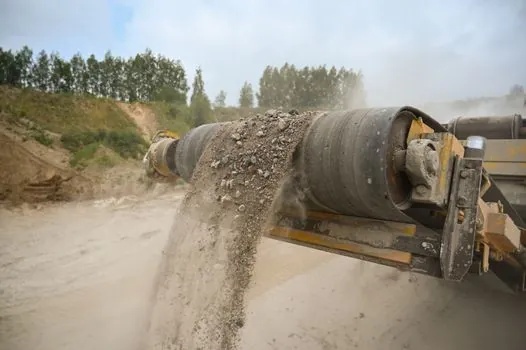
Four traps cause most mis-specs. First, treating the full code as a single strength grade instead of four independent fields; only the abrasion letter drives the component series, while density and lump size drive geometry inside the series [S2]. Second, ignoring the trailing modifier letter: an M, C, or T suffix changes the material-of-construction decision and the surface finish, not the mechanical series [S2]. Third, picking a screw diameter outside the 6 to 24 inch CEMA 300 envelope without flagging it as engineered/special, because no published CEMA standard governs those geometries [S5].
Fourth, conflating the CEMA B/C/D load rating with the 1D/2D/3D series; they rate different components and the two numbers do not substitute for each other [S6]. The same material handled by a screw conveyor in a light-duty 1D build cannot simply be re-rated to a heavier series by swapping in a CEMA D idler; the flight thickness, hanger spacing, and trough gauge have to be re-selected from the CEMA 350 tables. Related equipment families covered by other CEMA documents, including belt conveyors (ANSI/CEMA 402-2003 R-2020) and chain conveyors (unit-handling standards in the 401, 403, 404 series), have their own classification systems and should not be cross-wired with the CEMA 350/550 material code logic [S3].
Sourcing, standards currency, and where the codes live
The authoritative material classification tables are in ANSI/CEMA 550-2020, and the rules that consume those tables for screw conveyor design are in ANSI/CEMA 350-2021; both remain the current American National Standards as listed on the CEMA standards page in 2026-09-22 [S3]. CEMA accepts applications for Consensus Bodies in the 2025 to 2026 cycle covering all listed standards, which is the formal path through which any future revision of CEMA 350 or CEMA 550 would move before publication [S3].
For a working engineer the practical sources are the printed or PDF standards from CEMA/ANSI for the official tables, OEM technical bulletins that reproduce the code-to-series mapping for their product lines, and the lead screw and power-transmission literature for adjacent components such as ball screws and screw pumps, which use their own classification systems and should not be confused with CEMA 350 [S2][S3]. When a material is not listed in CEMA 550, the correct next step is to commission a bulk material test (bulk density, angle of repose, moisture, abrasion index) and have the OEM assign a new code before the screw geometry is frozen. Related reading on bearing preload logic in conveyor drives is in Cone and Cup Preload Adjustment in Tapered Roller Bearing Assemblies.