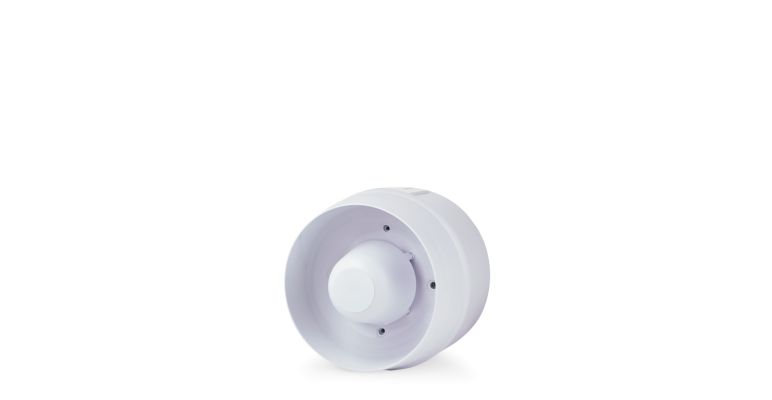
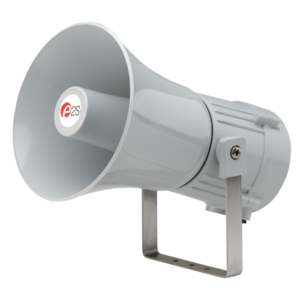
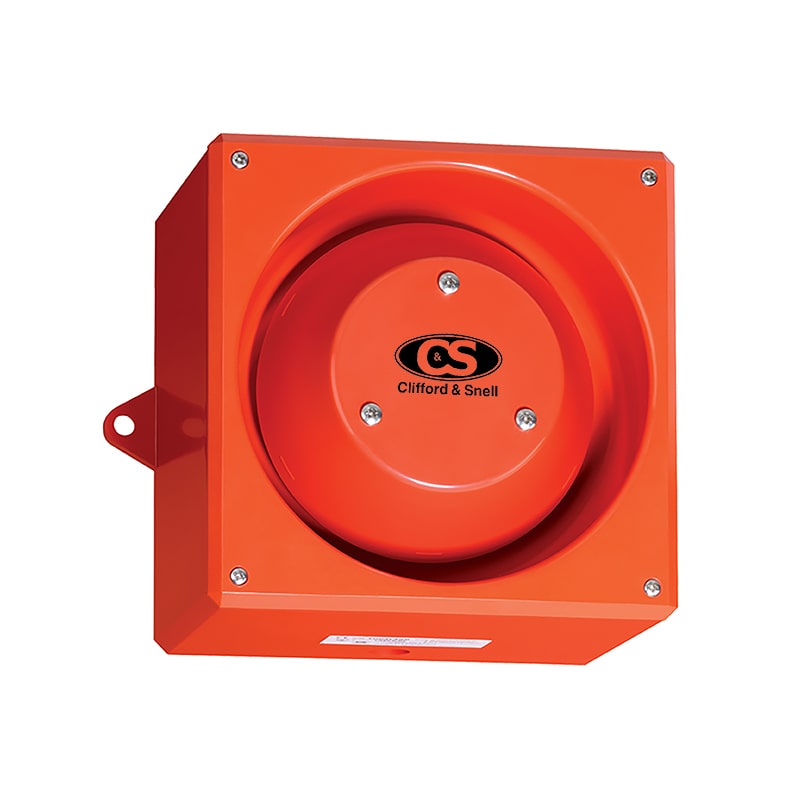
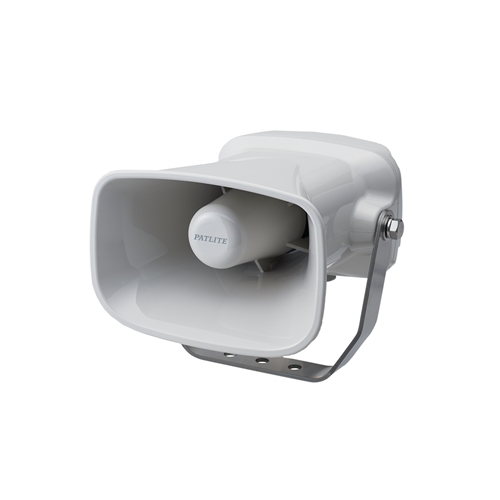
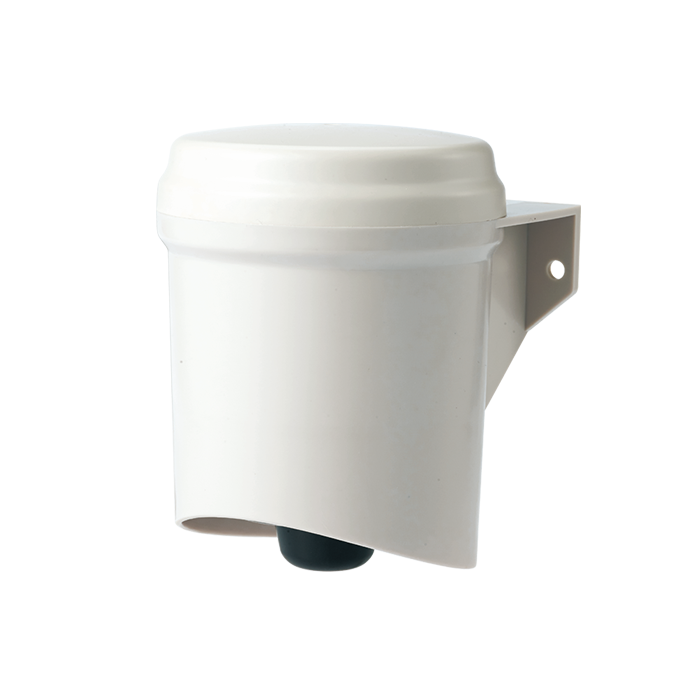
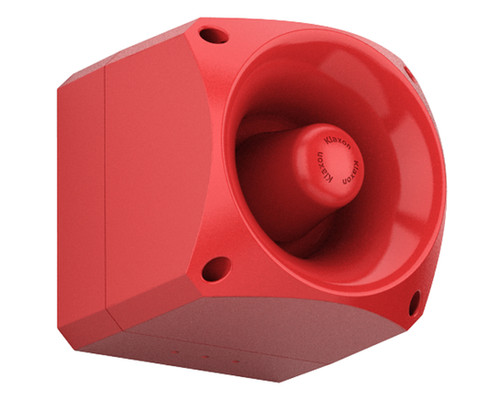
An industrial buzzer is an audible signaling device that converts an electrical input into sound, used to annunciate machine status, faults, and operator prompts on control panels, conveyor lines, and process equipment. The term spans a wide family: from a small 22 mm panel-mount buzzer that beeps inside a control cabinet, through multi-tone electronic sounders, up to high-output horns rated above 100 dB(A) on the plant floor.
Two physical principles dominate: piezoelectric and electromagnetic. Beyond the principle, the parameters that actually decide a purchase are sound pressure level in dB(A) at a stated distance, tone frequency and pattern, supply voltage, current draw, panel cutout size, and ingress protection rating. This guide decodes each so that an engineer can map a real alarm requirement to a specific, verifiable model.
Photo: Nvtj, CC BY-SA 3.0, via Wikimedia Commons
This guide is written for industrial purchasing engineers and panel designers. It covers 6 chapters from what a buzzer is, through piezo versus electromagnetic principles, active versus passive drive, mounting and ingress protection, spec-sheet decoding, to selection decisions, with 7 selection FAQs and manufacturer comparisons. All parameters reference public standards including IEC 60947-5-1 (control-circuit devices), IEC 60529 (IP code), IEC 60073 (indicator colours and marking), and EN 54-3 (fire-alarm sounders) where life safety applies.
Chapter 1 / 06
What is an Industrial Buzzer
An industrial buzzer is an electro-acoustic signaling device that turns an electrical drive into an audible tone to alert operators to a machine or process condition. In the hierarchy of human-machine signaling it sits alongside the pilot light (visual) and the signal tower (visual stack): the buzzer is the audible channel, the one that reaches an operator who is not looking at the panel. A buzzer is deliberately a simple, fixed-function device. It does not measure anything; its only job is to be heard reliably whenever a control circuit energizes it, for the full service life of the cabinet.
Structurally, a buzzer consists of three parts: (1) the transducer element, a vibrating diaphragm driven either by a piezoelectric ceramic disc or by an electromagnet coil; (2) the resonant cavity or housing, whose geometry tunes the output to a specific frequency and shapes how loud and how directional the sound is; and (3), in most industrial units, an internal oscillator and drive circuit, so the device sounds from a plain DC or AC supply without an external tone generator. When that oscillator is present the device is called active or self-drive; when it is absent the bare element is a passive transducer.
The industrial vocabulary distinguishes several closely related devices. A buzzer is a low-to-moderate output annunciator, often panel-mounted, typically 70 to 100 dB(A). A sounder is an electronic device, usually multi-tone, in the 90 to 110 dB(A) class. A horn is a higher-output device, frequently above 100 dB(A), built for noisy or outdoor environments. A bell or siren denotes specific tone characters. The boundaries blur between catalogs, so engineers should compare the published sound pressure level at a stated distance rather than the marketing label on the box.
Historically, the piezoelectric buzzer was developed by Japanese manufacturers and built into a wide range of consumer and industrial products through the 1970s and 1980s, exploiting the piezoelectric effect discovered by the Curie brothers in 1880. Electromagnetic sounders descend directly from the electric bell and telephone ringer of the late nineteenth century. Both technologies have matured into compact, solid-state-driven modules that share the same 22 mm and 30.5 mm panel platforms as pushbuttons and pilot lights, which is why a buzzer is usually specified as part of the same pilot-device family as the rest of the cabinet front.
In application terms, the industrial buzzer is ubiquitous wherever a machine must get a person's attention: end-of-cycle on CNC machines and packaging lines, fault and e-stop annunciation in control cabinets, start-up warnings on conveyors and automated guided vehicles, level and temperature alarms in process plants, and door or interlock prompts. It is low cost and easy to wire, but choosing the wrong sound level, tone, or ingress rating is a common and avoidable mistake that leaves an alarm unheard on a loud plant floor.
Chapter 2 / 06
Buzzer Types and Classification
Industrial buzzers can be classified along several independent axes at once: by sounding principle (piezoelectric or electromagnetic), by drive (active self-drive or passive external-drive), by tone behaviour (single fixed tone, multi-tone, continuous or pulsed), and by form factor and mounting (panel-mount, tower-stack module, or surface-mount horn or sounder). A real part number is a point in this multi-dimensional space, so it helps to fix each axis deliberately rather than picking the first catalog item that beeps. The table below summarizes the form-factor classes and where each is used.
Form factor
Typical output
Mounting
Typical use
22 mm panel buzzer
70 to 100 dB(A)
Front panel cutout, back nut
Control-cabinet annunciation
Tower-stack sounder
80 to 105 dB(A)
Clip-on signal-tower module
Machine status with light stack
Electronic sounder
90 to 110 dB(A)
Surface, bracket, or DIN panel
Multi-tone process and area alarm
Horn
100 to 120 dB(A)
Surface or wall bracket
Noisy plant floor, outdoor warning
PCB transducer
60 to 95 dB(A)
Board-mount, through-hole or SMD
OEM device and instrument alerts
Panel-mount buzzers are the workhorse of control cabinets. They share the IEC 60947-5-1 pilot-device platform with pushbuttons and pilot lights, so a 22 mm buzzer drops into the same cutout pattern, and many ranges (for example the Schneider Harmony XB5 XB5KSB annunciator) offer continuous or intermittent tone selection on the same body. They are wired from a relay or PLC output and typically run on 24 V AC/DC or 110/230 V AC, sounding at 70 to 100 dB(A) at 1 m.
Tower-stack sounders are modules that snap onto a 70 mm signal-tower base below or above the coloured light elements, giving a combined visual-and-audible status indicator on top of a machine. Schneider Harmony XVB and XVU and Werma tower systems are common examples. This is the natural choice when an operator needs both a colour cue and an audible cue from a distance across a shop floor.
Electronic sounders and horns are dedicated, usually surface-mounted, higher-output devices. Multi-tone electronic sounders such as the Pfannenberg PATROL PA 1 offer dozens of selectable tones (the PA 1 provides 80 tones in four stages) so that one device can encode several distinct events, and reach about 105 dB(A); the Pfannenberg DS series reaches up to 110 dB(A). Horns trade tone flexibility for raw output and penetration in very noisy or outdoor areas. Where the alarm is a fire-detection device rather than a process alert, it must instead be a certified fire sounder to EN 54-3 or UL 464, which is a different product class entirely.
The continuous-versus-pulsed distinction matters more than it appears. A continuous tone signals a steady state (running, ready), while a pulsed or warbling tone is psychoacoustically more urgent and is the convention for faults and evacuation. Multi-tone sounders let a designer reserve distinct tones for distinct events, but the tones must be agreed and documented so operators learn them, otherwise the extra tones add confusion rather than information.
Chapter 3 / 06
Sounding Principles and Drive
Two transducer principles cover almost all industrial buzzers, and overlaid on each is the active-versus-passive drive distinction. Getting both axes right determines tone, loudness, current draw, and how the device is wired. The table below compares the two physical principles on the parameters that drive selection.
Principle
Resonant frequency
Typical current
Supply range
Tone character
Piezoelectric
2 to 4 kHz
1 to 30 mA
3 to 220 V
Sharp, high-pitched, penetrating
Electromagnetic
1 to 3 kHz
20 to 100 mA
1.5 to 24 V
Fuller, lower-pitched, mellow
Piezoelectric buzzers bond a thin piezoelectric ceramic disc to a metal diaphragm. Applying an alternating voltage makes the ceramic expand and contract, flexing the diaphragm and radiating sound. Their resonant frequency is high, commonly 2 to 4 kHz, which coincides with the region where human hearing is most sensitive, so they sound loud for very little power. They draw only milliamps (often 1 to 30 mA), tolerate a wide supply range, have no moving contacts to wear, and reach high sound pressure cheaply. The trade-offs are a thin, sharp tone and a strongly resonant response, so output falls off if the device is driven away from its tuned frequency.
Electromagnetic buzzers work like a miniature electric bell: a coil energized by the drive signal pulls a ferrous diaphragm toward a pole piece, and releasing it lets the diaphragm spring back, the cycle repeating to make sound. Their resonant frequency is lower, around 1 to 3 kHz, giving a fuller, more rounded tone that many find less piercing and that penetrates doors and partitions better. They draw more current, roughly 20 to 100 mA, and run from lower supply voltages. The coil and moving diaphragm make them mechanically a little more complex, but they remain highly robust.
Active (self-drive) buzzers contain an internal oscillator. Apply a steady DC voltage and the device sounds immediately at its fixed factory-set frequency. This is the dominant type for industrial panel annunciation because wiring is trivial: connect the rated DC or AC supply through a relay or PLC output and the buzzer beeps. Self-driven piezo elements include a feedback electrode so the oscillator naturally locks to the element's resonant frequency, which is exactly where output is loudest.
Passive (external-drive) buzzers are bare transducers with no oscillator. They stay silent on DC and only sound when fed an AC square wave or pulse-width-modulated signal, with the pitch set by the drive frequency. This lets one device play multiple tones, which is the basis of multi-tone electronic sounders, but it requires a drive circuit (a microcontroller PWM pin, a dedicated driver IC, or the sounder's own electronics). For most cabinet annunciation, an active buzzer is simpler and preferred; passive transducers belong in multi-tone sounders and OEM designs where the pitch must change to encode events.
A practical consequence: a piezo buzzer can usually be driven directly from a low-current logic output, while an electromagnetic buzzer's higher coil current typically needs a transistor or relay driver and a flyback diode to absorb the coil's inductive kickback. Overlooking the flyback diode is a frequent cause of nuisance failures in coil-driven sounder circuits.
Chapter 4 / 06
Mounting, Sound Level, and Ingress Protection
Where and how a buzzer mounts, how its loudness is specified, and how well it is sealed against the environment are three physical decisions that engineers underestimate. They are linked: a higher ingress rating slightly reduces output, and the mounting location sets both the cutout size and the IP demand.
Mounting and cutout. Panel-mount buzzers follow the pilot-device families standardized under IEC 60947-5-1, which means the same cutout and back-nut scheme as pushbuttons and pilot lights. Two cutout sizes dominate: the 22 mm metric series (with a 22.5 mm cutout, used by Schneider Harmony XB4 and XB5 and most European ranges) and the 30.5 mm series common in North American practice. Tower-stack sounder modules clip onto a 70 mm signal-tower base, while horns and electronic sounders are surface- or bracket-mounted on the cabinet exterior or a wall. Before ordering, confirm the cutout diameter, the maximum supported panel thickness, and whether an anti-rotation notch or locating tab is needed.
Sound pressure level and distance. Output is published as a sound pressure level in dB(A) measured on the acoustic axis at a defined distance, almost always 1 metre for panel sounders and horns, sometimes 10 cm or 30 cm for small board transducers. A rating is meaningless without its reference distance. Because a point source spreads sound over an expanding sphere, level falls by about 6 dB for every doubling of distance: the inverse-square law. A horn rated 100 dB(A) at 1 m delivers roughly 94 dB at 2 m, 88 dB at 4 m, and 82 dB at 8 m. To be reliably heard, an alarm should sit at least 10 to 15 dB(A) above the local background noise at the listener, and building guidance commonly requires a minimum of 65 dB(A) in occupied areas while keeping signals below about 120 dB(A) to protect hearing.
Ingress protection. The IP code per IEC 60529 has two digits: the first is solid-particle and dust ingress (0 to 6), the second is water ingress (0 to 9). A buzzer living inside a clean, dry control cabinet can be IP20 or IP54; a face exposed on a machine console subject to washdown or weather should be IP65 or above; exterior horns in wet or dusty plants are typically IP66 or IP67. A subtlety: sound must escape through the housing, so a higher IP grille or sealing membrane attenuates output. A sealed IP66 sounder is usually a few dB quieter than an open-vent version at the same drive, which has to be accounted for in the dB budget.
The table below maps common environments to a recommended IP class and a starting sound-level class, as a first-pass shortlist before consulting individual datasheets.
Environment
Recommended IP
Typical sound class
Inside dry control cabinet
IP20 to IP54
70 to 90 dB(A) at 1 m
Machine console, indoor
IP54 to IP65
85 to 100 dB(A) at 1 m
Washdown / food and pharma
IP65 to IP69K
85 to 105 dB(A) at 1 m
Noisy plant floor
IP65 to IP66
100 to 110 dB(A) at 1 m
Outdoor / wet warning
IP66 to IP67
105 to 120 dB(A) at 1 m
Chapter 5 / 06
Key Specification Parameters
Reading a buzzer datasheet is straightforward once the parameters are decoded. The same device may list ten or more lines, but eight truly drive selection: sound pressure level and reference distance, tone frequency, tone pattern, supply voltage and type, current draw, operating temperature, ingress protection, and mounting and cutout. Each is explained below; the Key Specifications comparison table at the end of this chapter shows how the parameters differ across real classes of device.
Sound pressure level (dB(A)) and reference distance together state loudness. Always read them as a pair. A device quoting 105 dB(A) at 10 cm is far quieter at the operator station than one quoting 100 dB(A) at 1 m, because of the roughly 6 dB drop per distance doubling. A-weighting (the A in dB(A)) approximates the ear's frequency response and is the standard for alarm ratings.
Tone frequency is the pitch in hertz, set by the resonant tuning of the device. Piezo units typically peak at 2 to 4 kHz and electromagnetic units at 1 to 3 kHz. Higher pitch is more attention-grabbing in a quiet space; lower pitch penetrates barriers and is less fatiguing for prolonged alerts. Tone pattern describes the temporal behaviour: continuous, pulsed, intermittent, or warbling. Pulsed and warbling tones read as more urgent and are the convention for faults and evacuation.
Supply voltage and type must match the control circuit. Common industrial options are 24 V DC, 24 V AC/DC, 110 V AC, and 230 V AC. Many ranges offer a wide-input AC/DC variant. Mixing up AC-only and DC-only parts is a frequent ordering error; check whether the part is AC, DC, or genuinely universal AC/DC. Current draw sizes the driving relay or PLC output and the power budget. Piezo buzzers draw milliamps and often switch directly from a logic output; electromagnetic buzzers draw tens of milliamps and usually need a transistor or relay plus a flyback diode.
Operating temperature for industrial buzzers is commonly around -20 to +60 degrees C, with outdoor and engine-bay variants extending wider. Confirm it covers the cabinet's worst-case internal temperature, which can run well above ambient. Ingress protection per IEC 60529 was covered in Chapter 4; it is a hard environmental gate, not a nice-to-have. Mounting and cutout (22.5 mm, 30.5 mm, tower clip, or surface bracket) plus maximum panel thickness complete the mechanical fit.
The table below is the Key Specifications comparison across representative classes. Values are typical ranges for the class, not a single part number; always confirm against the specific manufacturer datasheet before ordering.
Spec
Panel piezo buzzer
Panel electromagnetic buzzer
Electronic sounder / horn
Sound level (at 1 m)
75 to 100 dB(A)
70 to 90 dB(A)
90 to 120 dB(A)
Tone frequency
2 to 4 kHz
1 to 3 kHz
multi-tone selectable
Tone pattern
Continuous or pulsed
Continuous or pulsed
Many (tens of tones)
Supply voltage
12 / 24 V, up to 230 V
12 / 24 V AC/DC
24 V AC/DC, 115 / 230 V AC
Current draw
5 to 30 mA
20 to 100 mA
tens of mA to amperes
Ingress protection
IP20 to IP65
IP20 to IP65
IP54 to IP67
Mounting
22.5 / 30.5 mm panel
22.5 / 30.5 mm panel
Surface / bracket / DIN
Chapter 6 / 06
Selection Decision Factors
To turn the preceding chapters into a specific model, follow the decision sequence below. Most selection mistakes come not from a single wrong parameter but from deciding loudness before knowing the background noise, or choosing a panel buzzer for a duty that legally needs a certified fire sounder. These eight steps work as a fixed RFQ template.
Define the alarm duty and class: Is this a general process or status alert, or a life-safety fire or evacuation signal? A fire-detection sounder must be certified to EN 54-3 or UL 464 and is a different product; do not substitute a general process buzzer.
Measure the background noise: Use a sound level meter at the listener's position. Target the alarm at least 10 to 15 dB(A) above ambient, and keep it within the 65 to 120 dB(A) audible-alarm window.
Set the required sound level at distance: Apply the inverse-square law (about 6 dB drop per doubling of distance) from the listener back to the device, then pick a dB(A) at 1 m rating that meets the target with margin.
Choose principle and tone: Piezo for compact high-volume penetrating alerts at 2 to 4 kHz; electromagnetic for a fuller, lower 1 to 3 kHz tone that carries through barriers. Decide continuous (status) versus pulsed or warbling (fault and urgent).
Choose drive and supply: Active self-drive for simple panel wiring; passive multi-tone where one device must encode several events. Match supply voltage and type (24 V DC, 24 V AC/DC, 115 or 230 V AC), and size the relay or PLC output for the current, adding a flyback diode for coil-driven units.
Fix mounting and cutout: 22.5 mm or 30.5 mm panel cutout, tower-stack clip, or surface bracket. Confirm maximum panel thickness and any anti-rotation feature.
Set ingress protection: IP per IEC 60529 to suit the location (IP20 to IP54 inside a cabinet, IP65 on an exposed console, IP66 or IP67 outdoors), remembering that higher sealing costs a few dB of output.
List certifications: IEC 60947-5-1 and CE for general control-circuit devices; EN 54-3 or UL 464 for fire; ATEX, IECEx, or NEPSI for hazardous areas; and a SIL rating where the alarm is safety-critical.
One last and commonly overlooked dimension is serviceability and platform fit. Choosing a buzzer from the same pilot-device family as the panel's pushbuttons and pilot lights (for example, staying within a single Schneider Harmony, Werma, or Pfannenberg ecosystem) keeps cutout sizes, accessories, and spare parts consistent, and simplifies stocking spares over a ten-year line life. For higher-output needs, Pfannenberg PATROL and DS series, Schneider Harmony XVS, E2S, Patlite, and Klaxon are established industrial sounder and horn suppliers; match the chosen family to your cutout, IP rating, supply voltage, and required certification rather than to the lowest unit price.
FAQ
What is the difference between a piezo buzzer and an electromagnetic buzzer?
A piezo buzzer bends a metal diaphragm by applying voltage across a piezoelectric ceramic disc, while an electromagnetic buzzer pulls a ferrous diaphragm with a coil-driven magnetic field. Piezo units resonate higher, typically 2 to 4 kHz, draw very little current (often 1 to 30 mA), tolerate wide supply voltages, and reach high sound pressure cheaply, but the tone is sharp and thin. Electromagnetic units resonate lower, around 1 to 3 kHz, draw more current (roughly 20 to 100 mA), and produce a fuller, lower-pitched tone that carries better through doors and walls. Choose piezo for compact high-volume alerts and electromagnetic where tone penetration and a softer sound matter.
What is the difference between an active buzzer and a passive buzzer?
An active (self-drive) buzzer has an internal oscillator, so applying a steady DC voltage makes it sound at a fixed factory-set frequency. A passive (external-drive) buzzer is just a transducer with no oscillator: it stays silent on DC and only sounds when you feed it an AC square wave or PWM signal, letting you set the pitch and play multiple tones. Active buzzers simplify wiring and are the norm for panel annunciators and control-cabinet alarms. Passive transducers suit multi-tone sounders and any design where the pitch must change to encode different events.
How is the decibel rating of a buzzer specified, and how does distance affect it?
Sound output is given as a sound pressure level in dB(A), measured on the acoustic axis at a stated distance, almost always 1 metre for panel sounders and horns. Because a point source radiates over a growing sphere, level drops by about 6 dB for every doubling of distance under the inverse-square law. A horn rated 100 dB(A) at 1 m reads about 94 dB at 2 m, 88 dB at 4 m, and 82 dB at 8 m. Always compare ratings at the same reference distance, since a 105 dB(A) at 1 m unit is far louder than a 105 dB(A) at 10 cm unit.
How loud should an alarm buzzer be relative to background noise?
A useful rule is to set the alarm at least 10 to 15 dB(A) above the steady background noise at the listener's position, so the alert is unambiguous. Building audible-alarm guidance commonly targets a minimum of 65 dB(A) in occupied areas while capping signals near 120 dB(A) to avoid hearing damage. For a noisy plant floor at 85 dB(A) ambient, a panel buzzer rated 80 dB(A) at 1 m is inadequate at a few metres, and a 100 to 110 dB(A) horn or sounder is the correct class. Verify with a sound level meter at the operator station rather than trusting the datasheet number alone.
What panel cutout and mounting options exist for industrial buzzers?
Control-cabinet buzzers follow the same pilot-device platform as pushbuttons and pilot lights under IEC 60947-5-1, with two dominant cutout sizes: 22.5 mm (the 22 mm metric series, Schneider Harmony XB5/XB4 and equivalents) and 30.5 mm in North American practice. Tower-stack sounder modules clip onto 70 mm signal-tower bases. Larger horns and sounders use surface or bracket mounting on the cabinet exterior or wall. A panel buzzer mounts from the front through a single hole with a back nut, so confirm the cutout diameter, the maximum panel thickness, and whether you need an anti-rotation notch.
What ingress protection (IP) rating does an industrial buzzer need?
IP ratings follow IEC 60529, where the first digit is dust ingress and the second is water. Inside a dry control cabinet, an IP20 or IP54 buzzer is usually sufficient. A front face exposed on a machine console in a washdown or outdoor area should be IP65 or higher, and exterior horns in wet or dusty plants are typically IP66 or IP67. Note that a high IP rating slightly attenuates output, because the sound must exit through a sealed grille or membrane, so a sealed sounder is often a few dB quieter than an open-vent equivalent at the same drive.
Which standards and certifications apply to industrial buzzers?
Panel-mount buzzers and sounders as control-circuit devices fall under IEC 60947-5-1, with enclosure protection per IEC 60529 and colour and marking guidance from IEC 60073. Dedicated fire-alarm sounders must instead meet EN 54-3 in Europe and UL 464 in North America, which fix audibility, durability, and tone requirements far beyond a general process buzzer. Hazardous-area duty needs ATEX, IECEx, or NEPSI explosion-protection certification, and safety-critical alarms may require a SIL rating. A general process buzzer carrying only CE and IEC 60947-5-1 is not a substitute for a certified life-safety fire sounder.
Industrial Buzzer Manufacturers
Source-backed product routes. Open a company dossier for procurement scope and cited evidence.