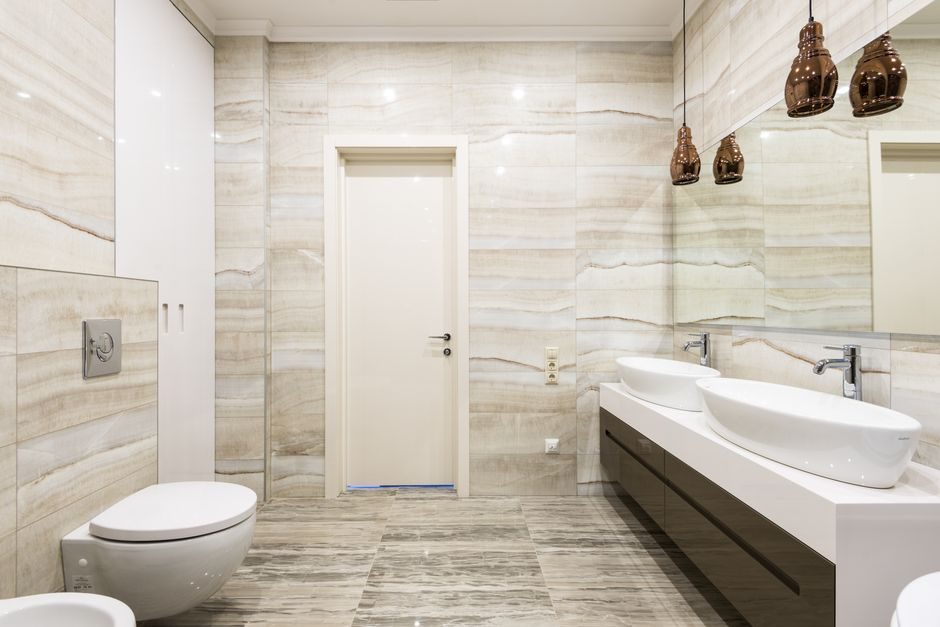
Glazed porcelain floor tile from Foshan lists at US$0.95–1.60 per 600×600 mm piece on the May 2026 Made-in-China index, while rigid SPC click-lock flooring from long-running Chinese mills (KBS Floor since 1999, ANYWAY Flooring since 2005) competes on install speed and thickness rather than fired-clay hardness [S6][S3][S1].
Both categories now ship to the same global distributors, but the spec sheets diverge sharply: ceramic relies on kiln-fired body, water absorption and PEI wear; SPC relies on a calcium-carbonate / PVC stone-plastic core with a printed wear layer and click locking. The comparison below is built for the specifier who has to pick one line item on a 2026 BOQ, not for the showroom buyer.
Material Construction and Core Specs
Ceramic floor tile is a pressed and fired clay body with a glazed or polished face. The Shanghai-factory index on Made-in-China shows 600×600 mm and 600×1200 mm "Carara" glazed polished bodies shipping in the sub-US$2 bracket, indicating the body is a standard porcelain formulation, not a specialty alumina [S6].
SPC (stone polymer composite) rigid core flooring is a calcium-carbonate-filled PVC core, typically 3.2–6 mm thick, topped with a 0.3–0.7 mm wear layer and a printed vinyl film, locked with a click profile. The KBS Floor product line, in production since 1999, is one of the older Chinese SPC houses still in continuous operation; ANYWAY Flooring has run an LVT/SPC line since 2005, and SELECT-TILE in the US rolled out "Lara, Natura, Patara" SPC collections in December 2025 [S3][S1][S2]. For an industrial flooring context, neither product is rated for fork-truck traffic, but both are common in light-commercial retrofits.
A third option that often shows up on the same bid is ceramic tile with through-body porcelain — heavier, harder, and far more UV-stable than SPC. If the project is an exterior terrace or a south-facing lobby, the ceramic tile line is usually the specifier's safe pick, while SPC stays inside the conditioned envelope.
Cost, Lead Time and Format Comparison
On a unit basis, the May 2026 Made-in-China index for Shanghai ceramic flooring shows 600×600 mm glazed polished porcelain landing between US$0.95 and US$1.60 ex-works, with 600×1200 mm "Carara" bodies in the same band [S6]. Zhejiang Jinfang Construction Material lists wall and floor tile in the same wholesale channel, with pricing gated behind RFQ but in the same commodity band typical of Wenzhou and Foshan output.
SPC runs in a different cost structure: the bill of materials is dominated by PVC resin, calcium carbonate, the wear layer and the click profile, so per-square-metre cost is sensitive to petrochemical pricing and to wear-layer thickness. KBS and ANYWAY both publish the full SPC range (LVP/SPC) as catalog items with RFQ pricing rather than list prices, which is normal for an OEM channel [S3][S1]. SELECT-TILE in the US markets the same SPC lines as small-batch retail collections, not commodity tile [S2].
Lead time differs by format: ceramic tile requires kiln scheduling, often 20–35 days from Chinese factories at peak season, plus sea freight. SPC is a continuous calender-and-press line and can be re-cut from stocked blank, so sample-to-ship windows as short as 7–15 days are common for stocked SKUs from the larger Chinese houses.
Selection Criteria: Where Each One Earns Its Place
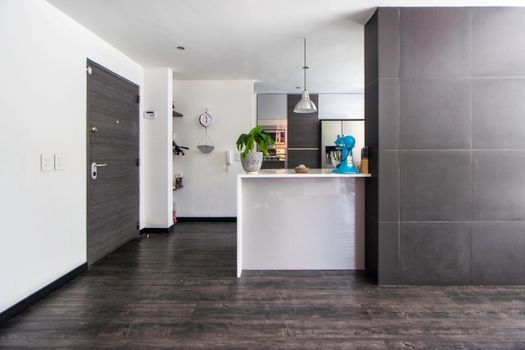
Four decision criteria line the two products up cleanly for a 2026 spec cut. [S1]
1) Moisture and water exposure. Porcelain ceramic with water absorption ≤0.5% is rated for wet areas, bathrooms, kitchens and exterior applications; SPC is rated for interior wet areas only if the click profile is sealed and the subfloor is dry. Standing water at the seams is the most common SPC failure mode.
2) UV exposure and color stability. Ceramic glaze is fired at 1200 °C+ and is essentially UV-stable; SPC's printed film and PVC wear layer will yellow or fade under sustained direct sun. South-facing curtain walls and atria are a ceramic spec, not an SPC spec.
3) Subfloor tolerance and install speed. SPC click-lock floats over a thin underlayment and tolerates minor subfloor variation, which is why it's the default for hotel and office retrofits on a tight schedule. Ceramic requires a flat, rigid subfloor, thinset mortar (per the China Ceramic Industry Association Technical Committee for Tiling's published guidance on tile-adhesive application) and grout, with longer cure time.
4) Indentation and impact. SPC's softer core is more comfortable underfoot and tolerates dropped objects better than ceramic, which chips on hard impact at edges. For residential or office underfoot comfort, SPC wins; for commercial kitchens, garages, and exterior decks, ceramic wins on hardness and indentation recovery.
Application Mapping: Who It's For, Who It Isn't
Ceramic tile is the right spec for: wet bathrooms, kitchens, laundry rooms, exterior terraces, commercial kitchens, healthcare and any high-UV environment. [S2]
SPC is the right spec for: interior light-commercial retrofits, rental units, hotel guestrooms, retail fit-outs, and any project where speed of install and acoustic underfoot comfort matter more than UV or impact resistance. The DEC 2025 "Lara, Natura, Patara" collection from SELECT-TILE is a typical example — a printed-design-driven product line for residential and small commercial [S2].
Neither is the right spec for: heavy industrial floors with fork-truck traffic, chemical exposure or point loads. For those, the specifier should look at proper industrial flooring systems, not at a tile or vinyl-floor BOQ line. If the spec is genuinely inside the process-industry envelope — think factory aisles, battery rooms, anodizing lines — the conversation moves to alumina ceramic tile or epoxy-resin systems, not to commodity porcelain or SPC.
Standards, Sourcing and Quality Signals
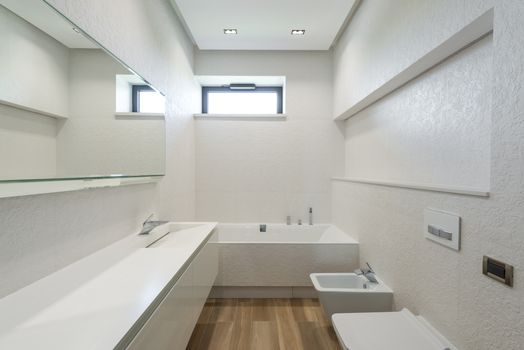
Sourcing signal: the Made-in-China wholesale channel in May 2026 lists multiple Foshan and Wenzhou factories with verified business licenses and on-site checkmarks, which is the baseline due-diligence step [S6].
For SPC, the relevant spec axes are core density (typically 1900–2100 kg/m³ for a well-filled stone-plastic core), wear-layer thickness (0.3 mm for residential, 0.5 mm+ for commercial, 0.7 mm for heavy commercial), click profile type (Unilin / Valinge or proprietary), and floor-score or indoor-air certifications. KBS Floor and ANYWAY Flooring both publish SPC and LVT as stocked OEM lines; sample requests are the standard pre-purchase step [S3][S1]. Custom cutting, when needed, is typically outsourced to a specialist shop such as Ceramic Tile Services, which has run a 48,000 sq ft custom-tile cutting facility in the US since 1991 [S4].
For specifiers cross-checking adjacent decisions, the ceramic vs steel ball bearings spec cut covers the same hardness-versus-toughness trade-off at a different scale, and the planetary reducer vs cycloidal reducer spec cut is a useful pattern for comparing two mature industrial options across 2–4 criteria.
Failure Modes and Limitations to Budget For
Ceramic's known failure modes are: chipping on edge impact (especially on cut pieces at corners), crack propagation through the body on a non-rigid subfloor, and grout discoloration in wet areas if the grout is not sealed. None of these are deal-breakers; they're maintenance items. [S3]
SPC's known failure modes are: seam separation if the click profile is mis-machined or the subfloor is uneven, telegraphing of subfloor bumps through the thin SPC body, and yellowing or delamination of the wear layer under direct UV or under rolling loads above the rated spec. The most common warranty claim in the SPC channel is cupping and peaking at the seams, driven by temperature swing in sun-exposed rooms.
One more operational risk: the SPC flooring category is sensitive to PVC-resin price moves, so a 2026 BOQ priced in Q1 will often re-quote by Q3 if the project slips. Ceramic is more stable on a unit basis but sensitive to kiln-fuel (natural gas) cost, especially in winter. Specifiers writing 2026 contracts should pin a price-validity window and a reorder clause for either product line.
Two trackable signals to watch for the rest of 2026: (1) the next Made-in-China index refresh for Foshan 600×600 mm glazed porcelain, which has been the cleanest public read on ceramic unit cost; (2) the next KBS Floor or ANYWAY Flooring catalog update, which will confirm whether 0.5 mm+ commercial-grade wear-layer SPC is dropping into the residential price band. Either signal will move the cost crossover point between the two products and is worth a quarterly check.