
Planetary gearheads from Orbray's SPG07 ship in coaxial solid-shaft packages down to 0-0.1 Nm for compact robotic joints, while Sumitomo's Cyclo Drive 6000 covers 20 Nm to over 10 kNm in the same family [S1][S2]. The two architectures overlap above 200 Nm but diverge sharply on backlash, shock absorption, and radial-load handling.
Spec-driven selection in 2026 hinges on four gates: continuous torque, single-stage ratio, backlash budget, and overload capacity. The Sumitomo ZS series, the A series, and the Cyclo Drive 6000 frame the cycloidal envelope, while the Orbray SPG07 anchors the precision planetary extreme. Both types now ship in hollow-shaft and right-angle bevel variants for machine builders that need drop-in motor mounting.
Torque and Ratio Envelopes: Where Each Topology Wins
Single-stage planetary units from Orbray target the 0-0.1 Nm micro-segment with multi-stage coaxial solid-shaft output, optimised for robotics, automation, and lifting actuators [S1]. Cyclo Drive 6000 spans 20 Nm to over 10 kNm in one product family, with a maximum gear ratio of 7,569:1 and foot-mounted or flange configurations [S2]. The 1-10 Nm gap, popular in collaborative-robot joints, is filled by cycloidal pin-wheel units such as the BWD/XWD series, which run horizontal cycloid pin wheel construction for textile, foodstuff, and metallurgy lines [S6].
For high-ratio single-stage reduction above 5 kNm, the Sumitomo Buddybox BBB5 delivers 5-10 kNm with a maximum ratio of 26,492:1, maximum 55 kW power, and maximum 412 kg mass in a right-angle bevel hollow-shaft package [S3]. The ZS series then extends the cycloidal envelope to 1-2 kNm, 2-5 kNm, and 5-10 kNm with hollow-shaft and solid-shaft outputs in flange or shaft mounting [S4]. Buyers who need a primer on reducer architecture should read the planetary reducer reference and the cycloidal reducer reference before locking a topology.
Backlash, Precision, and the Cycloidal Tooth Geometry
Planetary gearheads reach the sub-arc-minute backlash class demanded by CNC, semiconductor, and robot-joint applications, with high-torque and high-power variants positioned for actuators and electrical drives [S1]. Cycloidal A-series units are tagged as precision and zero-backlash in 200-500 Nm and 500-1000 Nm ratings, with 2-5 kNm, 5-10 kNm, and above-10 kNm options in compact coaxial hollow-shaft construction [S5].
The cycloidal pin wheel mesh uses a k-h-V less differential planetary transmission principle that distributes load across roughly two-thirds of the teeth at any moment, which is why Sumitomo rates the ZS series as high-performance and high-capacity [S4][S6]. That same geometry also absorbs torsional shock better than involute planetary gears because the cycloid disc can deflect elastically under impact spikes, an effect documented in the BWD/XWD horizontal cycloidal speed reducer build [S7].
Mounting, Shaft Configuration, and Footprint Trade-offs
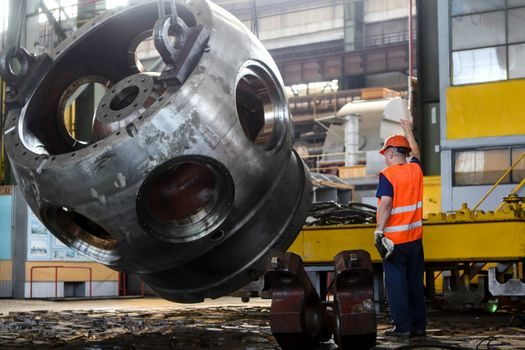
Coaxial solid-shaft planetary units are the default for inline servo packs; the SPG07 keeps the package compact and multi-stage for direct drive into a robot wrist [S1]. Coaxial hollow-shaft cycloidal units, by contrast, slide directly over a driven shaft and cut the number of coupling components on conveyor and mixer installations [S2][S5].
Right-angle bevel planetary units, such as the BBB5 Buddybox, mount shaft-style with hollow-shaft output and run 0.12-55 kW at ratios between 11:1 and 26,492:1, giving packagers and crane builders a single 412 kg package that can replace a separate helical or worm stage [S3]. The ZS series ships as flange or compact with hollow-shaft and solid-shaft options, so it can replace a foot-mounted helical reducer when the gearbox selection flow calls for higher shock tolerance, a comparison laid out in the gearbox selection 2026 reference.
Overload, Shock, and Maintenance Behaviour
Sumitomo's Buddybox BBB5 is explicitly rated maintenance-free at single-stage ratios up to 26,492:1, an advantage in 24/7 packaging and bulk-handling plants [S3]. The BWD/XWD horizontal cycloidal speed reducer likewise uses pin-wheel meshing that tolerates dust and intermittent overload, which is why Chinese OEM catalogues list US$45-200 FOB price bands and a 1,000-set monthly capacity for cycloidal pin-wheel units [S7].
Planetary gearheads need grease life management and backlash re-measurement after shock events, especially in presses and stamping lines. Cycloidal units keep a wider tooth contact patch and can ride through momentary stalls that would chip a planetary planet gear. For bearing-supported outputs, the load-path difference is detailed in the angular contact bearing selection guide, and the roller bearing cost guide covers the spend side of large cycloidal housings.
Selection Decision Matrix for 2026 Specs
Four decision gates let buyers lock the topology quickly. (1) Continuous torque below 10 Nm: planetary, single or multi-stage, with zero-backlash option, e.g. SPG07 0-0.1 Nm [S1]. (2) 20-500 Nm with shock load: cycloidal A-series, 200-500 Nm hollow-shaft zero-backlash [S5]. (3) 1-10 kNm with high ratio in one stage: cycloidal ZS 1-5 kNm or Cyclo Drive 6000 1-2 kNm and 2-5 kNm, both 7,569:1 maximum ratio class [S2][S4]. (4) Right-angle bevel layout above 5 kNm and up to 55 kW: cycloidal-bevel Buddybox BBB5, 26,492:1 maximum ratio, 412 kg [S3].
Two more constraints tip the call. First, radial load on the output shaft: hollow-shaft cycloidal designs transmit load through the driven shaft, not the gearbox housing, so they tolerate higher overhung loads than equivalent planetary units. Second, ambient environment: cycloidal units with sealed pin wheels and grease lubrication are common in cement, crane, and bulk-handling duty, where a slewing bearing selection checklist often crosses the same engineering desk.
Sourcing Signals and Industrial Catalogue Footprint
Made-in-China catalogues list 382 cycloidal-reducer-gear-factory suppliers with 1,146 products, an average plant area of 2,000+ m², 35 employees per supplier, and a top OEM tier posting US$1.12 million annual revenue [S8]. The same catalogue layer lists BWD/XWD and BWEY/XWEY horizontal cycloidal pin-wheel reducers at US$45-200 per piece FOB and US$130-430 per piece for premium B-series units with 2-piece minimum order [S7][S8].
For European and North American OEMs, Sumitomo's Cyclo Drive 6000, ZS, and A series are the dominant cycloidal reference points, with foot-mounted and flange options that drop into AGV, conveyor, and extruder skids [S2][S4][S5]. Orbray's SPG07 sits in the Japanese precision planetary space for micro-robotics and laboratory automation, where 0-0.1 Nm output and multi-stage coaxial solid-shaft design rule out larger cycloidal housings [S1].
Standards, Ratings, and Limits to Watch

Gearbox ratings should be read against AGMA 2001 and ISO 6336 gear-strength calculations, the two references that almost every planetary and cycloidal datasheet cites in the fine print. Sumitomo's Cyclo Drive 6000 caps the standard family at 7,569:1 maximum ratio, while the BBB5 Buddybox extends to 26,492:1 in a right-angle bevel hollow-shaft form factor [S2][S3]. Cycloidal A-series units are tagged zero-backlash and precision in 200-500 Nm and 500-1000 Nm classes, with the 2-5 kNm and 5-10 kNm tiers reserved for high-torque industrial applications [S5].
Buyers should treat 1,000 sets per month as a useful floor for the BWD/XWD output rate from Chinese cycloidal lines, and 412 kg as the practical top mass for the BBB5 right-angle bevel frame [S3][S7]. For torque-dense alternatives above 10 kNm, the worm reducer reference and the helical gear reducer reference frame the cost-versus-efficiency trade-off, while the rv reducer reference and the harmonic reducer reference cover the high-precision, high-ratio corner of the map.
Trackable signals for 2026 sourcing: confirm the exact single-stage ratio band (7,569:1 on Cyclo Drive 6000, 26,492:1 on BBB5) before issuing a PO, and pin the housing footprint against the chosen motor frame, since the BBB5 at 412 kg is the practical ceiling for a foot-mounted cycloidal-bevel package [S2][S3].