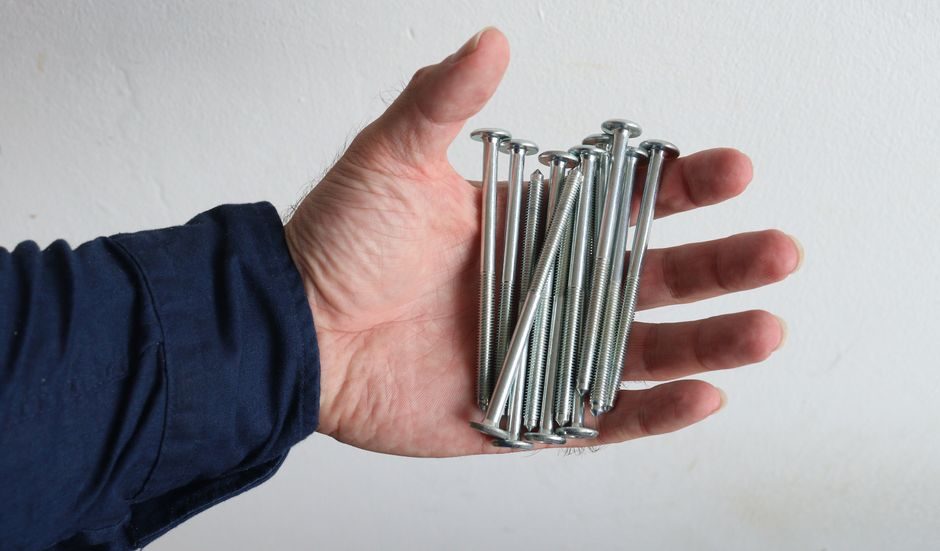
A correctly installed chemical anchor develops its capacity from three mechanical actions — adhesion between cured resin and concrete, micro-keying into the borehole wall, and friction — and the bonded length set in the ETA / ICC-ES evaluation report is the only number that should drive embedment depth on site [S3]. Getting the borehole geometry, hole cleanliness, resin grade, and cure window right is what separates an M16 stud pulling 35 kN in C25/30 concrete from one that walks out at 12 kN under the same wrench.
Chemical anchor systems split into two product families: injection mortars (vinylester, hybrid, pure epoxy) dispensed from a coaxial cartridge through a static mixer, and pre-portioned glass capsules dropped into the hole and spun with the stud. Both routes converge on the same acceptance gate — torque-test the first three fixings per shift on each rig, log the torque value, and reject the lot if any reading falls below the value printed on the cartridge label or in the ETA assessment [S3].
Substrate, hammer drill and hole geometry
Concrete grade C20/25 to C50/60 is the universal envelope covered by every mainstream ETA on chemical anchors, and cracked-concrete approvals (Option 1 / ETA seismic C1 / C2) require a minimum characteristic concrete compressive strength of 20 MPa with a maximum aggregate size typically ≤ 16 mm unless the approval document states otherwise [S3]. Carbide-tipped hammer drill bits to ISO 5468 are the default; diamond-cored holes are accepted only when the resin system is explicitly assessed for diamond-drilled bores and the bore is roughened with a purpose-made brush.
Hole diameter is stamped on the mortar cartridge, not on the stud: an M12 stud paired with an M14 resin-filled hole is normal, while an M16 stud in an M16 hole collapses the annular gap and starves the bond. Typical annular gaps in current production data sheets run 2 mm per side (M12 / M14, M16 / M18, M20 / M22, M24 / M28), and embedment depth hef ranges from 60 mm (M8) to 240 mm (M24) in standard concrete [S3]. Depth is set with a stop-drill bit or a depth gauge; the published hef is the bond length, not the hole depth, so add one stud diameter for the residual air pocket at the base.
Edge distance and spacing govern group behaviour: minimum edge distance cmin is usually 5 × hef for non-cracked concrete and 7 × hef for cracked, while minimum spacing smin falls in the 5 × hef to 6 × hef band. The Indo-Spark / Indo Wedge line published on the ICFS datasheet grades its ETA-approved wedge anchors against the same cmin / smin envelope, which is why the two product families share a common installation QC regime [S3].
Hole cleaning — the single biggest variable
Resin manufacturers universally list hole cleaning as a 2× blow + 2× brush + 2× blow sequence using oil-free compressed air at ≥ 6 bar, a steel brush sized to the nominal hole diameter, and a blow-out pump where the air supply is contaminated. The brush must contact the borehole wall — a stiff nylon brush is the bare minimum, a steel-wire brush is required for ≥ 30 MPa concrete and for pure-epoxy systems where bond is purely adhesive and any dust film acts as a release agent [S3].
Failure mode #1 in the field is dust film: a 0.1 mm laitance layer on the borewall cuts vinylester bond strength by 30–50% and pure-epoxy bond strength by 40–60% in independent EAD 330499 testing. Repeat the brush pass until the brush comes out visibly clean and the blow tube returns no concrete dust, not just until the timer hits 30 seconds.
Wet, flooded, or water-filled holes are out of bounds for standard vinylester and most hybrid systems; the published approvals restrict those resins to dry concrete and submerged applications are a separate approval line. Pure epoxy and certain winter-grade hybrid mortars carry flooded-hole and underwater approvals, and the cartridge label or ETA cover page will state the moisture class — never assume a 'universal' resin from a generic data sheet [S3].
Resin chemistry and selection gates

Three resin families dominate the 2026 spec map. Vinylester / unsaturated polyester hybrids cure fast (gel time 3–6 min at 20 °C), tolerate damp substrates in their summer grade, and are the economic default for non-cracked, non-seismic M8–M16 stud applications. Pure epoxy systems carry the broadest approval envelope — cracked concrete Option 1, seismic C1 / C2, flooded holes, and large diameters M24–M30 — at the cost of a 24-hour full-cure window and tighter ambient-temperature limits (typically 5–40 °C substrate) [S3].
Selection gate, in order: (1) seismic zone yes / no — if yes, the resin must carry ETA seismic C1 or C2; (2) cracked vs non-cracked concrete — cracked is Option 1 only, and vinylester hybrids often stop at Option 7 / non-cracked; (3) hole condition — dry, damp, flooded, or underwater narrows the resin list; (4) cure window — winter grade drops the gel time below 2 min at 0 °C but shortens the working life in a hot yard; (5) rebar grade — B500B / B500C and stainless A4-70 / A4-80 studs change the cure-stress profile. The CAS Chemical Anchor Studs family and Indo-Spark's CM350VESF / CM420VESF vinylester-esters, CM350P pure polyester, and CM360SH / AGNI420 seismic hybrid lines each map cleanly onto one or two of these gates [S3].
Glass capsules (e.g. the Supercap line) are a separate channel: a pre-portioned resin + hardener capsule is dropped into a dry, clean hole, the stud is spun in with a hammer drill on low RPM, and the capsule shatters to wet the threads. Capsule systems carry ETA Option 7 approvals and are common in façade and tunnel work where the resin quantity has to be reproducible shot-to-shot, but they are sensitive to hole depth — over-drilled holes leave an unmixed plug of resin at the base [S3].
Practical comparison — chemical mortar vs wedge vs capsule
Chemical injection mortars give the lowest expansion stress in the concrete, which is why they are the only family routinely specified close to a concrete edge (cmin as low as 5 × hef) and in thin members below 100 mm. Wedge anchors carry a torque-expansion mechanism that cracks the surrounding concrete, so cmin climbs to 10–15 × hef for cracked-concrete approvals and they are ruled out near prestressed tendons [S3].
On capacity-per-hef, an M16 chemical anchor in C30/37 with hef = 125 mm develops characteristic tension resistance NRk in the 35–50 kN band for pure epoxy and 25–40 kN for vinylester; the same M16 Indo Wedge with the published embedment reaches NRk in the 25–35 kN band but with a higher minimum edge distance. Capsules sit in between, with the advantage of fixed resin volume per fixing.
For procurement: mortar cartridges are sold in 300 ml, 345 ml, and 360 ml coaxial sizes, dispense with a standard silicone gun (1K foams use the same gun format), and the static mixer is a one-shot consumable. Capsule systems are sold per capsule, with no dispenser loss and no mixer waste, which simplifies site logistics on a tunnel face or a remote bridge pier. Wedge anchors are the cheapest per fixing and the fastest to install, but the most likely to be re-specified out of a job once a vibration, seismic, or edge-distance constraint appears.
Installation sequence and acceptance test
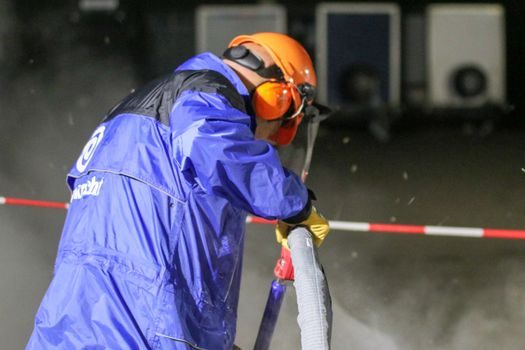
Step 1 — drill to the diameter and depth specified for the resin system, not for the stud. Step 2 — clean the hole with the 2× blow / 2× brush / 2× blow sequence, verifying the brush reaches the base. Step 3 — inject the resin from the bottom of the hole upward, withdrawing the static mixer as the bore fills, and discard the first 10 cm of bead (the unmixed tail from the static mixer). Step 4 — push the stud in with a slow twisting motion (3–4 turns) until it seats at the depth mark; do not hammer. Step 5 — respect the gel time tgel (typically 3–8 min at 20 °C for vinylester, 20–40 min for pure epoxy) and the full cure time tcure (45 min to 24 h depending on chemistry and substrate temperature) before applying any torque or load [S3].
Acceptance test on the first three fixings per shift: torque to Tinst on the cartridge label with a calibrated wrench; the wrench must click without stud rotation. For anchors where ETA design method A applies, a site pull-out test on a sacrificial fixing at 1.4 × the design load is the documented proof of suitability, and the test rig is a hollow hydraulic jack with a centre-pull rod. Pull-test loads below 80% of the characteristic resistance are a hard fail and trigger a re-drill / re-set on the affected fixing [S3].
Re-torquing is allowed only after the published full-cure time, never during the gel phase — a gel-phase retorque shears the partially cured resin skin and drops capacity by 40–60%. If the stud spins freely at install, pull it, re-drill the hole (do not re-use the resin), and start again with a fresh cartridge and mixer. For overhead or horizontal installations, use a resin with thixotropy ≥ 5 mm sag rating and plug the hole at the mouth during cure to retain the bead.
When NOT to use a chemical anchor
Uncracked lightweight concrete (LC12/13 and below), masonry hollow blocks without a sleeve, and aerated autoclaved concrete (AAC) under 600 kg/m³ density are outside the standard chemical-anchor approval envelope; use a screen-tube injection system or a plastic anchor instead. Polyester (unsaturated) resins are banned in potable-water and food-contact applications — pure epoxy is the only family with WRAS / KTW / NSF / ANSI 61 listings, and the data sheet must show the drinking-water approval line, not just 'food-grade' marketing language [S3].
Fire-rated fixings (F30, F60, F90, F120) require a fire-tested resin system with the F-rating stamped on the ETA, and the standard approach for chemical anchors is a fire-tested stud with mineral wool packing in the annular gap; the resin alone does not deliver fire performance, the system does. For chemical anchors close to dynamic or vibratory loads — elevator guide rails, crane rails, pump bases — the design must use the seismic C2 approval line and the fixing must be checked for fatigue per the resin manufacturer's S-N curve, which is published only for seismic-rated systems [S3].
When the application exceeds the resin's published window — substrate below 0 °C, chemical exposure to pH < 4 or > 12, sustained service temperature above 50 °C for vinylester or 80 °C for pure epoxy — escalate to a manufacturer-specific engineering judgement or move to a cast-in plate. There is no field fix for an out-of-envelope chemical anchor; the bond either develops to the printed capacity or it does not, and the failure mode is non-ductile.
For an adjacent process-engineering cross-reference on resin-bonded composite substrates, see the glass-fibre decision map for 2026; for the equipment-side anchor points that take the load off a chemical anchor, see the explosion-proof control-station buying guide. Two signal points worth tracking on the next procurement cycle: the EAD 330499-01-0601 revision that closed 2025, and the C2 seismic line extension from two Indian ETA holders to M30 diameters announced on the ICFS / Indo-Spark datasheet index [S3]. For a deeper look at resin-cartridge selection against concrete grade, the chemical anchor encyclopedia entry sits alongside the chemical reagent reference for the underlying binder chemistry.
Spec-level background on the components involved: expansion anchor.