
A 400 lb rear ballast assembly used with a 1,000 lb loader capacity illustrates why counterweight selection must match load, machine, and geometry rather than a universal mass target [S5].
Backhoe loaders, tractor-loader units, and other front-loading machines need rearward mass to control the load moment created by a raised front bucket, but the correct quantity depends on model, chassis, attachments, and operating conditions [S1][S4].
What front counterweight actually balances
A front-end loader moves the tractor or backhoe loader centre of gravity forward, and raising a load moves the combined centre of gravity both forward and higher. That shift can move the machine beyond its stable support polygon and create longitudinal or lateral instability [S4].
The counterweight creates a rearward moment that opposes the front-load moment. Its effectiveness depends on mass and distance behind the rear axle, so two assemblies with the same mass can behave differently when mounted 36 in. from the axle centre [S5]. A compact backhoe loader may also carry the rearward mass of the backhoe attachment, but that mass can sit high and create its own handling trade-off [S3][S5].
The quoted loader-assembly example used 400 lb at 36 in. from the axle centre: two 65 lb weights, two 100 lb weights, a 25 lb hitch, 10 lb of 2 x 2 x 3/16 in. box tubing, and 35 lb of three-point hitch components. The same machine had an approximately 1,000 lb loader capacity including the bucket [S5].
Mass percentage is a screening rule, not a specification
One practical forum rule of thumb places tractor-loader ballast near 70% of loader lifting capacity, producing about 1,100 lb for a 1,600 lb-capacity loader in that example [S2]. A discussion of the same configuration cited a rule of thumb of approximately 70% of loader capacity, giving an example of about 1,100 lb of ballast for a loader capacity of around 1,600 lb [S2].
These figures conflict as general rules because they cover different tractors, loaders, attachment combinations, and loading conditions. They are useful only for initial screening, not for certifying a particular assembly. The wheel loader and tractor-loader categories can have different stability envelopes, and the machine manufacturer’s stated configuration remains the controlling document [S1][S4].
A published field example described a 400 lb assembly on the same machine, whose loader capacity including the bucket was about 1,000 lb [S5]. Both examples show that rated payload and selected ballast cannot be treated as interchangeable numbers.
Compare ballast by location and failure risk
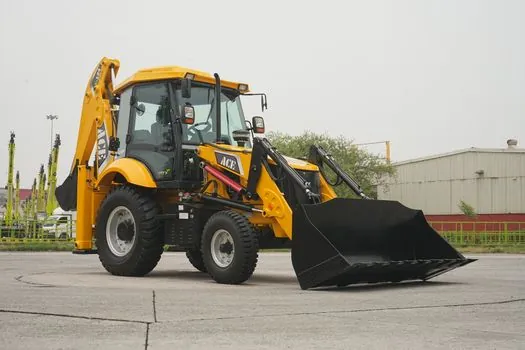
Three-point rear ballast and a frame-mounted weight are not equivalent even when their masses match. A three-point counterweight places downward force behind the rear axle, reducing front-tyre, rim, and axle loading while moving the combined centre of gravity rearward and lower [S4].
Three practical configurations can be compared against counter-moment, front-axle relief, and stability risk. A low, compact ballast box mounted behind the rear axle can provide rearward moment with less top-heavy behaviour than a backhoe assembly, provided mounting capacity permits it. A three-point counterweight can provide a long lever arm, but its permitted mass remains constrained by the tractor’s lifting and linkage ratings [S4][S5]. A backhoe bucket loaded with material can add mass, but using it as ballast may add overhead mass and shift handling behaviour [S3].
Wheel weights and liquid tyre ballast also differ from a dedicated rear counterweight. These additions may aid stability, but they do not reduce the front-axle load created by a raised loader load [S4]. The 400 lb comparison found the lower dedicated hitch felt more stable than a 700 lb backhoe that was top-heavy and prone to sway on rough ground [S5].
Use machine data for the selection decision
Counterweight requirements vary with machine model, chassis design, axle ratings, attachment configuration, required weight, dimensions, mounting points, and geometry [S1]. A counterweight designed for one machine should not be transferred to another solely because both have similar lifting capacities [S1].
There is also a distinction between ballast and a manufactured counterweight. Ballast is added mass used to manage weight distribution, while a counterweight is a component designed and positioned for that purpose [S6]. A rear counterweight should preserve the approved configuration; removing a required unit or fitting an unsuitable component can alter handling and increase loads on machine components [S1].
For a buyer, the required record set is the machine model, rated front-loader payload, front and rear axle limits, tyre loading, rear linkage or chassis attachment rating, counterweight dimensions, mounting geometry, and operating attachment combination. Where published capacity changes with lift geometry, the capacity at the intended height and radius should be used [S3].
Know which applications the counterweight cannot cover
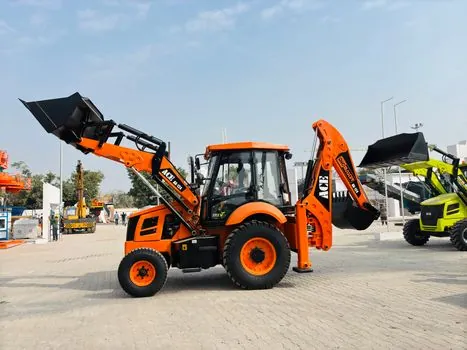
A correctly specified counterweight supports intended stability but does not eliminate lifting or excavation forces. Stability also depends on load limits, attachment positions, ground conditions, boom position, and correct deployment of stabilisers where required [S1].
Excessive ballast is not a safe substitute for manufacturer instructions [S1]. It can increase total vehicle mass, transmit higher axle and structural loads, change handling, or create a top-heavy machine [S1][S4]. A counterweight also cannot justify exceeding rated payload or using a fork attachment outside its rated configuration; one reported fork test involved 11 bags weighing 80 lb each against an advertised 512 lb loader capacity, with the load near the carriage and only about 12 in. of lift [S3].
For excavation with a backhoe fitted, stabiliser deployment and machine geometry carry more significance than simply maximizing rear mass. Field discussion describes the backhoe as adding ballast while also making the tractor feel tippy on slopes, and as permitting stabilisation deployment to compensate for some lateral effects [S3].
Verify the installed counterweight before service
A fit check must confirm the approved part number or equivalent, specified mass, mounting dimensions, clearance, attachment interference, and axle-load effect. Counterweights are commonly made from cast iron because its high density can provide substantial mass in a compact package, but the material choice does not establish suitability [S1].
The configuration check should also record the operating condition. Loader capacity is configuration-sensitive, and adding or removing the backhoe changes the rear mass, machine height, and handling response [S1][S3]. This is why a dedicated ballast box and an installed backhoe should not be treated as interchangeable [S5].
The next trackable verification is the machine’s own ballast or counterweight chart: confirm the required mass for the exact loader, tyres, rear attachment, and rated payload before ordering. If no chart exists, obtain a written configuration determination from the equipment manufacturer rather than substituting a forum percentage [S1][S2].