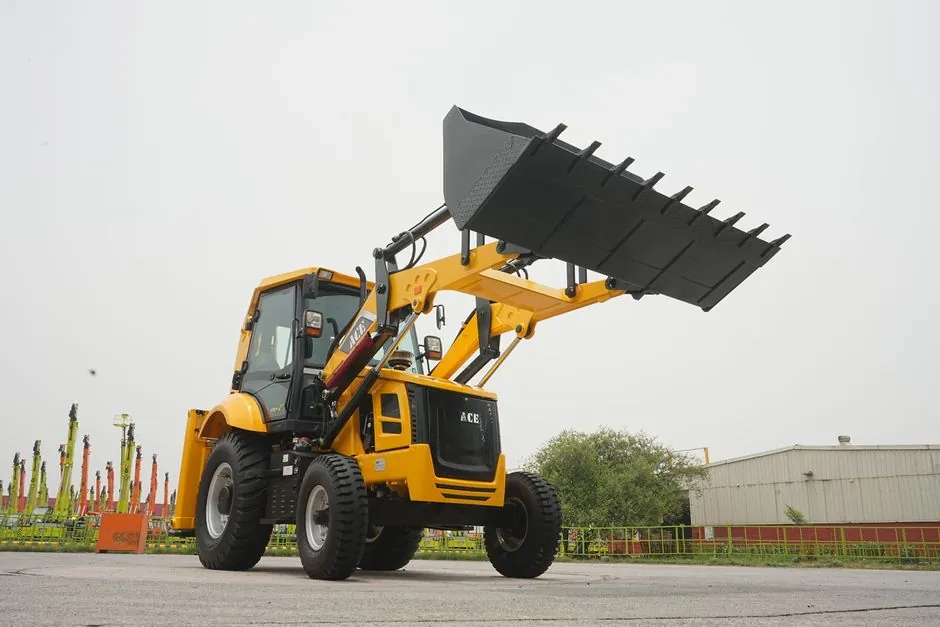
A compact excavator in the 2–10 tonne class is the stronger choice for access-restricted excavation because it combines narrow dimensions, full 360° upper-structure rotation, and concentrated digging performance [S1].
A backhoe loader combines a rear digging assembly with a front loader bucket, making it more efficient when one machine must also scoop, carry, load, and backfill on a site with adequate working room [S1][S3].
Core Equipment Differences
A mini excavator is a dedicated digging machine with a boom, stick, bucket or attachment, and a rotating upper structure that can work around the machine without repeated chassis repositioning [S2][S3]. Its defined operating class in the cited comparison is 2–10 tonnes, although width, operating weight, tail swing, reach, depth, lifting capacity, and attachment compatibility remain model-specific [S1][S5].
A backhoe loader is a wheeled machine with two working ends: a front loader bucket and a rear hydraulic boom, stick, and bucket [S2].
The operating distinction is functional. Excavators rotate 360 degrees, whereas a backhoe's rear digging assembly has a limited swing, described in one comparison as roughly 180 degrees against approximately 360 degrees for a compact excavator [S5]. These are broad reference figures, not acceptance criteria for a particular machine.
Decision Matrix for Urban Access and Ground Conditions
For a narrow lane, basement opening, fenced service yard, or excavation beside a wall, choose the compact excavator if the machine can pass through the access point and its tail fits during rotation.
Choose the backhoe loader where the site has room for stabilizers, road travel, and a separate loading workflow. Backhoes are suited to roads, farms, and mixed surfaces, while tracked mini excavators provide better traction and lower surface disturbance in confined, muddy, or uneven areas [S1]. Rubber tracks or steel tracks fitted with track pads can improve traction while reducing damage to finished surfaces [S1].
The practical comparison is clear: a compact excavator wins on access, precision, rotation, and ground protection, while a backhoe wins on loading capacity, on-road mobility, and task consolidation [S1][S4][S5].
Where Each Machine Fits
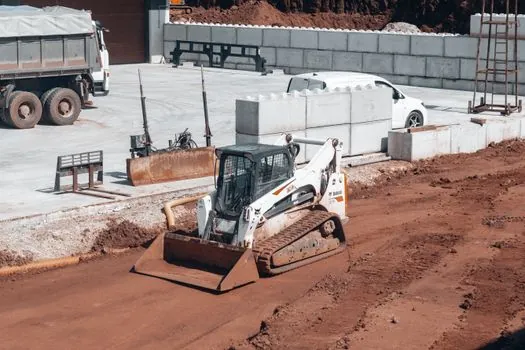
The compact excavator is suitable for utility trenching, drainage work, landscaping, foundation excavation, residential construction, land clearing, and small demolition [S3]. It is the better option when excavation consumes most of the working time, spoil must be placed around the machine, and the machine must work beside a fence or structure [S5].
The backhoe loader is suitable for road construction, municipal maintenance, drainage projects, farm work, general construction, material loading, and backfilling [S3]. Its advantage appears when the operator must alternate between the rear bucket and front loader without mobilizing a separate loader [S2][S5].
A compact excavator is not the right choice when bulk loading dominates the production cycle and the site has sufficient space for a wheeled backhoe and its stabilizers. Conversely, a backhoe is a poor substitute for a compact excavator when precision trenching or continuous rotation in a confined area controls productivity [S1][S5].
Dimensions, Reach, and Site Verification
Do not select either machine from a general weight class alone. For a compact excavator, verify width, operating weight, tail swing, digging depth, dump height, lifting chart, auxiliary hydraulic flow, bucket width, and attachment compatibility [S5]. For a backhoe loader, confirm transport width, travel configuration, stabilizer deployment, rear reach, loading height, and attachment requirements before mobilizing.
That size illustrates why a conventional backhoe may be difficult to place in a narrow urban work zone, but it applies to that model rather than every backhoe. Request the exact specification sheet for gates, driveways, slopes, transport, and overhead clearance [S5].
Attachments can alter the selection. Backhoes may use drills, forks, hammers, plow blades, road booms, and compaction wheels, while excavators can use buckets, thumbs, rippers, and other hydraulic equipment subject to machine compatibility [S4]. For a compact excavator, verify hydraulic flow and attachment interfaces rather than assuming that every attachment will operate at the required speed or force [S5].
Cost, Productivity, and Operating Exposure
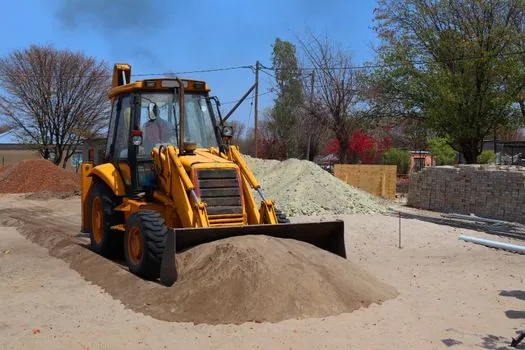
A backhoe loader combines digging, loading, material handling and general site work in one machine. A compact excavator is designed around excavation, trenching and precise digging and can perform better in confined spaces, muddy conditions and uneven terrain.
Productivity should be measured in complete work cycles rather than bucket capacity alone. For a backhoe, count excavation, turning, loading, carrying, backfilling, and repositioning. For a compact excavator, count access, setup, repeated tail clearance, spoil placement, attachment changes, and the need for a separate loader. A backhoe may save mobilization and switching time, while an excavator may remove repeated repositioning and stabilizer setup from a restricted trench operation [S2][S5].
Urban operating exposure also differs. Tracked machines can limit surface damage on soft or finished ground, while backhoes are generally more natural on roads and stable mixed surfaces [S1][S4]. For fleet planning, compare total hourly cost, utilization, transport cost, surface restoration, attachment hours, and operator time rather than rental price alone. The wider urban equipment decision is covered in Construction Equipment Selection for Urban and Open Sites.
Specification Checklist Before Mobilization
Set the machine against measured site constraints before ordering: narrowest access width, turning radius, overhead clearance, usable trench length, required dig depth, spoil placement distance, ground bearing condition, and the shortest route to the work area [S5]. These measurements determine whether the theoretical advantage of either configuration survives access constraints.
Then match the work package. Specify continuous excavation, trenching, foundations, utility work, drainage, or landscaping for a compact excavator [S3]. Specify a mixed cycle of digging, loading, carrying, backfilling, road work, or municipal maintenance for a backhoe [S2][S3]. If material volume is substantial, a separate wheel loader can preserve continuous excavator production, but it adds another machine to the confined-site logistics.
For final acceptance, use the manufacturer's model-specific specification sheet and the operating weight, working range, stability, and lift data for the exact configuration. A 2–10 tonne descriptor, 12–16 ft typical backhoe depth, 360-degree excavator rotation, or approximately 180–200 degree backhoe swing are screening values only, not proof that a machine is safe or productive at a particular site [S1][S4][S5].
Select a compact excavator when access, rotation, and surface protection dominate; select a backhoe when one machine must dig and load. Measure the site and request the exact model specification sheet before committing equipment.